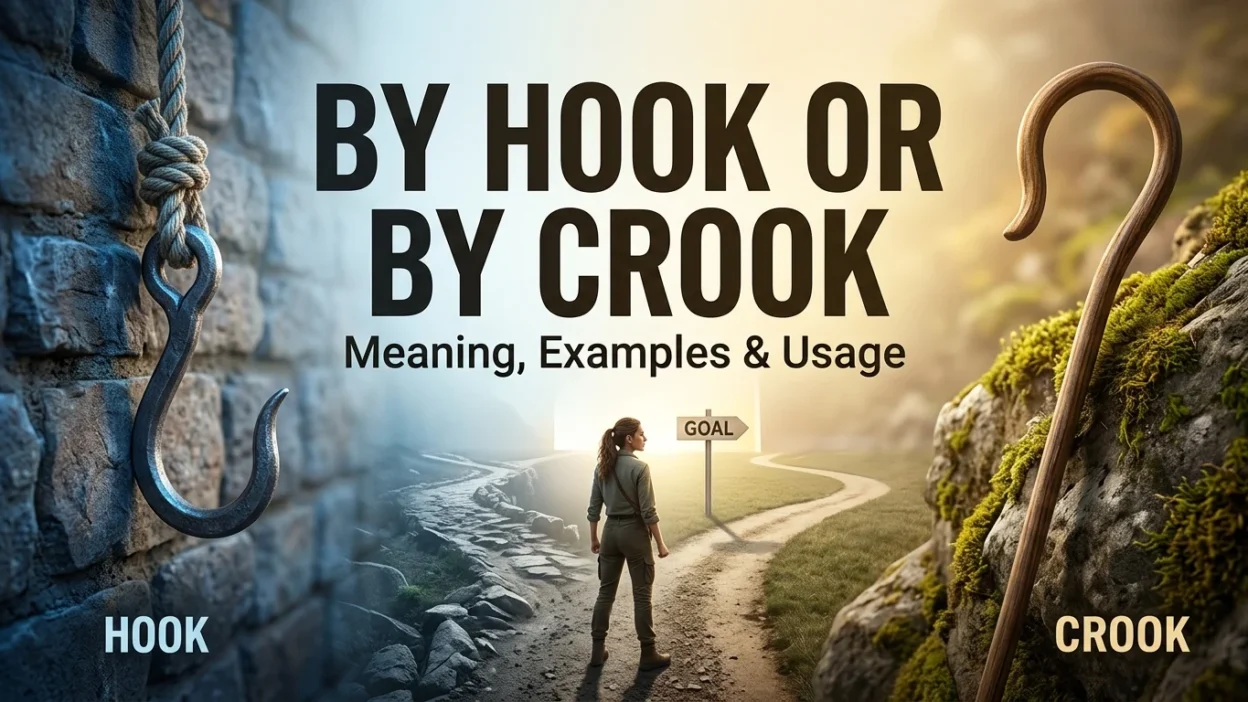
“By hook or by crook” is a common English idiom meaning by any means necessary. It describes a situation in which someone is determined to achieve a particular goal, even if they have to use unusual, difficult, indirect, or sometimes dishonest methods. For example, “She was determined to finish the project by hook or by crook” means she was determined to finish it somehow, whatever it took.
English learners often find this expression confusing because hook and crook have several ordinary meanings, but together they create an idiomatic expression. The phrase is usually used when talking about strong determination to achieve something. Depending on the context, it can sound neutral, humorous, or slightly negative because it may suggest that the person is willing to bend the rules.
Quick Answer
“By hook or by crook” means by any means necessary or by whatever method is needed to achieve a goal. It often suggests determination and may imply using unconventional, indirect, or even dishonest methods. Example: “He planned to get the job by hook or by crook.”
Why Do People Confuse “By Hook or by Crook”?
People often confuse this expression because the individual words hook and crook do not clearly explain the meaning of the complete phrase.
A hook is a curved tool or object used for catching, pulling, or hanging something. A crook can mean something curved, and it can also refer to a dishonest person.
However, “by hook or by crook” is an established idiom. Its meaning cannot be understood simply by adding the dictionary meanings of the two words.
The expression emphasizes determination to accomplish something, regardless of the method used.
First Word: Hook
Hook is a noun that commonly refers to a curved device used for catching, holding, or pulling something.
For example:
- The fisherman put bait on the hook.
- Hang your coat on the hook.
- The boat was caught on a hook.
In the idiom “by hook or by crook,” however, hook is part of a fixed expression rather than referring directly to a fishing hook.
Second Word: Crook
Crook has several meanings in English.
As a noun, it can describe something curved, such as the curved part of a walking stick. It can also mean a dishonest person.
For example:
- The shepherd carried a crook.
- The detective believed the man was a crook.
In “by hook or by crook,” crook contributes to the expression’s sense of using whatever method is necessary.
Comparison Table
| Expression | Meaning | Example |
|---|---|---|
| By hook or by crook | By any means necessary | She will succeed by hook or by crook. |
| By any means necessary | Using whatever method is needed | We must solve the problem by any means necessary. |
| By fair means or foul | Using either acceptable or unacceptable methods | He wanted to win by fair means or foul. |
| At all costs | Regardless of the difficulties or consequences | They wanted to protect the business at all costs. |
| Somehow | In some way, even if the method is unclear | We’ll get there somehow. |
When Should You Use “By Hook or by Crook”?
Use “by hook or by crook” when you want to emphasize someone’s determination to accomplish a goal.
It works particularly well when:
- Someone is extremely determined.
- The exact method is not important.
- Several possible methods may be used.
- The methods could be unconventional.
- The speaker wants to suggest that rules might be bent.
- The expression is being used humorously or dramatically.
Example
“I will get that contract by hook or by crook.”
This suggests that the person is determined to obtain the contract and will use whatever method seems necessary.
Because the expression can imply questionable behavior, it is worth considering the context before using it in formal or professional communication.
10+ Examples of “By Hook or by Crook”
Here are practical examples showing how the idiom works in everyday English.
- I will finish this assignment by hook or by crook.
- She was determined to get the tickets by hook or by crook.
- We have to reach the village by hook or by crook before sunset.
- He wanted to win the competition by hook or by crook.
- They promised to complete the project by hook or by crook.
- I’ll find a way to solve this problem by hook or by crook.
- The team was determined to qualify by hook or by crook.
- She planned to recover her lost documents by hook or by crook.
- He was going to meet his old friend by hook or by crook.
- We need to raise the money by hook or by crook.
- The company wanted to meet the deadline by hook or by crook.
- She said she would get the truth by hook or by crook.
What Do These Examples Have in Common?
In each sentence, the important idea is determination. The speaker focuses on achieving the goal, while the exact method is secondary.
The phrase does not always mean that someone is definitely doing something illegal. It can simply suggest that someone will try every possible method, although it sometimes carries a suggestion of questionable tactics.
Common Mistakes
1. Changing the Order
The standard expression is:
By hook or by crook
Avoid changing it to unusual forms such as:
- By crook or by hook
- By hook and crook
- By hooks or crooks
The established idiom is “by hook or by crook.”
2. Taking the Words Literally
A learner might think the expression must involve an actual hook or a curved object.
It usually does not.
“She’ll finish the job by hook or by crook.”
This means she will find some way to finish the job.
3. Assuming It Always Means Illegal
The phrase can suggest dishonest or questionable methods, but that implication depends on context.
For example:
“We need to get everyone home by hook or by crook.”
This can simply mean somehow, by whatever practical method is available.
4. Using It in Every Formal Situation
Although the idiom is standard English, it can sound informal, dramatic, or slightly old-fashioned in some contexts.
In a formal report, “by whatever means are available” or “by any available method” may be clearer.
Memory Trick
A simple way to remember “by hook or by crook” is:
Hook + Crook = Whatever it Takes
Think:
“I don’t care which method I use—I just need to get it done.”
So when you see “by hook or by crook,” remember:
Goal first, method second.
American English vs British English
“By hook or by crook” is understood in both American and British English.
There is no major difference in the basic meaning:
By hook or by crook = by any means necessary / somehow
The expression may sound somewhat traditional or idiomatic in modern conversation, but it remains understandable and usable in both varieties of English.
For everyday American English, speakers may sometimes choose simpler alternatives such as:
- somehow
- by any means necessary
- whatever it takes
- at all costs
British speakers also use these alternatives, depending on the context.
Similar Words and Expressions
Several English expressions have meanings that overlap with “by hook or by crook.”
By Any Means Necessary
This is one of the closest alternatives.
We need to solve the problem by any means necessary.
It emphasizes the willingness to use whatever method is required.
Whatever It Takes
This expression emphasizes determination.
I’ll do whatever it takes to succeed.
It does not necessarily suggest dishonest behavior.
At All Costs
This means doing something regardless of the consequences or difficulties.
They were determined to protect the company at all costs.
Somehow
Somehow is less dramatic and simply means in some way.
We’ll finish the work somehow.
By Fair Means or Foul
This expression is particularly close in meaning when questionable methods are involved.
He was determined to win by fair means or foul.
It explicitly contrasts acceptable and unacceptable methods.
Final Verdict
“By hook or by crook” is a correct and well-established English idiom meaning “by any means necessary” or “by whatever method is needed.”
It is useful when emphasizing strong determination to achieve a goal. Depending on the context, it can imply unconventional, questionable, or even dishonest methods, but it does not automatically mean illegal behavior.
Frequently Asked Questions
1. What does “by hook or by crook” mean?
It means by any means necessary or by whatever method is needed to achieve a goal.
2. Is “by hook or by crook” an idiom?
Yes. “By hook or by crook” is a traditional English idiom.
3. Is “by hook or by crook” negative?
It can have a slightly negative implication because it may suggest that someone is willing to use questionable methods. However, the context determines how strongly negative it sounds.
4. Can I use “by hook or by crook” in formal English?
Yes, but it may sound somewhat idiomatic or traditional. In highly formal writing, “by any available means” may be more direct.
5. What is another way to say “by hook or by crook”?
Possible alternatives include “by any means necessary,” “whatever it takes,” “somehow,” and “at all costs.”
6. Does “by hook or by crook” mean illegally?
Not necessarily. It can suggest questionable or unconventional methods, but it does not automatically mean illegal action.
7. What is an example of “by hook or by crook”?
“She was determined to finish the project by hook or by crook.”
This means she was determined to finish the project somehow, regardless of the method required.
Remember This
By hook or by crook = by any means necessary.
When someone says they will do something “by hook or by crook,” they mean they are determined to accomplish it and will use whatever method seems necessary.
Remember the simple idea:
The goal matters more than the method.
Conclusion
“By hook or by crook” is a useful English idiom for expressing strong determination. It means achieving something by any means necessary, and it can suggest that the person may use unconventional or questionable methods. The expression is understood in both American and British English.
For English learners, the most important thing is to remember the phrase as a complete idiom rather than interpreting hook and crook separately. When you want to describe someone who is determined to accomplish a goal somehow, “by hook or by crook” can be an effective expression.