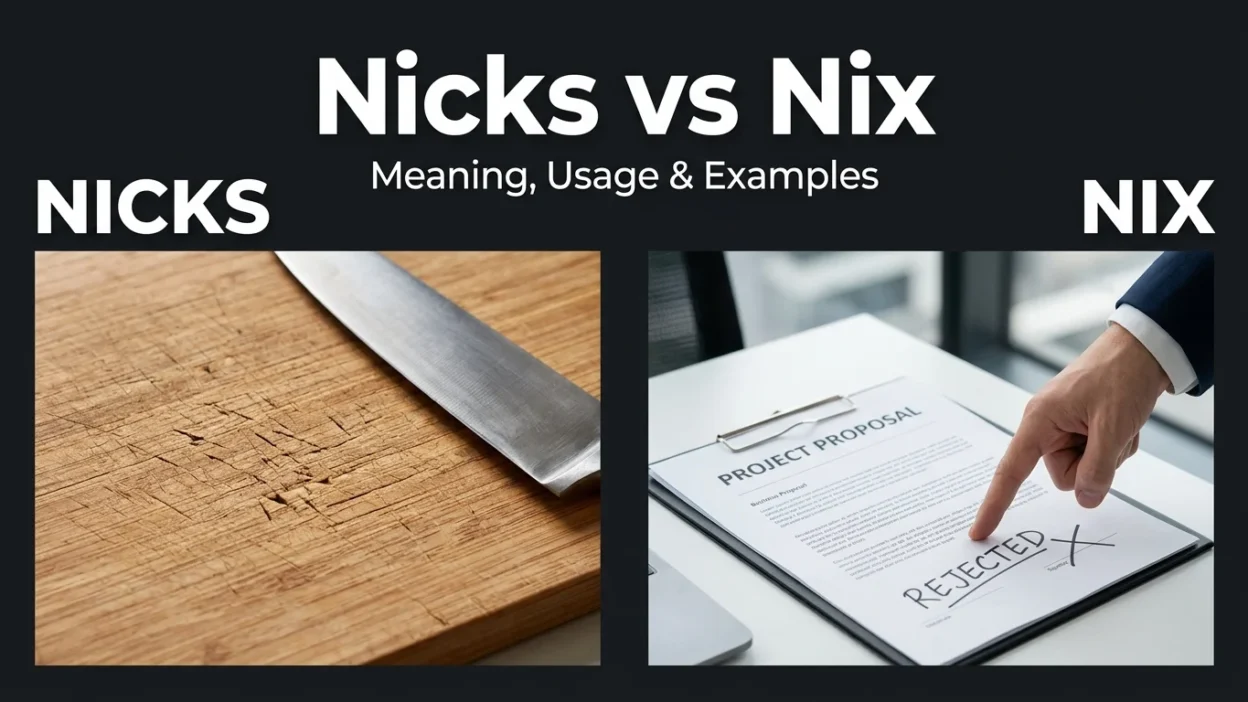
English has many words that sound alike or look similar but have completely different meanings. “Nicks” and “nix” are a good example. Although both can appear in everyday English, they are used in different ways and belong to different grammatical patterns.
The word “nicks” can be related to nick, which may mean small cuts or notches, or it can be the third-person singular form of the verb nick. “Nix,” on the other hand, is an informal verb and noun meaning to reject, cancel, stop, or prohibit something. Understanding the difference makes it easier to choose the correct word in writing and conversation.
Quick Answer
“Nicks” is usually the plural of nick or the third-person singular form of the verb nick. “Nix” means to reject, cancel, or prohibit something. For example, “The blade has several nicks” uses nicks as a noun, while “They nixed the proposal” uses nixed as a verb.
Why Do People Confuse “Nicks” and “Nix”?
People may confuse nicks and nix because they are short words with similar sounds, especially in rapid speech. Both can also appear in informal English, making their distinction less obvious to learners.
However, their meanings are quite different:
- Nicks → small cuts, notches, or marks; also a verb form of nick
- Nix → reject, cancel, prevent, or say no to something
The surrounding sentence usually makes the intended meaning clear.
First Word: Nicks
Nicks has several meanings depending on how it is used.
As a noun, nicks is the plural of nick. A nick can be a small cut, notch, or indentation in a surface.
- The knife has several nicks along its edge.
- There are tiny nicks in the wooden table.
- The glass has a few nicks around the rim.
Nicks can also be the third-person singular form of the verb nick. In British English, nick can informally mean steal.
- He nicks food from his brother’s plate.
- The thief nicks a wallet from the counter.
In British informal usage, nick can also refer to arresting someone, although this sense is generally expressed through forms such as nicked.
Nicks as a Plural Noun
When nicks refers to small cuts or marks, it is simply the plural of nick.
The old table has several nicks on its surface.
Here, nicks means small damaged areas.
Second Word: Nix
Nix is an informal word meaning to reject, cancel, stop, or prohibit something.
It can function as a verb:
The manager nixed the plan.
This means the manager rejected or canceled the plan.
It can also function as a noun meaning a rejection or refusal:
The proposal got a nix from the committee.
The expression “nix it” is also common in informal English.
We decided to nix it because the cost was too high.
In this sentence, nix it means cancel or abandon it.
Nicks vs Nix: Comparison Table
| Feature | Nicks | Nix |
|---|---|---|
| Basic form | Nick | Nix |
| Common role | Noun or verb | Verb or noun |
| Common meaning | Small cuts/notches; steals in informal British English | Rejects, cancels, or prohibits |
| Example | The surface has several nicks. | They nixed the proposal. |
| Related forms | nick, nicked, nicking | nix, nixed, nixing |
| Style | General or informal, depending on meaning | Informal |
When Should You Use “Nicks” or “Nix”?
Use nicks when you are talking about small cuts, notches, marks, or certain actions associated with the verb nick.
Use nicks for:
- small cuts
- tiny surface marks
- notches
- minor damage
- the third-person singular of nick
Use nix when you mean reject, cancel, stop, or prohibit.
Use nix for:
- rejecting an idea
- canceling a plan
- stopping a proposal
- refusing permission
- abandoning an option
Easy Comparison
- The knife has several nicks.
- The director decided to nix the proposal.
The first sentence describes physical marks. The second describes rejection.
10+ Examples of “Nicks” and “Nix”
Examples with “Nicks”
- The old knife has several nicks along its edge.
- I noticed a few nicks in the wooden door.
- The table has small nicks from years of use.
- There are several nicks on the metal surface.
- The glass has two tiny nicks near the rim.
- His bicycle frame has a few nicks in the paint.
- The third-party repair left several nicks on the surface.
Examples with “Nix”
- The committee decided to nix the proposal.
- We had to nix our original plan.
- The editor nixed the unnecessary paragraph.
- The company nixed the idea after reviewing the costs.
- They decided to nix the event because of the weather.
- The manager gave the suggestion a nix.
- Let’s nix that option and consider another one.
Common Mistakes
Mistake 1: Using “nix” for a small cut
Incorrect:
The table has several nix.
Correct:
The table has several nicks.
When referring to small cuts or marks, use nicks.
Mistake 2: Using “nicks” when you mean “rejects”
Incorrect:
The committee nicks the proposal.
Correct:
The committee nixes the proposal.
The verb nix means to reject or cancel, and its third-person singular form is nixes.
Mistake 3: Confusing “nix” with “nicks”
Remember that nix is the base form, while nicks is a different word or grammatical form.
- They nix the proposal.
- She nixes the proposal.
- They nixed the proposal.
Memory Trick
Think:
Nicks = marks
Nix = no
The word nix can remind you of saying “no” to something.
Nicks = little cuts or marks
Nix = say no, reject, or cancel
This simple association can help you remember the difference.
American vs British English
Nix is used in American English as an informal way to mean reject, cancel, or prohibit something. It is also understood in other varieties of English.
Nick, however, has some additional informal meanings in British English. In British usage, nick can mean steal, while the nick can refer informally to a police station.
For example:
Someone nicked my phone.
In this British informal usage, nicked means stole.
Therefore, context is particularly important when you encounter nick, nicked, or nicks in British English.
Similar Words
Several words are related to the meanings discussed above.
Words Similar to “Nix”
- reject
- refuse
- cancel
- prohibit
- veto
- abandon
- stop
- rule out
For example:
They nixed the plan.
could be expressed as:
They rejected the plan.
Words Similar to “Nicks”
When nicks refers to small marks, related words include:
- cuts
- scratches
- notches
- chips
- marks
- dents
The exact choice depends on the type and severity of the damage.
Final Verdict
Nicks and nix have different meanings and grammatical uses. Nicks is commonly the plural of nick, referring to small cuts or marks, although it can have other meanings as a verb form. Nix means to reject, cancel, stop, or prohibit something.
If you are talking about small marks or cuts, choose nicks. If you mean rejecting or canceling something, choose nix.
FAQs About Nicks vs Nix
Is “nix” a real English word?
Yes. Nix is an informal English word that can mean to reject, cancel, stop, or prohibit something. It can function as both a verb and a noun.
What does “nicks” mean?
Nicks can mean small cuts, notches, or marks. It can also be the third-person singular form of the verb nick.
Is “nix” formal or informal?
Nix is generally considered informal. In formal writing, words such as reject, cancel, prohibit, or exclude may be more appropriate depending on the context.
What is the past tense of “nix”?
The past tense is nixed.
The committee nixed the proposal.
What is the third-person form of “nix”?
The third-person singular form is nixes.
She nixes every suggestion.
Does “nick” mean steal?
Yes. In informal British English, nick can mean steal.
Someone nicked my wallet.
Are “nicks” and “nix” interchangeable?
No. They have different meanings. Nicks commonly refers to small cuts or marks, while nix means to reject, cancel, stop, or prohibit something.
Remember This
Nicks = small cuts, marks, or notches.
Nix = reject, cancel, or say no.
A quick memory aid is:
Nicks = marks
Nix = no
Conclusion
Although nicks and nix look and sound somewhat similar, they serve different purposes in English. Nicks commonly refers to small cuts or marks, while nix means to reject, cancel, or prohibit something.
When choosing between them, focus on the meaning of the sentence. If you are describing physical marks, use nicks. If you are talking about rejecting or canceling an idea, plan, or proposal, use nix.