
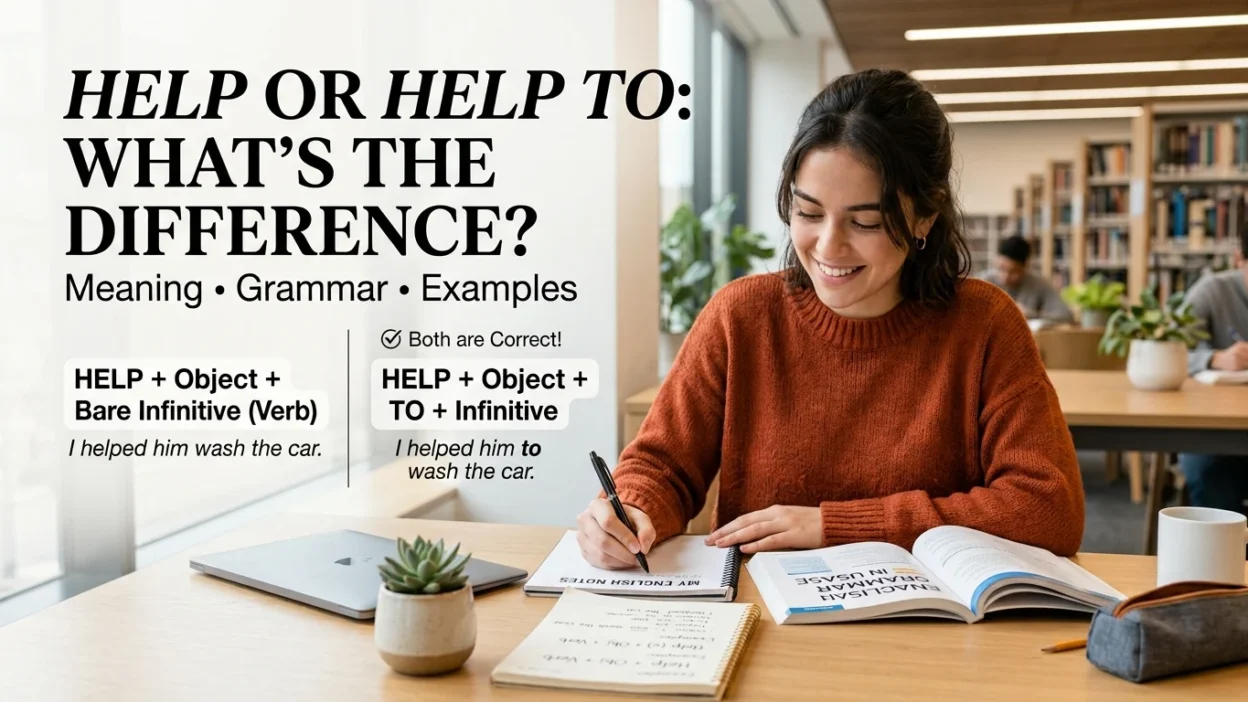
When should you say “help do” and when should you say “help to do”? Both forms are correct in English, but learners often wonder if there is a difference in meaning or grammar. The good news is that help can be followed by either a bare infinitive or a to-infinitive.
For example, you can say “She helped me finish the project” or “She helped me to finish the project.” Both sentences are grammatically correct and have essentially the same meaning. However, there are some differences in style, especially between American and British English. Understanding these patterns will help you use help, help to, and related structures naturally and confidently.
Quick Answer
Help can be followed by either the base verb or to + base verb. Both “help me do” and “help me to do” are correct. The meaning is usually the same. The form without to is especially common in everyday American English, while both forms are widely used in British English.
Why Do People Confuse “Help” and “Help To”?
The confusion happens because help behaves differently from many other verbs.
After verbs such as want, need, and decide, we normally use to + verb:
- I want to learn.
- She decided to leave.
- They need to study.
With help, however, English allows two patterns:
- Help + object + base verb
- Help + object + to + base verb
For example:
- She helped me carry the boxes.
- She helped me to carry the boxes.
Both are correct.
The same flexibility can occur when there is no object:
- This book helps improve my English.
- This book helps to improve my English.
First Word: “Help”
Help can be a verb meaning to assist someone or make something easier.
It can be followed directly by another verb:
Can you help me find my keys?
It can also be followed by to + verb:
Can you help me to find my keys?
The structure is:
help + object + base verb
or
help + object + to + base verb
Examples
- Please help me clean the room.
- Please help me to clean the room.
- He helped his brother move the furniture.
- He helped his brother to move the furniture.
Second Word: “Help To”
Help to is also grammatically correct. Here, to introduces an infinitive.
For example:
Exercise helps to improve your health.
You can often remove to without changing the basic meaning:
Exercise helps improve your health.
Both sentences mean that exercise contributes to improving your health.
However, help to should not be confused with help + noun:
- She helped her friend. ✓
- She helped to her friend. ✗
When help has a direct object such as me, him, her, us, or them, you do not normally put to before that object.
Help vs Help To: Comparison Table
| Structure | Example | Correct? | Typical Use |
|---|---|---|---|
| help + base verb | She helped me study. | ✓ | Very common |
| help + to + verb | She helped me to study. | ✓ | Also correct |
| help + object | She helped me. | ✓ | Direct assistance |
| help + with + noun | She helped me with my homework. | ✓ | Assistance with something |
| help + -ing | This helps reducing costs. | Usually awkward | Prefer helps reduce or helps to reduce |
| help to + object | She helped to me. | ✗ | Incorrect |
When Should You Use Each?
In most situations, help do and help to do are interchangeable.
Use “help + base verb”
This pattern is very common in conversational English.
- Can you help me open this door?
- She helped me understand the lesson.
- They helped us move the table.
- This guide will help you learn English.
It is often concise and natural.
Use “help + to + verb”
This pattern is also completely correct.
- Can you help me to open this door?
- She helped me to understand the lesson.
- They helped us to move the table.
- This guide will help you to learn English.
It can sometimes sound slightly more formal or traditional, although context and dialect matter.
The important point
Do not assume that help to is more grammatically correct. It is not. Both patterns are standard.
10+ Examples of “Help” and “Help To”
Here are practical examples showing how both structures work.
- Can you help me carry these bags?
- Can you help me to carry these bags?
- She helped me finish my homework.
- She helped me to finish my homework.
- This app helps people learn new words.
- This app helps people to learn new words.
- He helped his mother prepare dinner.
- He helped his mother to prepare dinner.
- Regular practice helps improve your pronunciation.
- Regular practice helps to improve your pronunciation.
- The teacher helped us understand the grammar rule.
- The teacher helped us to understand the grammar rule.
- A dictionary can help you find the correct meaning.
- A dictionary can help you to find the correct meaning.
In these examples, changing between the two patterns generally does not change the basic meaning.
Common Mistakes
Mistake 1: Adding “to” before the object
Incorrect:
She helped to me with my homework.
Correct:
She helped me with my homework.
Or:
She helped me to finish my homework.
Mistake 2: Thinking “help to” is always required
Incorrect assumption:
You must say “help me to understand.”
Actually, this is also correct:
You must say “help me understand.”
Both forms are grammatical.
Mistake 3: Using “helping to” unnecessarily
Consider:
This exercise helps to improve your English.
This is correct.
But:
This exercise helps improving your English.
This is generally not the standard construction when help means “assist in making something happen.”
Prefer:
This exercise helps improve your English.
or:
This exercise helps to improve your English.
Mistake 4: Confusing “help” with “help with”
These structures have different patterns:
She helped me write the report.
She helped me with the report.
Both are correct, but the grammar after help is different.
A Simple Memory Trick
Remember:
HELP can take TO — but it doesn’t need TO.
Think of these two patterns:
help + person + verb
Help me understand.
help + person + to + verb
Help me to understand.
If you remember that both patterns are possible, you will avoid one of the most common mistakes with help.
American vs British English
Both help do and help to do are used in American and British English.
However, the version without to is particularly common in everyday American English:
Can you help me find my phone?
British English also commonly uses the form without to, but help to + verb is well established as well:
Can you help me to find my phone?
The difference should therefore not be treated as a strict American vs. British rule. Both varieties use both constructions.
Similar Words and Structures
Understanding related structures can make help easier to remember.
Help with
Use help with before a noun or noun phrase.
Can you help me with this problem?
She helped him with his homework.
Help someone do something
Use the base verb after the person.
I helped her solve the problem.
Help someone to do something
Use to + verb after the person.
I helped her to solve the problem.
Help someone with something
Use with + noun.
I helped her with the problem.
These patterns are all useful and grammatical.
Final Verdict
“Help do” and “help to do” are both correct. When help is followed by another verb, English allows either the bare infinitive or the to-infinitive.
For example:
She helped me clean the house.
and
She helped me to clean the house.
Both mean that she assisted me in cleaning the house. In everyday conversation, the version without to is very common, but there is no general rule saying that help to is wrong.
FAQs
Is “help me do” correct?
Yes. “Help me do” is completely correct and very common.
Please help me finish this work.
Is “help me to do” correct?
Yes. “Help me to do” is also grammatically correct.
Please help me to finish this work.
Is “help do” or “help to do” more correct?
Neither is inherently more correct. Both are standard grammatical constructions.
Can I say “help me doing”?
Usually, not in the same construction. Say:
Help me do this.
or:
Help me to do this.
For assistance with a noun, use help me with:
Help me with this project.
Is “help to improve” correct?
Yes.
Exercise helps to improve your health.
You can also say:
Exercise helps improve your health.
Should I use “help to” in formal English?
You can, but you do not have to. Help improve is also standard and appropriate in formal writing.
Is “help with” different from “help to”?
Yes. Help with is normally followed by a noun or noun phrase, while help to is followed by a verb.
She helped me with the project.
She helped me to complete the project.
Remember This
- Help + base verb is correct.
- Help + to + verb is also correct.
- Help me do and help me to do usually have the same meaning.
- Help with + noun is another common structure.
- Do not say “help to me” when me is the person receiving assistance.
- The form without to is especially common in everyday American English.
Conclusion
The choice between help and help to is usually not a question of right versus wrong. English permits both help + base verb and help + to-infinitive, so sentences such as “She helped me learn” and “She helped me to learn” are both correct.
For everyday communication, simply remember that to is optional when help is followed by an infinitive. Choose the form that sounds natural in your context, and focus on avoiding incorrect patterns such as “help to me.”