
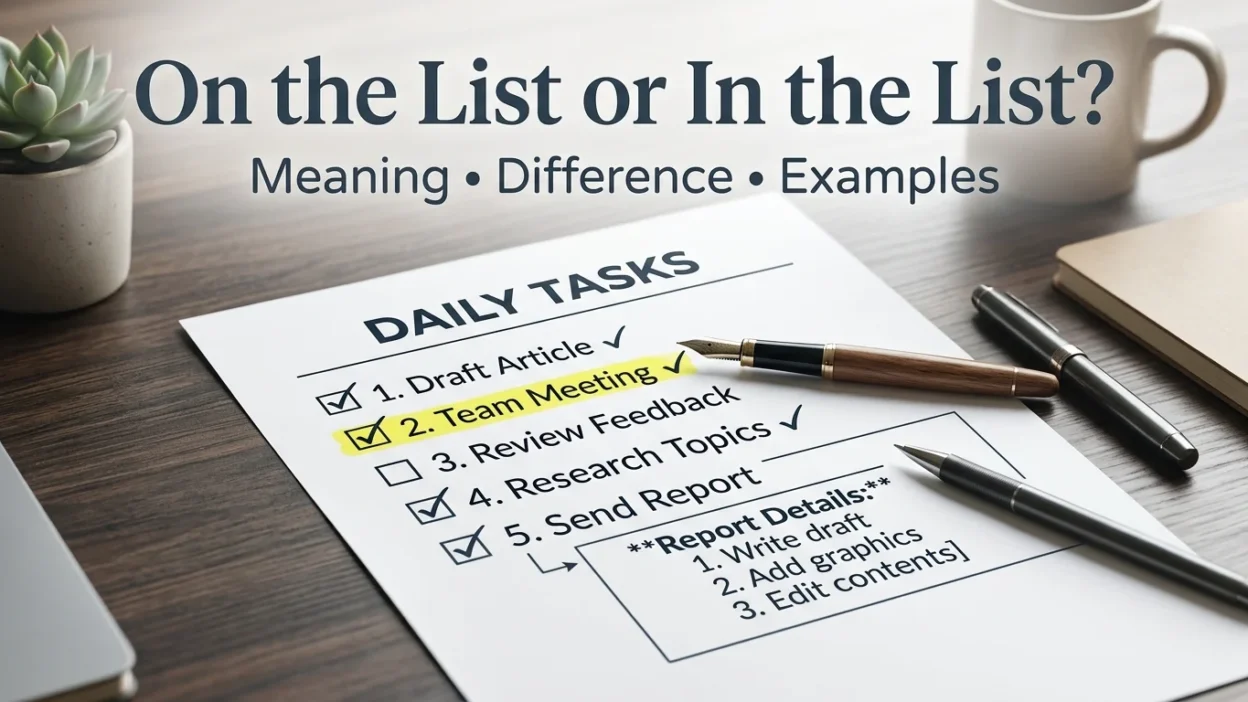
When deciding between “on the list” and “in the list,” many English learners wonder which phrase is grammatically correct. The answer depends on what you mean, but “on the list” is the usual and natural expression when referring to something that appears as an item on a list. For example, “Your name is on the list” is standard English.
The phrase “in the list” is also possible, but it is generally used when talking about something contained within a list, especially when focusing on the contents, wording, or structure of the list. Understanding this small difference can help you sound more natural in everyday English. In this guide, you will learn when to use each expression, see practical examples, and discover an easy way to remember the difference.
Quick Answer
“On the list” is the standard phrase when someone or something is included as an item on a list: “Her name is on the guest list.” “In the list” can be correct when referring to something contained within the list itself, especially its contents or wording. In everyday situations, use “on the list” for inclusion.
Why People Confuse It
The confusion comes from the different ways English uses prepositions to describe location.
We normally use “on” when something appears as an item on a written or organized list:
- Your name is on the list.
- Pizza is on the shopping list.
- He is on the waiting list.
However, “in” can describe something that exists within the contents of a list:
- There is a spelling mistake in the list.
- I found your name in the list of participants.
Both expressions can therefore be grammatically correct, but they do not always communicate exactly the same idea.
On the List
“On the list” means that a person, thing, name, or item is included as an entry or item on a list.
This is the most common expression when talking about whether something has been included.
Examples
- Is my name on the list?
- She is on the guest list.
- Your favorite restaurant is on the list.
- His name wasn’t on the attendance list.
- We put milk on the shopping list.
- The book is on my reading list.
- They are on the waiting list.
- Your name should be on the invitation list.
The phrase is also common in expressions such as:
- on the guest list
- on the waiting list
- on the priority list
- on the mailing list
- on the membership list
- on the shortlist
In these expressions, “on” emphasizes membership or inclusion as an item.
In the List
“In the list” means that something is contained within the list or appears somewhere among its contents.
It is less common than “on the list” when simply talking about inclusion, but it can be perfectly natural in the right context.
Examples
- There is an error in the list.
- I noticed a duplicate name in the list.
- The information in the list is outdated.
- There are several unusual words in the list.
- I found a mistake in the list of names.
- The final item in the list is incorrect.
Here, the focus is not simply on whether an item is included. Instead, the speaker is discussing something within the contents or structure of the list.
On the List vs In the List: Comparison Table
| Phrase | Main meaning | Commonness | Example |
|---|---|---|---|
| On the list | Included as an item | Very common | Your name is on the list. |
| In the list | Contained within the list’s contents | Less common | There is an error in the list. |
| On the guest list | Included among invited people | Very common | She is on the guest list. |
| In the list of names | Within the contents of a list | Common in specific contexts | I found his name in the list of names. |
| On my shopping list | Included as something to buy | Very common | Eggs are on my shopping list. |
When to Use Each
The easiest way to choose between these phrases is to consider what you are emphasizing.
Use “On the List” for Inclusion
Use “on the list” when you mean that someone or something has been included.
Examples:
- Is John on the list?
- Your name is on the list.
- Chocolate is on my shopping list.
- She is on the guest list.
Think of the list as a surface containing separate entries. Each entry is on the list.
Use “In the List” for Contents
Use “in the list” when you are examining or describing the contents of a list.
Examples:
- There is a mistake in the list.
- I found three duplicate entries in the list.
- The names in the list are arranged alphabetically.
- There are several errors in the list of participants.
Here, your attention is directed toward what is contained within the list.
10+ Examples of “On the List” and “In the List”
Seeing the expressions in context makes the difference easier to understand.
- Your name is on the list.
This means your name has been included. - Is Sarah on the guest list?
This asks whether Sarah has been invited. - Milk is on my shopping list.
Milk is one of the things you need to buy. - He is on the waiting list.
He has been included among people waiting for something. - That restaurant is on our list of places to visit.
The restaurant is one of the selected places. - There is a spelling mistake in the list.
The mistake occurs somewhere within the list’s contents. - I found his name in the list of employees.
His name appears within the larger collection of employee names. - There are two duplicate entries in the list.
The duplicates are contained within the list. - The final name on the list is mine.
The name is an individual entry. - I noticed an error in the list of addresses.
The error occurs within the list’s contents. - Your item is on the priority list.
The item has been given a place on the list. - Several names in the list are misspelled.
The sentence focuses on the contents of the list.
Common Mistakes
Mistake 1: Using “In the List” for Every Situation
Some learners say:
My name is in the list.
This can be understood, but “My name is on the list” is usually more natural when you simply mean that your name has been included.
Mistake 2: Thinking “On” Always Means Physical Location
In English, “on” is not limited to physical surfaces.
We commonly say:
- on the list
- on the schedule
- on the menu
- on the agenda
- on the register
These expressions describe inclusion or appearance in an organized set of information.
Mistake 3: Assuming “In” Is Always Wrong
“In the list” is not grammatically incorrect.
For example:
There is an error in the list.
This is completely natural because the speaker is talking about something contained within the list.
Memory Trick
Use this simple rule:
ON = an item has a place on the list.
IN = something exists within the contents of the list.
Think:
Your name is ON the list.
A mistake is IN the list.
If you are asking whether somebody or something has been included, “on the list” will usually be the right choice.
American vs British English
There is no major American-versus-British difference in the basic use of “on the list” and “in the list.”
Both American and British English commonly use “on the list” when referring to inclusion:
- She is on the list.
- His name is on the guest list.
- Put it on the list.
Both varieties can also use “in the list” when focusing on the contents of a list:
- There is an error in the list.
- I found the information in the list.
Therefore, the distinction is mainly about meaning and emphasis, rather than American versus British grammar.
Similar Words
Several related expressions follow the same general pattern.
On the Schedule
Use “on the schedule” when something has been scheduled.
The meeting is on the schedule for Monday.
On the Menu
Use “on the menu” when food or drinks are offered by a restaurant.
Pasta is on the menu tonight.
On the Agenda
Use “on the agenda” when a topic is included for discussion.
Climate policy is on the agenda.
On the Register
Use “on the register” when someone’s name has been officially recorded.
Her name is on the register.
In the Document
Use “in the document” when referring to something contained within a document.
There is an error in the document.
These examples show that English prepositions depend heavily on the relationship between the object and the information being discussed.
Final Verdict
When you mean “included as an item,” use “on the list.” This is the natural choice in sentences such as “Your name is on the list,” “She is on the guest list,” and “Eggs are on my shopping list.”
Use “in the list” when you are talking about something contained within the list’s contents, such as an error, duplicate entry, spelling mistake, or piece of information. So, “on the list” is usually the better choice for inclusion, while “in the list” is useful when focusing on the contents.
Frequently Asked Questions
Is “on the list” grammatically correct?
Yes. “On the list” is grammatically correct and is the usual expression when saying that a person or item has been included in a list.
Is “in the list” grammatically correct?
Yes. “In the list” can be grammatically correct when referring to something contained within the list, particularly its contents or structure.
Should I say “my name is on the list” or “in the list”?
Say “My name is on the list.” This is the standard and natural way to say that your name has been included.
Is it “on the shopping list” or “in the shopping list”?
The usual expression is “on the shopping list.”
Apples are on the shopping list.
Is it “on the guest list” or “in the guest list”?
The normal expression is “on the guest list.”
David is on the guest list.
Can “in the list” ever be better than “on the list”?
Yes. Use “in the list” when focusing on something contained within the list.
There is a typo in the list.
What is the easiest way to remember “on the list” vs. “in the list”?
Remember: ON = included as an item; IN = contained within the contents. Therefore, “Your name is on the list,” but “There is an error in the list.”
Remember This
- On the list = included as an item.
- In the list = contained within the list’s contents.
- On the list is more common when talking about inclusion.
- In the list is useful when discussing errors, information, entries, or other things found within a list.
- Say “My name is on the list.”
- Say “There is a mistake in the list.”
Conclusion
The difference between “on the list” and “in the list” is small but useful. In most everyday situations, choose “on the list” when you want to say that a person or item has been included. This is why we naturally say “on the guest list,” “on the waiting list,” and “on the shopping list.”
“In the list” is also possible, but it usually shifts attention toward the contents of the list. Once you understand this distinction, choosing the correct preposition becomes much easier: an included item is usually ON the list, while something contained within its contents can be IN the list.