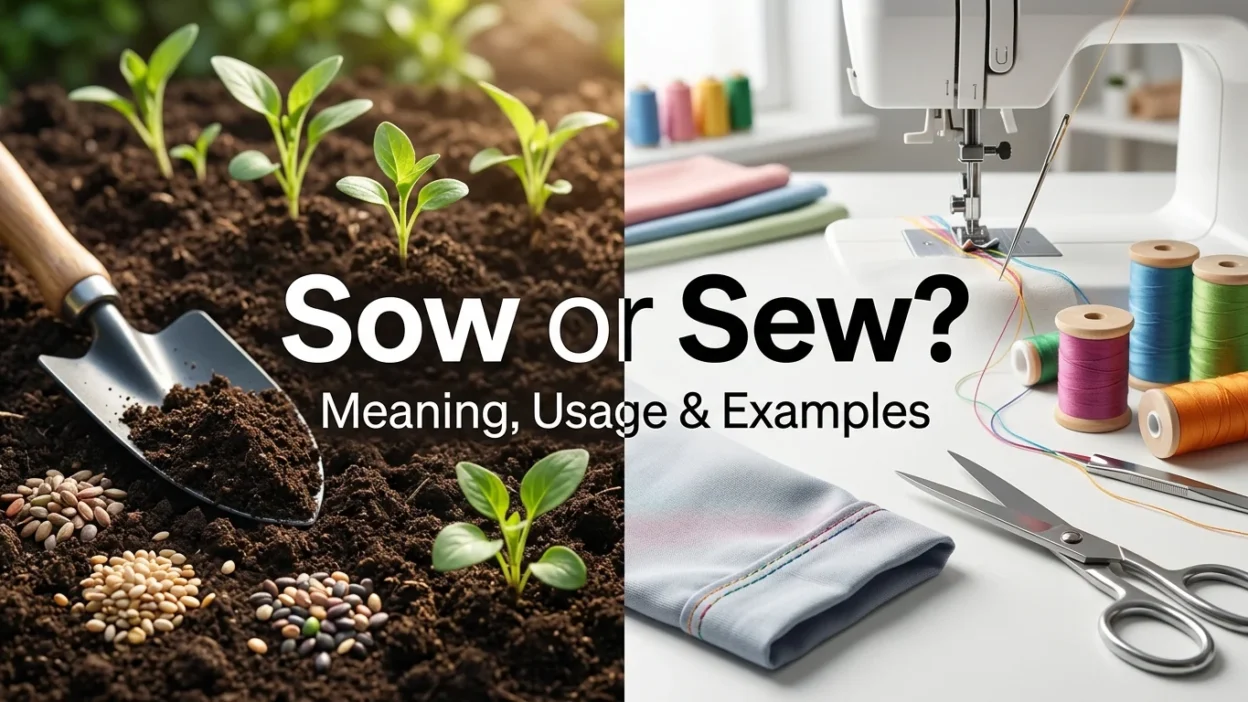
English has many words that sound similar but have completely different meanings. Sow and sew are a good example. They can easily confuse learners because both words are short, common, and connected to everyday activities. However, they are used in very different situations.
Sow is mainly related to planting seeds or spreading something, while sew means to join or repair fabric using a needle and thread. Understanding the difference between sow and sew can help you avoid common spelling and vocabulary mistakes. In this guide, you will learn their meanings, pronunciation, grammar, examples, common mistakes, and a simple memory trick to remember which word to use.
Quick Answer
Sow means to plant seeds in the ground or spread something. Sew means to join, repair, or decorate fabric with a needle and thread. Although they look and sound similar in some forms, their meanings are completely different. For example: “Farmers sow seeds,” but “Tailors sew clothes.”
Why Do People Confuse Sow and Sew?
People often confuse sow and sew because they are pronounced similarly in some contexts and both are common English words.
The spelling difference is especially important because the words belong to completely different areas of vocabulary:
- Sow → planting seeds or spreading something
- Sew → joining fabric with a needle and thread
There is also an interesting pronunciation point. The verb sow, meaning “to plant,” is pronounced like “so” /soʊ/. The verb sew is also pronounced like “so” /soʊ/.
However, sow has another meaning when it refers to an adult female pig. In that case, it is usually pronounced /saʊ/, like “sau.”
Sow: Meaning and Usage
Sow is a verb that usually means to plant seeds in soil so that they can grow.
For example:
- Farmers sow wheat seeds in autumn.
- We sowed flower seeds in the garden.
- The gardener is sowing tomato seeds.
The word can also be used figuratively to mean to introduce or spread something, especially an idea, feeling, or influence.
For example:
- The speech sowed doubt among the audience.
- Kind actions can sow the seeds of friendship.
- The incident sowed fear in the community.
Sow as a Noun
Sow can also be a noun referring to an adult female pig.
Example:
- The sow stayed with her piglets.
In this meaning, sow has a different pronunciation from the verb meaning “to plant.”
Sew: Meaning and Usage
Sew is a verb that means to join, repair, or decorate pieces of fabric using a needle and thread.
For example:
- My grandmother taught me how to sew.
- She sewed a button onto my shirt.
- I need to sew this small hole.
- The tailor sewed the dress by hand.
The word is associated with activities such as:
- Making clothes
- Repairing clothing
- Embroidery
- Quilting
- Sewing buttons
- Creating fabric decorations
- Altering garments
Forms of Sew
The main forms of the verb are:
- Sew – present form
- Sewed – simple past form
- Sewn or sewed – past participle, depending on usage
Examples:
- I sew clothes for my family.
- She sewed the torn shirt yesterday.
- The dress has been sewn by hand.
Sow vs Sew: Comparison Table
| Word | Meaning | Main Use | Example |
|---|---|---|---|
| Sow | To plant seeds | Farming and gardening | Farmers sow seeds in spring. |
| Sow | To spread something | Figurative use | His words sowed doubt. |
| Sow | Female pig | Animal vocabulary | The sow stayed near her piglets. |
| Sew | To join fabric with needle and thread | Clothing and textiles | She can sew a beautiful dress. |
The easiest distinction is sow = plant and sew = stitch.
When Should You Use Sow or Sew?
Use sow when you are talking about seeds, planting, or spreading something figuratively.
Use sew when you are talking about fabric, clothing, needles, thread, stitching, or repairing garments.
Compare these sentences:
- We sow seeds in the garden.
- We sew pieces of fabric together.
Another useful comparison is:
- The farmer sowed the field with wheat.
- The tailor sewed the fabric into a jacket.
Although the two words sound alike when sow means “plant,” the context tells you which spelling is correct.
10+ Examples of Sow and Sew
Here are practical examples to make the difference easier to remember.
Examples With Sow
- Farmers sow wheat seeds before the rainy season.
- We sowed sunflower seeds in the garden.
- The gardener will sow the seeds tomorrow.
- She carefully sowed the flower seeds in rows.
- The farmer is sowing corn in the field.
- Good teachers can sow the seeds of curiosity in children.
- His actions sowed confusion among the workers.
- The campaign helped sow hope in the community.
Examples With Sew
- My mother taught me to sew when I was young.
- She can sew a button onto a shirt.
- I need to sew this tear before wearing the dress.
- The tailor sewed the sleeves onto the jacket.
- She is sewing a new cushion cover.
- My sister sewed the pieces together carefully.
- The costume was sewn by hand.
- He learned how to sew while working with his grandmother.
Common Mistakes With Sow and Sew
One common mistake is choosing the spelling based only on pronunciation.
Because sow and sew can both sound like “so,” it is easy to write the wrong word.
Incorrect:
I will sew the seeds tomorrow.
Correct:
I will sow the seeds tomorrow.
Seeds are planted, so sow is correct.
Incorrect:
She will sow the torn shirt.
Correct:
She will sew the torn shirt.
A shirt is repaired with needle and thread, so sew is correct.
Another mistake is assuming that sow always has the same pronunciation. Remember that the animal noun sow is pronounced differently from the verb meaning “plant.”
Memory Trick: Sow or Sew?
A simple memory trick can make these words much easier.
Sow = Seeds
Both sow and seeds are associated with planting.
Think:
Sow → Seeds → Soil
If you are putting seeds into the ground, use sow.
Sew = Stitch
Think:
Sew → Stitch → Shirt
If you are using a needle and thread to join fabric, use sew.
You can remember the difference with this simple sentence:
Sow seeds, sew shirts.
That short phrase connects each word with its main meaning.
American vs British English
There is generally no difference between American and British English in the basic meanings of sow and sew.
Both varieties use:
- sow for planting seeds
- sew for joining fabric with needle and thread
The pronunciation of sew is generally /soʊ/ in both varieties.
The verb sow, meaning “to plant,” is also generally pronounced /soʊ/. The noun sow, meaning an adult female pig, is pronounced /saʊ/.
So, this is primarily a meaning and spelling distinction, not an American-versus-British vocabulary difference.
Similar Words to Sow and Sew
Several related words can help you understand the vocabulary surrounding these terms.
Words Related to Sow
- Plant
- Seed
- Grow
- Cultivate
- Scatter
- Cultivation
- Harvest
- Germinate
Example:
Farmers sow seeds and later harvest the crops.
Words Related to Sew
- Stitch
- Needle
- Thread
- Fabric
- Tailor
- Embroidery
- Garment
- Mend
- Repair
Example:
The tailor used a needle and thread to sew the garment.
Final Verdict: Sow or Sew?
Use sow when you mean to plant seeds or, in a figurative sense, to spread or introduce something.
Use sew when you mean to join or repair fabric with a needle and thread.
The pronunciation can make these words confusing, but their meanings are easy to separate once you connect them with their typical objects:
Sow → seeds
Sew → fabric
Remembering this simple distinction will help you choose the correct spelling in writing.
Frequently Asked Questions
Is it sow or sew seeds?
The correct word is sow.
Farmers sow seeds in the soil.
Sew is used for fabric and clothing.
Is it sow or sew a dress?
The correct word is sew.
She knows how to sew a dress.
You use a needle and thread to make or repair the dress.
Do sow and sew sound the same?
When sow means “to plant,” it is pronounced like “so,” and sew is also pronounced like “so.” Their spelling and meanings are different.
What is the past tense of sow?
The past tense of sow is commonly sowed.
Example:
The farmer sowed the seeds last week.
The past participle can be sown or sowed, with sown common in contexts referring to seeds.
What is the past tense of sew?
The past tense of sew is sewed.
Example:
She sewed the button onto my coat.
The past participle can be sewn or sewed.
What does sow mean besides planting?
Sow can also refer to an adult female pig. In addition, the verb can be used figuratively to mean spreading or introducing something, such as an idea, feeling, or doubt.
What is an easy way to remember sow and sew?
Remember:
Sow seeds. Sew shirts.
If you are talking about planting, use sow. If you are talking about stitching fabric, use sew.
Remember This
- Sow = plant seeds
- Sow = spread something figuratively
- Sow = adult female pig
- Sew = join or repair fabric
- Sew = use a needle and thread
- Sow seeds
- Sew clothes
The easiest memory sentence is:
Sow seeds, sew shirts.
Conclusion
The difference between sow and sew is mainly about meaning and spelling. Sow is connected with planting seeds and can also describe spreading something figuratively, while sew refers to joining or repairing fabric with a needle and thread.
Although sow and sew can sound identical when sow means “plant,” their contexts are very different. Remember “sow seeds, sew shirts,” and you will have a simple way to choose the correct word whenever you write.