
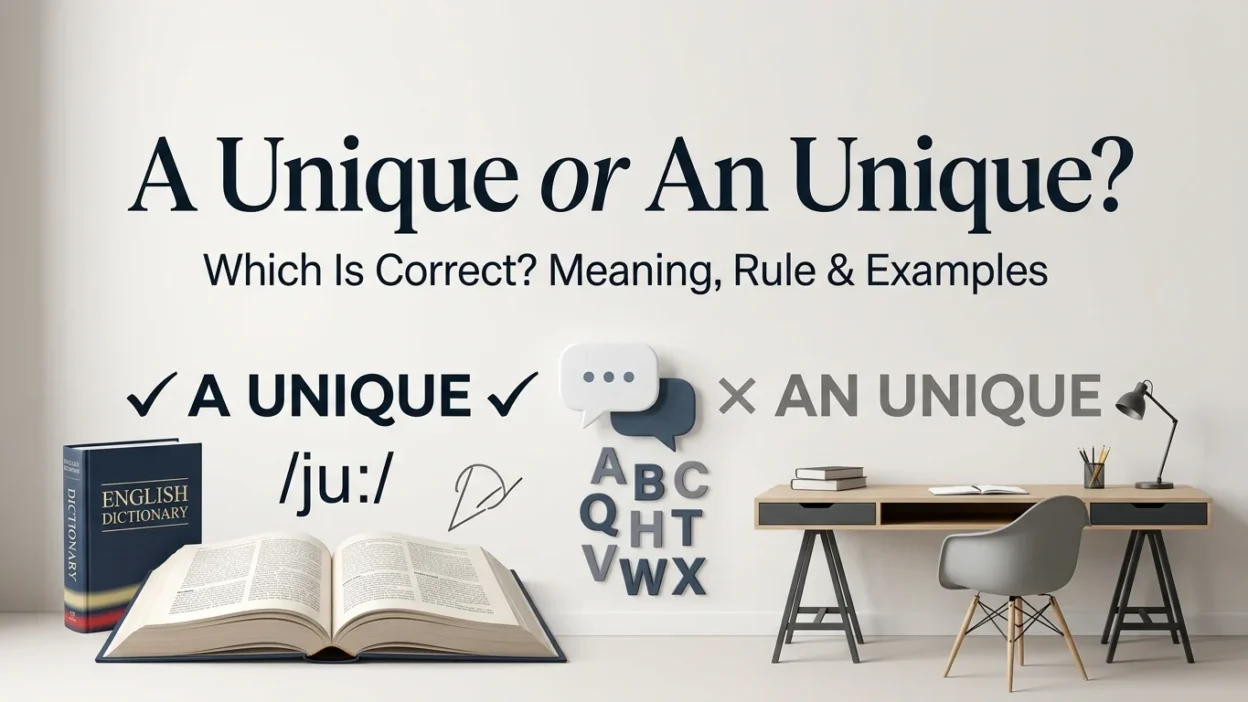
When choosing between “a unique” and “an unique,” many English learners hesitate because the word unique begins with the letter u, which often makes people think it should take “an.” However, English articles are based on sound, not simply on the first letter of a word. That makes the correct choice easier to understand once you know how unique is pronounced.
The correct expression is “a unique,” not “an unique.” The word unique begins with a consonant sound, /juː/, similar to the sound at the beginning of you. Therefore, we say “a unique idea,” “a unique opportunity,” and “a unique experience.” This article explains the rule clearly, gives practical examples, compares related words, and shows how to avoid this common mistake.
Quick Answer
The correct phrase is “a unique,” not “an unique.” We use “a” because unique starts with the consonant sound /juː/, like you. For example, say “a unique idea,” “a unique design,” and “a unique opportunity.” English articles depend on pronunciation rather than spelling.
Why Do People Confuse It?
People often confuse a unique and an unique because unique starts with the vowel letter u.
A common rule says:
- Use a before a consonant sound.
- Use an before a vowel sound.
The important word here is sound.
Although unique begins with the letter u, its pronunciation begins with the sound /juː/. This is a consonant sound.
Compare these:
- a unique idea ✓
- an unique idea ✗
- a university ✓
- a European country ✓
- a useful tool ✓
Words such as unique, university, and useful begin with a sound similar to “yoo.” Therefore, they take a, not an.
The First Word: “A”
A is an indefinite article used before a singular countable noun when the following word begins with a consonant sound.
Examples:
- a book
- a car
- a teacher
- a university
- a unique idea
- a useful suggestion
- a European city
The spelling of the next word does not determine whether we use a. Pronunciation does.
For example:
She has a unique way of solving problems.
Here, unique begins with /juː/, so a is correct.
The Second Word: “An”
An is an indefinite article used before a singular countable noun when the following word begins with a vowel sound.
Examples include:
- an apple
- an orange
- an idea
- an interesting book
- an honest person
- an unusual situation
Notice that an is determined by pronunciation.
For example:
He is an honest man.
The h in honest is silent, so the word begins with a vowel sound.
However:
She is a unique person.
The beginning of unique has the consonant /j/ sound, so a is correct.
A Unique or An Unique: Comparison Table
| Expression | Correct? | Reason |
|---|---|---|
| a unique | ✓ Correct | Unique begins with /juː/, a consonant sound |
| an unique | ✗ Incorrect | Unique does not begin with a vowel sound |
| a unique idea | ✓ Correct | The first sound is /j/ |
| an unique idea | ✗ Incorrect | The article does not match the pronunciation |
| a university | ✓ Correct | University begins with /juː/ |
| an unusual idea | ✓ Correct | Unusual begins with a vowel sound |
The key principle is simple: choose the article according to the first sound, not the first letter.
When Should You Use “A Unique”?
Use a unique before a singular noun when you are describing one particular thing as unique.
Examples:
- a unique idea
- a unique opportunity
- a unique experience
- a unique design
- a unique approach
- a unique solution
- a unique perspective
- a unique talent
- a unique style
- a unique product
For example:
The company has a unique approach to customer service.
We had a unique experience during our trip.
She created a unique design for the building.
You can also use unique without an article when it is not directly modifying a singular countable noun:
Her approach is unique.
Here, unique is an adjective after the verb is, so there is no need for a or an.
10+ Examples of “A Unique”
Here are practical examples showing how a unique is used naturally:
- She has a unique talent for storytelling.
- This restaurant offers a unique dining experience.
- He developed a unique method for teaching English.
- The building has a unique architectural design.
- We found a unique solution to the problem.
- She brought a unique perspective to the discussion.
- The artist created a unique piece of artwork.
- This product has a unique feature that competitors do not offer.
- They gave us a unique opportunity to learn from experts.
- He has a unique style of writing.
- The village has a unique cultural identity.
- That was a unique experience for everyone involved.
- She suggested a unique approach to the project.
- The company developed a unique strategy for reaching customers.
- We need a unique name for the new business.
Common Mistakes
Mistake 1: Using “an” Because of the Letter U
A common error is:
❌ an unique idea
The spelling begins with u, but the pronunciation begins with /juː/.
Correct:
✓ a unique idea
Mistake 2: Thinking Every Word Beginning With a Vowel Letter Takes “An”
This is another common misunderstanding.
Consider:
- a university
- a uniform
- a useful book
- a user
- a unique opportunity
All of these begin with a vowel letter but a consonant sound.
Mistake 3: Applying the Rule to Spelling Instead of Sound
The rule is not:
“Use an before every vowel letter.”
The better rule is:
Use “an” before a vowel sound and “a” before a consonant sound.
That distinction solves many article problems.
Mistake 4: Writing “An Unique” in Formal English
Because an unique does not match the usual pronunciation of unique, it is considered incorrect in standard modern English.
Use:
a unique
instead.
A Simple Memory Trick
Remember this:
Unique sounds like “you-nik.”
The first sound is like the beginning of you:
you → /juː/
Because the word begins with a y-like consonant sound, use a:
a unique
You can use the same trick with words such as:
- a university
- a uniform
- a useful idea
- a user
- a union
- a European country
Think:
“If it sounds like ‘you,’ use A.”
American vs British English
The choice between a unique and an unique does not normally change between American and British English.
Both varieties use:
a unique idea
rather than:
an unique idea
This is because the pronunciation of unique begins with the /j/ sound in standard American and British pronunciation.
The same principle applies to words such as:
- a university
- a European
- a useful tool
- a uniform
Regional differences in pronunciation can sometimes affect article choice with certain words, but unique is straightforward in standard usage.
Similar Words
Several words beginning with u can cause the same confusion.
A University
Correct:
She attends a university in London.
University begins with /juː/, so we use a.
A Useful Tool
Correct:
This is a useful tool for students.
Useful also begins with /juː/.
A User
Correct:
Every customer receives a user account.
User begins with the same general /juː/ sound.
An Unusual Idea
Correct:
That is an unusual idea.
Unlike unique, unusual begins with a vowel sound, so an is appropriate.
An Unexpected Result
Correct:
We received an unexpected result.
Unexpected begins with a vowel sound.
An Umbrella
Correct:
She carried an umbrella.
Umbrella begins with the vowel sound /ʌ/, so an is required.
These examples demonstrate why looking only at the first letter can be misleading.
Final Verdict
The correct expression is “a unique.”
Use a because unique begins with the consonant sound /j/, as in you. Therefore:
- a unique idea ✓
- a unique opportunity ✓
- a unique experience ✓
- an unique idea ✗
The most useful rule to remember is that English articles depend on pronunciation rather than spelling. A word can begin with a vowel letter and still require a if its first sound is a consonant sound.
Frequently Asked Questions
Is it “a unique” or “an unique”?
The correct form is “a unique.” Unique begins with the /juː/ sound, which is a consonant sound.
Why is “a unique” correct?
We use a because the pronunciation of unique starts with a /j/ sound, similar to the beginning of you.
Is “an unique” grammatically correct?
In standard modern English, “an unique” is generally considered incorrect. The usual form is “a unique.”
Do you say “a unique opportunity”?
Yes. “A unique opportunity” is correct because unique begins with the consonant /j/ sound.
Is “a unique experience” correct?
Yes. You should say “a unique experience.”
Is unique a vowel sound?
No. Although unique starts with the vowel letter u, its initial sound is /j/, followed by /uː/. Therefore, it begins with a consonant sound.
What is the rule for “a” and “an”?
Use a before a consonant sound and an before a vowel sound. The sound, rather than the spelling, determines the article.
Remember This
Unique starts with the sound “you,” so use “a”:
a unique
Not:
❌ an unique
Remember the pronunciation-based rule:
Consonant sound → a
Vowel sound → an
That is why we say a unique idea, but an unusual idea.
Conclusion
The difference between a unique and an unique becomes easy once you focus on pronunciation. Although unique starts with the vowel letter u, it begins with the consonant sound /j/, like the beginning of you. Therefore, a unique is the correct expression in standard English.
Whenever you are unsure about a or an, listen to the first sound of the following word rather than looking only at its first letter. This simple habit will help you use articles correctly with words such as unique, university, useful, and unusual.