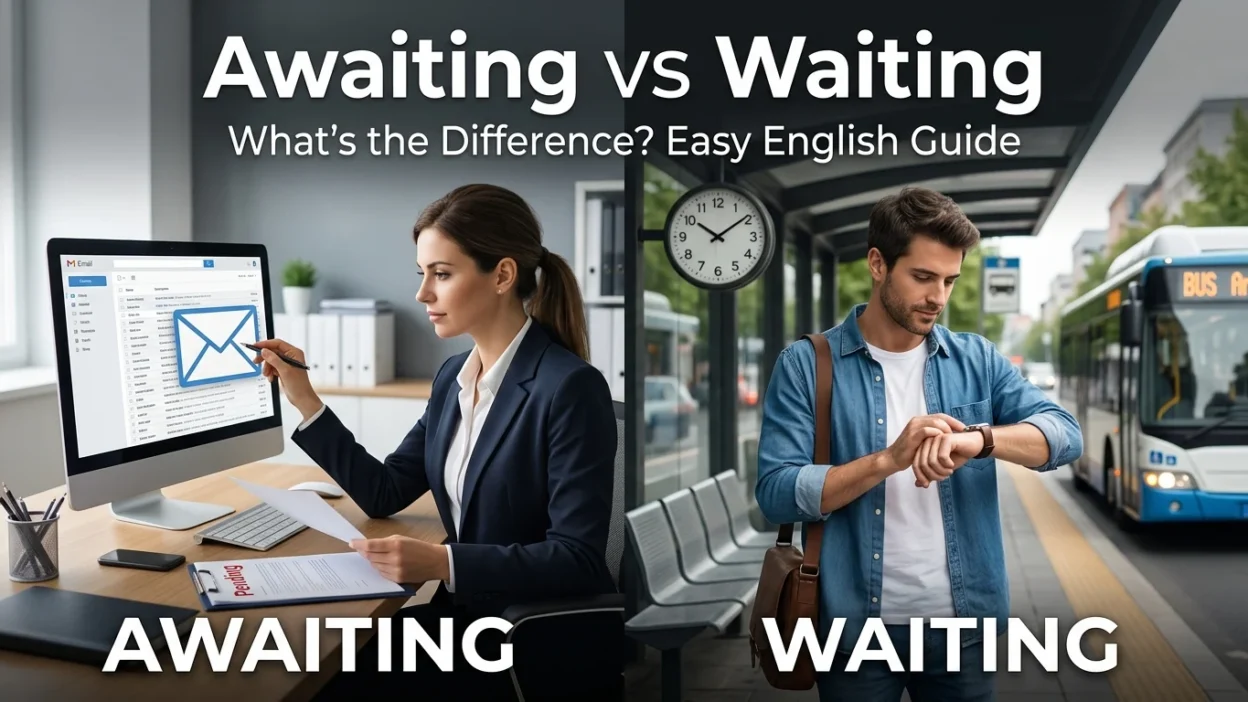
When you are learning English, “awaiting” vs “waiting” can be confusing because both words describe staying in expectation of something. However, they are not always used in the same way. The main difference is grammar, tone, and what comes after the word. Awaiting is usually more formal and normally takes a direct object, while waiting is more common in everyday English and can be used with “for.”
For example, you can say “We are awaiting your response” or “We are waiting for your response.” Both are grammatically correct, but the first sounds more formal. Understanding this small difference can help you choose the right word in emails, conversations, academic writing, workplace communication, and everyday situations.
Quick Answer
Awaiting and waiting both mean expecting something to happen or arrive. Awaiting is more formal and is followed directly by an object: “We are awaiting your reply.” Waiting is more common and usually uses for before an object: “We are waiting for your reply.”
Why Do People Confuse “Awaiting” and “Waiting”?
People confuse these words because their basic meanings are very similar. Both can describe someone expecting something, such as a reply, decision, arrival, or result.
The biggest difference is how they work grammatically.
- Awaiting + object: We are awaiting your decision.
- Waiting + for + object: We are waiting for your decision.
There is also a difference in style. Waiting is natural and conversational, while awaiting often sounds more formal, professional, or official.
What Does “Awaiting” Mean?
Awaiting means expecting or waiting for something to happen or arrive.
It is the -ing form of “await.” Unlike “wait,” the verb await normally takes a direct object and does not need the preposition for.
Examples
- We are awaiting your response.
- She is awaiting the results.
- The company is awaiting approval.
- They are awaiting further instructions.
“Awaiting” is especially common in formal writing, business communication, official notices, and professional contexts.
Is “Awaiting for” Correct?
Usually, no.
The standard construction is:
await + object
So write:
- ✅ We are awaiting your reply.
- ❌ We are awaiting for your reply.
But with wait, use:
- ✅ We are waiting for your reply.
What Does “Waiting” Mean?
Waiting means staying in a place or situation until someone or something arrives, happens, or becomes available.
It is the -ing form of “wait.”
“Waiting” is extremely common in everyday English.
Examples
- I am waiting for the bus.
- She is waiting for her friend.
- We are waiting for an answer.
- They are waiting for the results.
Unlike “await,” wait commonly uses for when you identify the person or thing you are expecting.
Awaiting vs Waiting: Comparison Table
| Feature | Awaiting | Waiting |
|---|---|---|
| Basic meaning | Expecting something | Staying until something happens or arrives |
| Style | More formal | More common and conversational |
| Common structure | Await + object | Wait + for + object |
| Example | We are awaiting your response. | We are waiting for your response. |
| “For” required before object? | No | Usually yes |
| Everyday conversation | Less common | Very common |
| Business writing | Common | Also common |
| Can describe waiting at a place? | Usually not | Yes |
When Should You Use “Awaiting” or “Waiting”?
The best choice depends on both grammar and context.
Use “Awaiting” for Formal Situations
Choose awaiting when your sentence has a formal or professional tone.
Examples:
- We are awaiting your confirmation.
- The application is awaiting approval.
- The patient is awaiting further tests.
- The court is awaiting additional evidence.
Use “Waiting” for Everyday Conversation
Use waiting when speaking naturally with friends, family, coworkers, or other people in ordinary situations.
Examples:
- I’m waiting for the bus.
- She’s waiting for me.
- We’re waiting for dinner.
- He’s waiting for his friend.
Use “Waiting” for a Place or Period of Time
“Wait” can describe remaining somewhere until something happens.
- I am waiting at the station.
- She waited outside the office.
- We waited for two hours.
- They are waiting in the lobby.
“Await” generally does not work this way.
10+ Examples of Awaiting and Waiting
Here are practical examples showing the difference.
1. Email Response
- Formal: We are awaiting your response.
- Everyday: We are waiting for your response.
2. Bus
- I am waiting for the bus.
- ❌ I am awaiting for the bus.
“Waiting” is the natural choice here.
3. Approval
- The project is awaiting approval.
- The project is waiting for approval.
Both can be understood, but awaiting approval sounds more formal.
4. Friend
- I am waiting for my friend.
- “Awaiting my friend” sounds unusually formal in ordinary conversation.
5. Results
- The students are awaiting the results.
- The students are waiting for the results.
Both are correct.
6. Decision
- We are awaiting a final decision.
- We are waiting for a final decision.
The first sounds more official.
7. Package
- I am waiting for my package.
- “I am awaiting my package” is grammatically possible but sounds more formal.
8. Instructions
- The team is awaiting further instructions.
- The team is waiting for further instructions.
Both are correct.
9. Train
- We are waiting for the train.
- ❌ We are awaiting for the train.
Use waiting for in this sentence.
10. Confirmation
- We are awaiting confirmation.
- We are waiting for confirmation.
Both work, but “awaiting confirmation” is common in formal communication.
11. Doctor
- The patient is awaiting the doctor’s decision.
- The patient is waiting for the doctor’s decision.
Both are grammatically correct.
12. Phone Call
- I’m waiting for your call.
- “I am awaiting your call” sounds more formal and somewhat stiff in casual conversation.
Common Mistakes With Awaiting and Waiting
Mistake 1: Using “Awaiting For”
Incorrect:
- ❌ We are awaiting for your reply.
Correct:
- ✅ We are awaiting your reply.
Remember that await takes the object directly.
Mistake 2: Forgetting “For” After “Wait”
Incorrect:
- ❌ I am waiting the bus.
Correct:
- ✅ I am waiting for the bus.
The common structure is wait for + person/thing.
Mistake 3: Using “Await” for a Location
Incorrect or unnatural:
- ❌ I am awaiting at the station.
Better:
- ✅ I am waiting at the station.
“Wait” can describe staying at a location.
Mistake 4: Making Casual English Too Formal
You can say:
- “I am awaiting your response.”
But in a casual text, this may sound unnecessarily formal.
A more natural choice is:
- “I’m waiting for your response.”
Mistake 5: Thinking the Words Are Always Interchangeable
Their meanings overlap, but their grammar and typical contexts differ.
Compare:
- Awaiting your reply ✅
- Waiting for your reply ✅
- Awaiting for your reply ❌
Memory Trick: Await Needs No “For”
A simple way to remember the difference is:
Await = directly awaits something
Wait = waits FOR something
Think of this pattern:
Await + object
Wait + for + object
Examples:
- Await the results.
- Wait for the results.
This one rule will prevent many common mistakes.
American vs British English
There is no major grammatical difference between American and British English when it comes to awaiting and waiting.
Both varieties use:
- await + object
- wait + for + object
For example:
- American English: We are awaiting your response.
- British English: We are awaiting your response.
And:
- American English: I’m waiting for the train.
- British English: I’m waiting for the train.
The main difference is not American versus British grammar. It is formality and context. “Waiting” is more natural in everyday speech, while “awaiting” often appears in formal or official writing.
Similar Words to Awaiting and Waiting
Several words and phrases are related to these two verbs.
Expecting
Expecting means believing that something will happen or arrive.
- We are expecting a reply.
- She is expecting a package.
Anticipating
Anticipating means expecting something, often with a sense of looking forward to or preparing for it.
- We are anticipating strong demand.
Looking Forward To
This usually expresses that you are pleased or excited about something that will happen.
- I am looking forward to meeting you.
Standing By
Standing by means being ready and waiting for instructions or an event.
- The team is standing by for further instructions.
Pending
Pending means something has not yet been decided, completed, or resolved.
- The application is pending approval.
These words are related to waiting, but they do not always have exactly the same meaning.
Final Verdict: Awaiting vs Waiting
Awaiting and waiting are both correct words, but they are used differently.
Use awaiting when you want a more formal expression and when the thing being expected comes directly after the verb:
We are awaiting your response.
Use waiting for everyday English, especially when you use for before the person or thing:
We are waiting for your response.
The easiest rule is “await something” but “wait for something.”
Frequently Asked Questions
Is “awaiting” the same as “waiting”?
They have very similar meanings, but they are not identical in usage. Awaiting is more formal and normally takes a direct object, while waiting commonly takes for before the object.
Is it correct to say “awaiting for”?
No. In standard English, use await + object, not “await for.”
- ✅ We are awaiting your answer.
- ❌ We are awaiting for your answer.
Is “waiting for” correct?
Yes. Waiting for is the normal construction when you identify the person or thing you are expecting.
- I am waiting for my friend.
- She is waiting for the bus.
Which is more formal, “awaiting” or “waiting”?
Awaiting is generally more formal. It is common in professional, official, academic, and administrative contexts.
Can I say “I am awaiting you”?
It is grammatically possible, but it sounds very formal or unusual in most everyday situations. “I am waiting for you” is much more natural.
Can “awaiting” be used in everyday English?
Yes, but it may sound formal depending on the situation. For ordinary conversation, waiting is usually more natural.
What is the easiest way to remember the difference?
Remember:
Await something.
Wait for something.
For example:
- We are awaiting the results.
- We are waiting for the results.
Remember This
- Awaiting = formal way of saying expecting or waiting for something.
- Waiting = common everyday word.
- Await + object → awaiting your response.
- Wait + for + object → waiting for your response.
- Never normally say “awaiting for.”
- Use waiting when talking about waiting at a place or for a period of time.
- Choose awaiting when a formal or official tone is appropriate.
Conclusion
Understanding awaiting vs waiting is mainly about recognizing their grammar and level of formality. Awaiting is more formal and takes its object directly, while waiting is more common in everyday English and usually uses for before the object.
When in doubt, remember the simple pattern: await something, but wait for something. Once you learn this structure, choosing between “awaiting” and “waiting” becomes much easier in conversations, emails, schoolwork, and professional writing.