
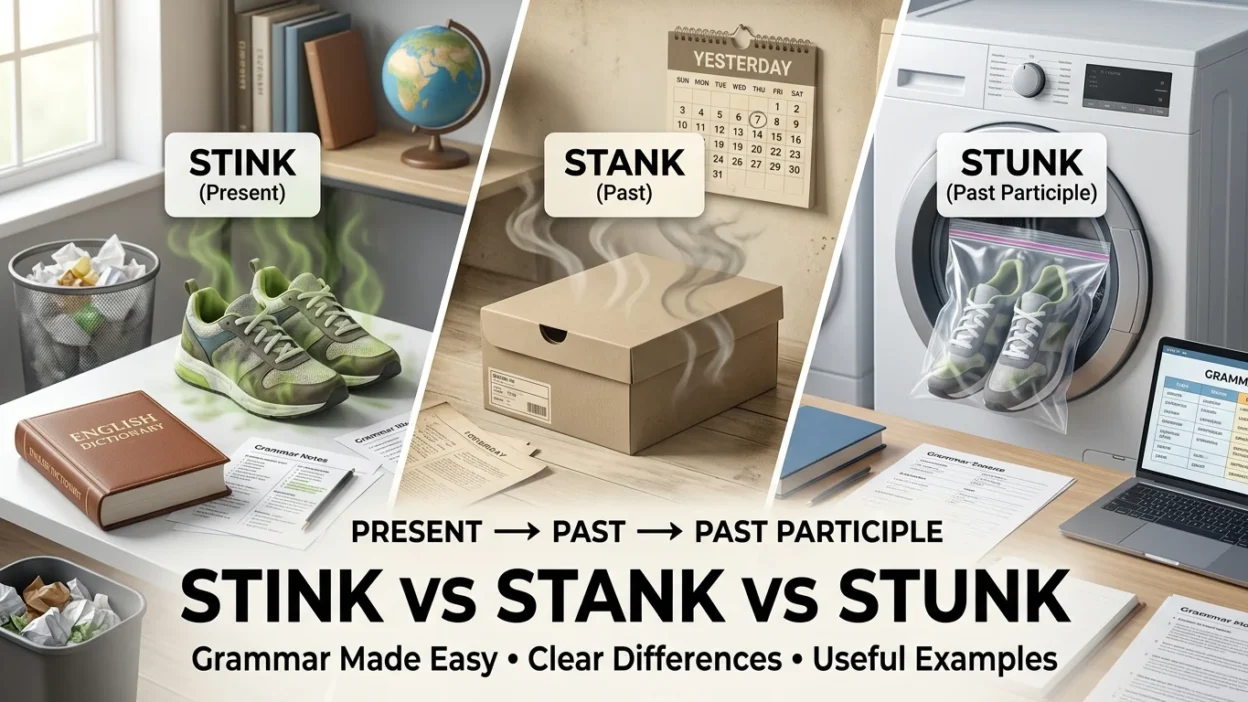
English learners often confuse stink, stank, and stunk because all three words describe a bad smell, but they do not always work in the same grammatical situations. The main difference is that stink is primarily the present form, while stank and stunk are forms used for the past and past participle of the verb.
Understanding these three forms becomes much easier when you look at how they function in real sentences. if you are writing an essay, speaking English, or simply trying to choose the correct word, knowing when to use stink vs stank vs stunk can make your English sound much more natural. This guide explains their meanings, grammar, pronunciation, examples, common mistakes, and the differences between American and British usage.
Quick Answer
Stink is the present form: “These shoes stink.” Stank is the simple past: “The shoes stank yesterday.” Stunk is the past participle, usually used with have, has, or had: “The shoes have stunk for days.” In informal English, “stink” can also be used more broadly to mean something is very unpleasant.
Why Do People Confuse Stink, Stank, and Stunk?
The confusion comes from the fact that stink is an irregular verb. Unlike regular verbs, it does not form its past tense by simply adding -ed.
For example:
- Walk → walked
- Talk → talked
- Clean → cleaned
But:
- Stink → stank → stunk
The three forms are related, but each has a different grammatical role.
There is another reason for the confusion: stank and stunk can both refer to something that smelled bad in the past, but they are used differently depending on the sentence structure.
First Word: Stink
Stink is the base form and present form of the verb.
It means to smell very bad or unpleasant.
Examples:
- These socks stink.
- The garbage stinks.
- Your shoes stink after the game.
- Something in the refrigerator stinks.
You can also use stink in other forms:
- I stink at cooking.
- That idea stinks.
- The room is starting to stink.
In these examples, stink can describe a bad smell or, informally, something that is very bad or unpleasant.
Stink as a Noun
Stink can also be a noun.
For example:
There was a terrible stink coming from the basement.
Here, stink means a strong, unpleasant smell.
Second Word: Stank
Stank is the simple past form of stink.
Use stank when something smelled bad at a particular time in the past.
Examples:
- The garbage stank yesterday.
- His wet shoes stank after the hike.
- The kitchen stank after the food burned.
- The old refrigerator stank terribly.
The important point is that stank can stand alone as the past-tense verb.
For example:
The fish stank.
This sentence is grammatically complete.
You do not normally say:
The fish stunk yesterday.
if you are simply trying to form the simple past. In standard usage, stank is the traditional simple past form.
Comparison Table
| Word | Grammatical Form | Main Use | Example |
|---|---|---|---|
| stink | Base/present form | Present or after certain helping verbs | These shoes stink. |
| stank | Simple past | Something smelled bad in the past | The shoes stank yesterday. |
| stunk | Past participle | Usually with have, has, or had | The shoes have stunk for days. |
A simple way to remember the pattern is:
Stink → Stank → Stunk
Just as:
Sing → Sang → Sung
and:
Drink → Drank → Drunk
When Should You Use Stink, Stank, and Stunk?
Use “Stink” for the Present
Use stink when describing something that smells bad now.
My gym bag stinks.
These shoes stink.
The kitchen stinks.
You may also use it after to:
I don’t want to stink up the room.
Use “Stank” for the Simple Past
Use stank when describing an unpleasant smell that happened in the past.
The bathroom stank this morning.
The trash stank after three days in the sun.
His clothes stank after the camping trip.
Use “Stunk” with Perfect Tenses
Use stunk as the past participle, commonly after have, has, or had.
The garbage has stunk for two days.
The room had stunk before we opened the windows.
Those shoes have stunk ever since the rain.
The pattern is:
have/has/had + stunk
10+ Examples of Stink, Stank, and Stunk
Here are practical examples that show the difference clearly.
- The trash stinks.
The trash smells bad now. - The trash stank yesterday.
The bad smell happened in the past. - The trash has stunk all week.
The smell started earlier and continues or is relevant now. - His socks stink.
His socks smell bad now. - His socks stank after the football match.
The smell occurred after the match. - His socks have stunk up the whole room.
The unpleasant smell has affected the room. - The refrigerator stinks.
It smells bad now. - The refrigerator stank when we opened it.
It smelled bad at that past moment. - That old refrigerator had stunk for months.
The bad smell existed for a period before another past event. - The drain stinks after it rains.
This describes a repeated or general situation. - The drain stank last night.
This refers to a specific past event. - The drain has stunk since Monday.
This connects the past with the present. - The kitchen stinks because something is burning.
- The kitchen stank after dinner last night.
- The kitchen had stunk before we discovered the spoiled food.
Common Mistakes
Mistake 1: Using “Stunk” as the Simple Past
A common learner mistake is:
The garbage stunk yesterday.
For standard formal English, use:
The garbage stank yesterday.
Use stunk as a past participle:
The garbage has stunk all week.
Mistake 2: Using “Stank” After “Have”
Another common error is:
The shoes have stank for days.
The correct form is:
The shoes have stunk for days.
Remember:
have/has/had + stunk
Mistake 3: Treating “Stink” Like a Regular Verb
Avoid forms such as:
The garbage stinked yesterday.
The standard irregular forms are:
The garbage stank yesterday.
The garbage has stunk for days.
Mistake 4: Forgetting Subject-Verb Agreement
With a singular third-person subject in the present tense, use stinks:
The room stinks.
With plural subjects, use stink:
The rooms stink.
Memory Trick: Stink, Stank, Stunk
A simple memory trick is to compare stink with another familiar irregular verb:
Sing → Sang → Sung
Stink → Stank → Stunk
Think:
- Stink = now
- Stank = past
- Stunk = has/have/had
For example:
It stinks now.
It stank yesterday.
It has stunk for a week.
This three-step pattern is one of the easiest ways to remember the difference.
American vs British English
The basic forms stink, stank, and stunk are understood in both American and British English.
However, informal usage can vary. In everyday speech, speakers sometimes use stunk in ways that traditional grammar would reserve for the past participle. You may therefore encounter sentences that differ from the standard pattern taught in English classes.
For formal writing and careful English, the safest pattern is:
- stink → present
- stank → simple past
- stunk → past participle
This pattern is widely understood and is appropriate for students, academic writing, and professional communication.
Similar Words to Stink, Stank, and Stunk
Several words have meanings related to unpleasant smells.
Smell
Smell is neutral. Something can smell good, bad, or unusual.
The flowers smell wonderful.
The kitchen smells strange.
Reek
Reek means to smell extremely bad or strongly of something.
The garbage reeked.
Odor
Odor is a noun meaning a smell. It is often used for an unpleasant smell.
There was a strange odor in the room.
Stench
Stench refers to a very strong and unpleasant smell.
A terrible stench came from the drain.
Whiff
A whiff is a brief smell that you notice.
I caught a whiff of smoke.
Final Verdict: Stink vs Stank vs Stunk
The easiest way to distinguish the three is to focus on time and grammar.
Stink is the present/base form:
The shoes stink.
Stank is the simple past:
The shoes stank yesterday.
Stunk is the past participle:
The shoes have stunk for days.
So, when choosing between stink vs stank vs stunk, remember the basic sequence:
Stink → Stank → Stunk
Frequently Asked Questions
Is “stank” the past tense of stink?
Yes. Stank is the standard simple past form of stink.
The garbage stank yesterday.
Is “stunk” the past tense of stink?
Stunk is traditionally the past participle, not the simple past.
The garbage has stunk all week.
Which is correct: “stank” or “stunk”?
Both are correct, but they have different grammatical functions. Use stank for the simple past and stunk as the past participle.
Is it “it stinks” or “it stinks”?
The correct form is “it stinks.”
Because it is singular, the present-tense verb takes -s.
Can you say “I stunk”?
Yes. Stunk can be correct when it is used as the past participle with an appropriate helping verb, but in ordinary simple past statements, “I stank” is the standard form.
For example:
I stank after the workout.
I have stunk up the room.
What is the past participle of stink?
The past participle is stunk.
The garbage has stunk for days.
What is the difference between “stank” and “stunk”?
Stank is the simple past, while stunk is the past participle.
The room stank last night.
The room has stunk all week.
Remember This
Stink = present/base form
Stank = simple past
Stunk = past participle
The easiest pattern is:
Today: It stinks.
Yesterday: It stank.
Since Monday: It has stunk.
If you remember those three examples, you can usually choose the correct form without hesitation.
Conclusion
The difference between stink, stank, and stunk is mainly grammatical. Stink is the base and present form, stank is the simple past form, and stunk is the past participle. Although informal speech may sometimes blur these distinctions, the standard pattern is clear and useful for learners.
Whenever you are unsure, look at the helping verb and the time of the action. If you are talking about something that smells bad now, use stink/stinks. If it happened in the past, use stank. If you have have, has, or had, use stunk.