When learning English grammar, restrictive and nonrestrictive clauses can be confusing because both types add information about a noun. The biggest difference is whether that information is essential to identify the noun. A restrictive clause gives necessary information, while a nonrestrictive clause gives extra information that can be removed without changing the basic identity of the noun.
Understanding this distinction also helps you use commas correctly. Restrictive clauses generally do not use commas, whereas nonrestrictive clauses are set off with commas. This guide explains the difference in simple English, shows how each type works, and provides practical examples for students, ESL learners, writers, and anyone who wants to improve their grammar.
Quick Answer
A restrictive clause gives essential information needed to identify a noun, so it is not separated by commas. A nonrestrictive clause gives additional information that is not essential, so it is separated by commas. Restrictive clauses commonly use that, while nonrestrictive clauses commonly use which or who.
Why Do People Confuse Restrictive and Nonrestrictive Clauses?
The confusion happens because both clauses usually begin with words such as who, which, or that and both describe nouns.
For example:
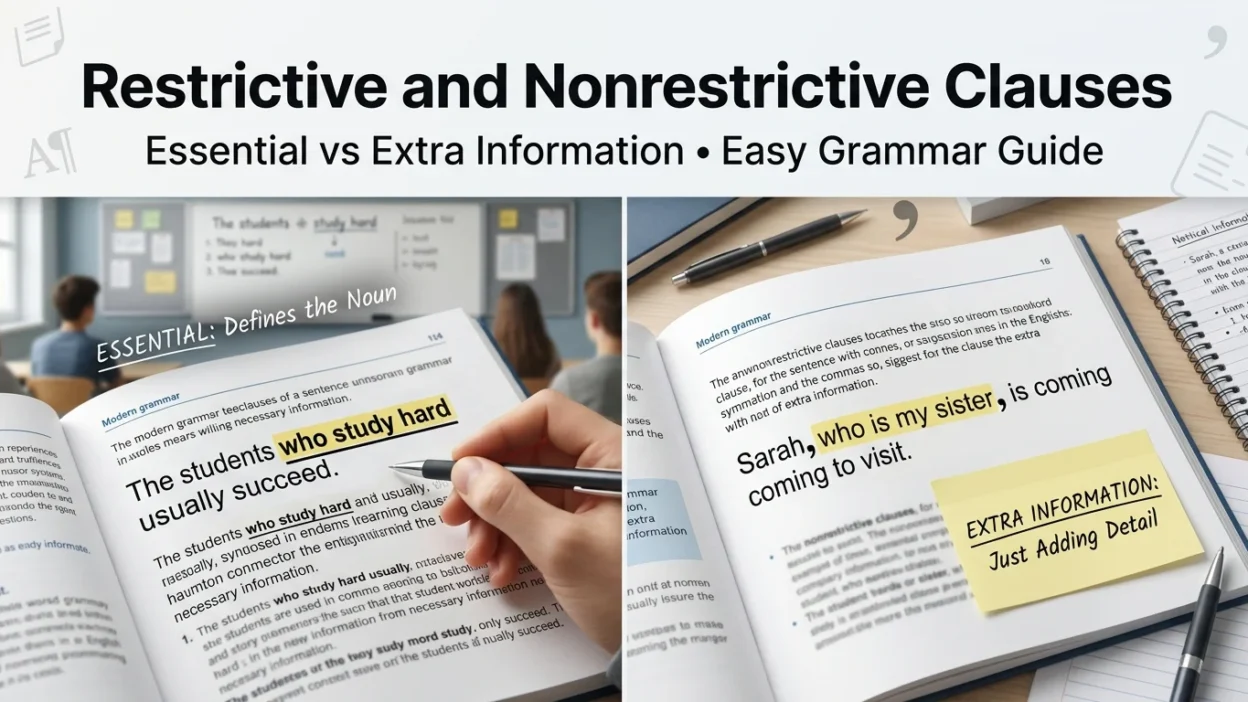
- The students who studied passed the test.
- The students, who studied, passed the test.
The words are almost identical, but the commas change the meaning.
In the first sentence, only the students who studied passed. The clause identifies which students we mean.
In the second sentence, all the students studied, and the clause simply adds extra information.
So, the key question is:
Is the information necessary to identify the noun?
If yes, use a restrictive clause. If no, use a nonrestrictive clause.
What Is the First Word: “Restrictive”?
Restrictive means limiting or narrowing something.
In grammar, a restrictive clause limits the meaning of a noun by telling us exactly which person, thing, or group we are talking about.
For example:
The book that I bought yesterday is excellent.
The clause that I bought yesterday tells us which book. If there are several books, this information helps identify the particular book.
A restrictive clause is therefore also called an essential clause.
Examples of Restrictive Clauses
- The car that has a red roof belongs to Sarah.
- People who exercise regularly may feel more energetic.
- The restaurant that opened last week is already popular.
- The students who arrived early found good seats.
Notice that there are no commas around the clauses.
What Is the Second Word: “Nonrestrictive”?
Nonrestrictive means not limiting or restricting the meaning.
A nonrestrictive clause provides additional information about a noun, but the noun is already clearly identified without the clause.
For example:
My brother, who lives in London, is visiting us.
The phrase who lives in London gives extra information. We already know which brother the speaker means.
A nonrestrictive clause is also called a nonessential clause.
Examples of Nonrestrictive Clauses
- My car, which I bought last year, is very reliable.
- Maria, who is my best friend, lives nearby.
- London, which is the capital of England, attracts millions of visitors.
- The dog, which was sleeping outside, suddenly barked.
The commas show that the information is additional rather than necessary.
Restrictive vs Nonrestrictive Clauses: Comparison Table
| Feature | Restrictive Clause | Nonrestrictive Clause |
|---|---|---|
| Meaning | Essential information | Extra information |
| Purpose | Identifies or limits the noun | Adds information about an already identified noun |
| Commas | Usually no commas | Commas are required |
| Common relative words | that, who, which | who, which |
| Can the clause be removed? | Removing it may change the meaning | Usually yes |
| Example | The books that are new are expensive. | The books, which are new, are expensive. |
When Should You Use Each?
Use a Restrictive Clause When the Information Is Essential
Use a restrictive clause when the reader needs the information to know exactly which noun you mean.
The employees who work remotely attend the online meeting.
This could mean that only the employees who work remotely attend the meeting.
Another example:
I want the dress that is hanging by the window.
The clause tells us which dress.
Use a Nonrestrictive Clause When the Information Is Extra
Use a nonrestrictive clause when the noun is already clearly identified.
My sister, who works as a teacher, is coming tonight.
The identity of my sister is already clear. Her occupation is additional information.
Another example:
Paris, which is famous for its museums, attracts many visitors.
We already know which city Paris is. The clause simply gives us additional information.
10+ Examples of Restrictive and Nonrestrictive Clauses
1. Students
Restrictive:
Students who complete the assignment can leave early.
Only students who complete it can leave early.
Nonrestrictive:
The students, who completed the assignment, can leave early.
The sentence presents the students as a known group and adds information about them.
2. Books
Restrictive:
The books that are on the table belong to me.
The clause identifies which books.
Nonrestrictive:
These books, which are on the table, belong to me.
The books are already identified as these books.
3. Cars
Restrictive:
Cars that use less fuel can save money.
The clause limits the type of cars being discussed.
Nonrestrictive:
My car, which uses very little fuel, saves me money.
The car is already identified as my car.
4. Teachers
Restrictive:
Teachers who encourage questions often create active classrooms.
The clause identifies a particular group of teachers.
Nonrestrictive:
Mr. Khan, who encourages questions, creates an active classroom.
We already know who Mr. Khan is.
5. Restaurants
Restrictive:
The restaurant that serves vegetarian food is nearby.
The clause identifies which restaurant.
Nonrestrictive:
The restaurant near my house, which serves vegetarian food, is popular.
The restaurant is already identified.
6. Dogs
Restrictive:
Dogs that are trained properly can follow commands.
The clause specifies which dogs.
Nonrestrictive:
My dog, which is well trained, follows commands easily.
The phrase gives extra information about an already identified dog.
7. Cities
Restrictive:
Cities that have good public transportation can be easier to explore.
The clause limits the cities being discussed.
Nonrestrictive:
Islamabad, which has many green spaces, is an important city in Pakistan.
The city is already specifically named.
8. Employees
Restrictive:
Employees who arrive before 8 a.m. can use the parking area.
The clause identifies which employees.
Nonrestrictive:
Ahmed, who arrives before 8 a.m., usually gets a parking space.
Ahmed is already identified.
9. Computers
Restrictive:
Computers that have large amounts of memory can handle certain tasks more easily.
The clause identifies a particular type of computer.
Nonrestrictive:
My computer, which has 16 GB of memory, works well for my needs.
The computer is already identified.
10. Movies
Restrictive:
Movies that have strong characters can be memorable.
The clause describes the particular movies under discussion.
Nonrestrictive:
That movie, which won several awards, was released last year.
The movie is already identified.
11. People
Restrictive:
People who speak two languages are often described as bilingual.
The clause identifies a particular group.
Nonrestrictive:
My cousin, who speaks two languages, works as a translator.
The cousin is already identified.
12. Phones
Restrictive:
Phones that support wireless charging can be convenient.
The clause specifies which phones.
Nonrestrictive:
My phone, which supports wireless charging, is very convenient.
The clause adds extra information.
Common Mistakes
Mistake 1: Adding Commas to Every Relative Clause
Incorrect:
The students, who studied hard, passed the exam.
If the intended meaning is that only the students who studied hard passed, the commas should not be used.
Correct:
The students who studied hard passed the exam.
Mistake 2: Removing Commas From a Nonrestrictive Clause
Incorrect:
My mother who is a doctor lives nearby.
If you mean that your mother is already clearly identified and her profession is additional information, commas are needed.
Correct:
My mother, who is a doctor, lives nearby.
Mistake 3: Using “That” in a Nonrestrictive Clause
In standard formal English, that is generally not used to introduce a nonrestrictive relative clause.
Less appropriate:
My car, that I bought last year, is reliable.
Better:
My car, which I bought last year, is reliable.
Mistake 4: Forgetting That Meaning Can Change
Compare:
The employees who work at night receive an allowance.
This identifies a particular group of employees.
The employees, who work at night, receive an allowance.
This suggests that the employees being discussed all work at night.
The commas are not merely punctuation. They can change the intended meaning.
A Simple Memory Trick
Remember:
Restrictive = Required
If the information is required to identify the noun, don’t use commas.
The students who passed the test celebrated.
Nonrestrictive = Not required
If the information is not required, use commas.
Sarah, who passed the test, celebrated.
A useful shortcut is:
Essential = no commas. Extra = commas.
American vs British English
The basic distinction between restrictive and nonrestrictive clauses is used in both American English and British English.
Both varieties generally use commas to set off nonrestrictive information and avoid commas when the relative clause is restrictive.
One noticeable difference is that British English can use “which” in some restrictive clauses, especially in formal writing:
The book which I bought yesterday is excellent.
American English commonly prefers that for many restrictive clauses:
The book that I bought yesterday is excellent.
However, which is also possible in American English in certain restrictive constructions, particularly in formal or carefully edited writing.
The important point is to focus on the meaning and comma usage, rather than assuming that American and British English always follow completely different rules.
Similar Words and Related Grammar Terms
Several grammar terms are closely connected to restrictive and nonrestrictive clauses.
Relative Clause
A relative clause is a clause that describes or gives information about a noun.
The woman who called you is here.
Restrictive and nonrestrictive clauses are both types of relative clauses.
Essential Clause
An essential clause is another name for a restrictive clause.
The students who arrived late missed the introduction.
Nonessential Clause
A nonessential clause is another name for a nonrestrictive clause.
John, who arrived late, missed the introduction.
Relative Pronoun
Words such as who, whom, whose, which, and that can introduce relative clauses.
For example:
- The person who called me
- The book that I bought
- The car which she drives
- The student whose essay won
Final Verdict
The most important distinction is simple: restrictive clauses identify or limit a noun, while nonrestrictive clauses provide additional information about a noun that is already identified.
The punctuation rule follows this difference. Restrictive clauses normally have no commas, while nonrestrictive clauses are separated by commas. When deciding which type to use, ask whether removing the clause would make it unclear which person or thing you mean.
Frequently Asked Questions
What is a restrictive clause?
A restrictive clause gives essential information that identifies or limits the noun it describes. It is normally not separated from the rest of the sentence with commas.
The students who studied passed the exam.
What is a nonrestrictive clause?
A nonrestrictive clause gives extra information about a noun that is already clearly identified. It is set off with commas.
Maria, who studied hard, passed the exam.
Do restrictive clauses use commas?
Normally, no. Restrictive clauses are not separated by commas because their information is essential to the meaning.
The car that is parked outside is mine.
Do nonrestrictive clauses use commas?
Yes. Nonrestrictive clauses are normally enclosed by commas.
My car, which is parked outside, is mine.
Can “that” introduce a nonrestrictive clause?
Generally, no. In standard English, that is normally used for restrictive relative clauses, not nonrestrictive ones.
What is the easiest way to identify a restrictive clause?
Remove the clause and see whether you lose information needed to identify the noun. If the noun becomes unclear or the meaning changes significantly, the clause is likely restrictive.
What is the difference between “who” and “which”?
Who generally refers to people, while which generally refers to things or animals. The choice also depends on the type of relative clause and the intended meaning.
Remember This
- Restrictive = essential information
- Nonrestrictive = extra information
- Restrictive clauses usually have no commas
- Nonrestrictive clauses use commas
- That commonly introduces restrictive clauses
- Who and which can introduce nonrestrictive clauses
- Punctuation can change the meaning of a sentence
Conclusion
Restrictive and nonrestrictive clauses are easier to understand when you focus on one question: Does the clause identify the noun, or does it simply add information? If it identifies the noun, it is restrictive and normally needs no commas. If it adds extra information, it is nonrestrictive and should be set off with commas.
Once you connect meaning with punctuation, the distinction becomes much clearer. Practice comparing pairs of sentences, especially those where adding or removing commas changes the intended meaning. With regular practice, choosing between restrictive and nonrestrictive clauses will become much more natural.