
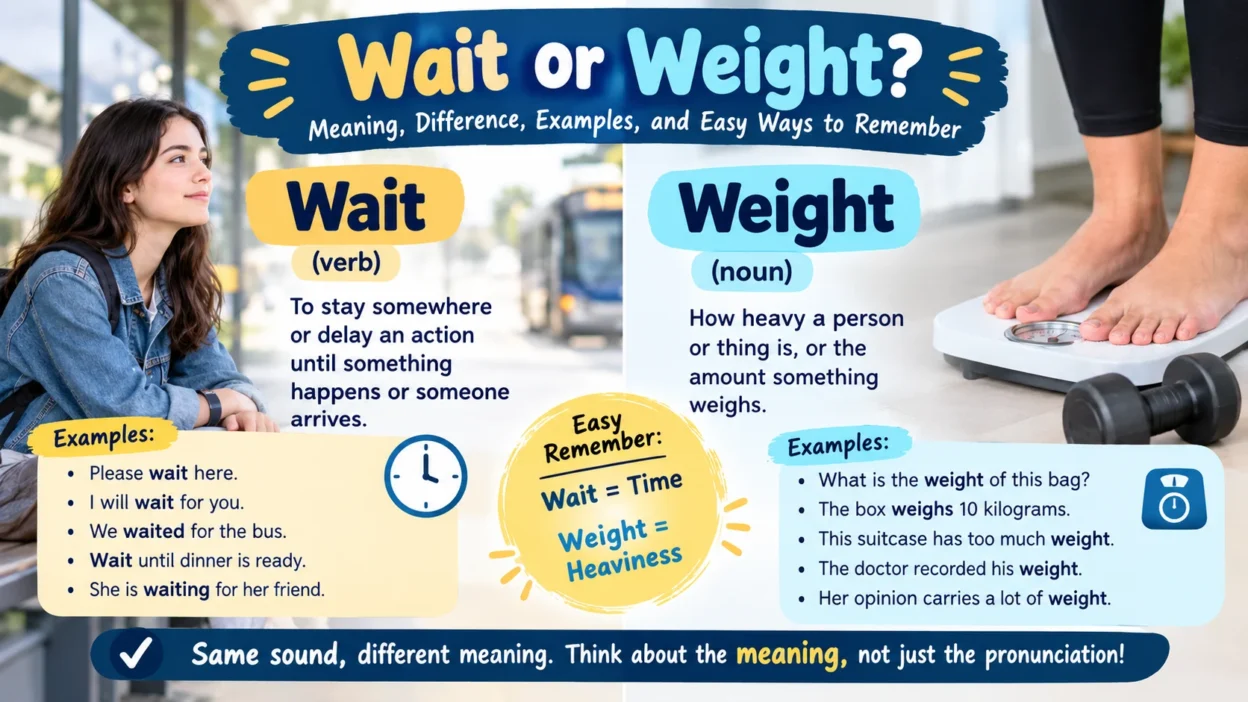
The words wait and weight sound exactly the same, but they have completely different meanings and uses. This makes them easy to confuse, especially for English learners, students, and anyone who is still building confidence with homophones. Wait is usually a verb related to staying somewhere or delaying an action, while weight is a noun that describes how heavy a person or thing is.
Understanding the difference between wait or weight is important because using the wrong spelling can change the meaning of a sentence. For example, “Please wait here” asks someone to stay, while “The weight of the box is 10 kilograms” talks about heaviness. Although the pronunciation is the same, their grammar, meanings, and contexts are different. This guide explains both words with simple definitions, examples, common mistakes, and memory tricks.
Quick Answer: Wait or Weight?
Wait means to stay somewhere until something happens or someone arrives. Weight means how heavy a person or object is. They are pronounced the same but have different spellings, meanings, and grammatical uses. Remember: wait = time, while weight = heaviness.
Why Do People Confuse Wait and Weight?
People confuse wait and weight because they are homophones. Homophones are words that sound the same but have different spellings and meanings.
For example:
- Please wait for me. → Stay until I arrive.
- What is the weight of this bag? → How heavy is the bag?
The pronunciation does not help you distinguish these words when speaking. You need to use the meaning and context to choose the correct spelling when writing.
Another reason for the confusion is that weight contains the letters -eigh-, which can be difficult for English learners. Similar spelling patterns appear in words such as eight, neighbor, and freight.
First Word: Wait
Wait is mainly a verb. It means to stay in one place or delay doing something until a particular time, event, or person arrives.
Common meanings of wait
You can use wait when:
- You stay until someone arrives.
- You stay until something happens.
- You delay an action.
- You expect something to happen.
- You remain in a place for a period of time.
Examples with wait
- Please wait outside.
- I will wait for you.
- We waited for the bus.
- Wait until dinner is ready.
- She is waiting for her friend.
Wait can also be used as an interjection to tell someone to stop briefly.
Wait! I forgot my phone.
Second Word: Weight
Weight is mainly a noun. It refers to how heavy someone or something is.
Common meanings of weight
You can use weight when talking about:
- How heavy an object is
- A person’s body mass in everyday language
- The heaviness of luggage
- The amount something weighs
- Importance or influence in a figurative sense
Examples with weight
- The weight of the box is 15 kilograms.
- This suitcase has too much weight.
- The doctor recorded his weight.
- The bridge cannot support the weight of the truck.
- Her opinion carries a lot of weight.
In the expression carry weight, the word has a figurative meaning: something has influence or importance.
Wait vs Weight: Comparison Table
| Word | Part of Speech | Meaning | Example |
|---|---|---|---|
| wait | Verb | Stay or delay until something happens | Please wait here. |
| wait | Interjection | Ask someone to stop briefly | Wait! Come back. |
| weight | Noun | How heavy something or someone is | What is the weight of the bag? |
| weight | Noun | Importance or influence | His words carry weight. |
The easiest distinction is:
Wait = time or delay
Weight = heaviness
When Should You Use Wait or Weight?
Use wait when the sentence is about time, staying, or delaying.
- Wait for me.
- Wait until tomorrow.
- I am waiting for the train.
- They waited outside.
Use weight when the sentence is about how heavy something is or about influence.
- The weight of the package is 5 kg.
- I need to check the weight of my luggage.
- The weight of the evidence was significant.
A useful question can help:
Is the sentence about time or staying? → Use wait.
Is it about heaviness or influence? → Use weight.
10+ Examples of Wait and Weight
Examples with Wait
- Please wait for me at the entrance.
- I had to wait for an hour.
- She is waiting for the doctor.
- We waited until the rain stopped.
- Wait here while I get the tickets.
- He waited patiently for his turn.
- They are waiting for the results.
- I cannot wait any longer.
- Please wait until I finish speaking.
- We waited outside the restaurant.
- Wait a moment, please.
- The children are waiting for the school bus.
Examples with Weight
- What is the weight of this package?
- The weight of the box is 20 kilograms.
- Please check the weight of your luggage.
- The bridge can handle the weight of the vehicles.
- The baby gained weight quickly.
- The doctor measured her weight.
- This bag is light in weight.
- The weight of the snow damaged the roof.
- His words carry considerable weight.
- The weight of the evidence changed the decision.
- The machine has a weight of 50 kilograms.
- The athlete is training to manage his weight.
Common Mistakes with Wait and Weight
Mistake 1: Using weight when you mean delay
❌ Please weight for me.
✅ Please wait for me.
The sentence is about staying until someone arrives, so wait is correct.
Mistake 2: Using wait when you mean heaviness
❌ What is the wait of this box?
✅ What is the weight of this box?
You are asking how heavy the box is, so weight is correct.
Mistake 3: Confusing “wait for” with “weight”
The phrase wait for means to remain until someone or something arrives or happens.
- I am waiting for my friend.
- She waited for the bus.
It has nothing to do with physical heaviness.
Mistake 4: Forgetting that weight is a noun
Usually, weight names a measurement or quality.
- The weight is 10 kilograms.
- I checked the weight.
The related verb is weigh:
- The box weighs 10 kilograms.
Notice the difference:
weight = noun
weigh = verb
Memory Trick: Wait or Weight?
Try this simple memory trick:
WAIT has to do with TIME.
WEIGHT has to do with HEAVINESS.
You can also remember the “I” in wait as standing for an imaginary person saying:
“I’ll wait.”
For weight, think of a scale measuring how heavy something is.
Another useful connection is:
- wait → waiting
- weight → weigh
If you are talking about a scale, kilograms, pounds, or heaviness, think weight.
If you are talking about staying, delaying, or expecting something, think wait.
American vs British English
There is essentially no difference in the meaning or spelling of wait and weight between American and British English.
Both varieties use:
- wait for staying or delaying
- weight for heaviness or influence
The two words are also pronounced the same in standard American and British English, although accents can affect their exact pronunciation.
For example:
American English:
- Please wait here.
- What is the weight of this box?
British English:
- Please wait here.
- What is the weight of this box?
The spelling and basic meanings remain the same.
Similar Words: Wait, Weight, Weigh, Waiting
These words are related in sound but should not be treated as interchangeable.
Wait
A verb meaning to stay or delay.
- I will wait here.
Weight
A noun meaning heaviness.
- The weight is 10 kg.
Weigh
A verb meaning to measure how heavy something is.
- The package weighs 10 kg.
Waiting
The -ing form of wait.
- She is waiting outside.
A helpful group to remember is:
wait → waiting
weigh → weight
Although weigh and weight are closely related in meaning, wait is completely different.
Final Verdict: Wait or Weight?
The correct word depends on what you mean.
Use wait when you are talking about staying, delaying, or expecting something:
Please wait for me.
Use weight when you are talking about how heavy someone or something is, or about influence:
What is the weight of the package?
Because they sound the same, pronunciation cannot tell you which spelling to use. Think about the meaning of the sentence first.
Frequently Asked Questions
Is it wait or weight?
Both words are correct, but they have different meanings. Wait means to stay or delay, while weight means heaviness or the amount something weighs.
What is the difference between wait and weight?
Wait is generally a verb connected with time or staying. Weight is a noun connected with heaviness. For example, “Wait for me” and “The weight is 10 kg.”
Are wait and weight homophones?
Yes. Wait and weight are homophones because they have the same pronunciation but different spellings and meanings.
Is “wait for me” correct?
Yes. Wait for me is the correct expression when you want someone to stay until you arrive or are ready.
Is “what is the weight?” correct?
Yes. What is the weight? is correct when asking how heavy something or someone is, although you may need to specify the object for clarity.
What is the difference between weight and weigh?
Weight is usually a noun referring to heaviness, while weigh is a verb meaning to measure or have a particular heaviness. For example, “The weight is 5 kg” and “The box weighs 5 kg.”
What is the easiest way to remember wait and weight?
Remember: wait = time, and weight = heaviness. If you can connect the sentence with staying or delaying, use wait. If it concerns kilograms, pounds, scales, or heaviness, use weight.
Remember This
- Wait = stay or delay.
- Weight = heaviness.
- Wait is usually a verb.
- Weight is usually a noun.
- They sound the same but are spelled differently.
- Wait for me is correct.
- The weight of the box is correct.
- Weigh is the verb related to weight.
The fastest memory rule is:
WAIT = TIME
WEIGHT = HEAVINESS
Conclusion
Wait or weight is a common English confusion because these two words sound alike. However, their meanings are completely different. Use wait when someone needs to stay, delay, or expect something to happen. Use weight when discussing heaviness, measurements, or influence.
Once you connect wait with time and weight with heaviness, the difference becomes much easier to remember. When writing, always consider the meaning of the sentence rather than relying on pronunciation.