Choosing between wasn’t and weren’t can be confusing for English learners because both words express a negative meaning in the past. Although they look similar and often appear in the same types of sentences, they follow different subject–verb agreement rules. Understanding these rules will help you speak and write English more accurately.
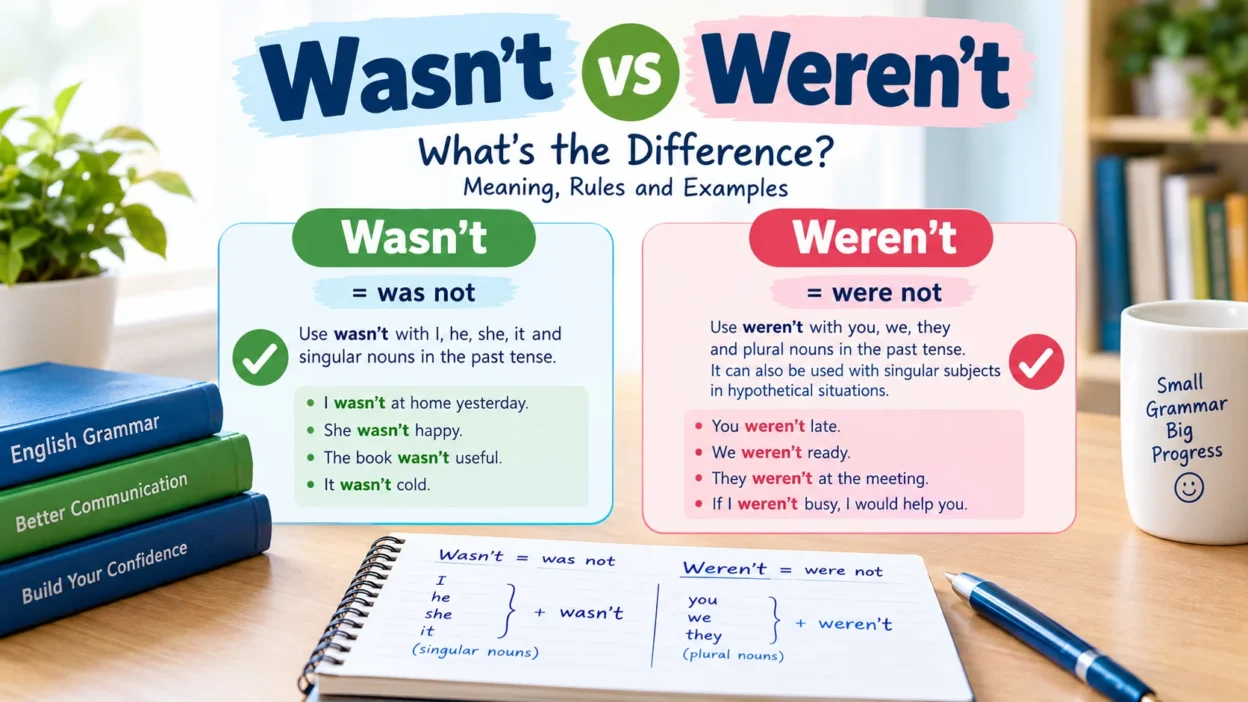
The main difference is that wasn’t is the contraction of was not, while weren’t is the contraction of were not. We generally use wasn’t with singular subjects such as I, he, she, and it, and weren’t with you, we, and they. However, there is an important exception: weren’t can also be used with singular subjects in hypothetical or unreal situations, as in “If I weren’t so busy, I would help you.” Learning when to use each form will make everyday conversations, academic writing, and grammar exercises easier.
Quick Answer: Wasn’t vs Weren’t
Wasn’t means was not and is generally used with I, he, she, and it, as well as singular nouns. Weren’t means were not and is generally used with you, we, and they, as well as plural nouns. In hypothetical situations, weren’t can also follow singular subjects, as in “If I weren’t tired, I would go out.”
Why Do People Confuse Wasn’t and Weren’t?
People often confuse these words because both are negative forms of the verb to be in the past tense. They express similar meanings, but the subject determines which form is normally correct.
Consider these examples:
- She wasn’t at school yesterday.
- They weren’t at school yesterday.
Both sentences describe a situation that was not true in the past. The difference is the subject: she is singular, while they is plural.
Another reason for confusion is that English has special grammatical rules for hypothetical situations. For example, “If I weren’t afraid, I would try it” is correct in standard English because it describes an unreal or imagined condition.
What Does Wasn’t Mean?
Wasn’t is the contraction of was not. It is used to describe a negative state, condition, location, or situation in the past.
In ordinary past-tense statements, use wasn’t with I, he, she, and it, as well as singular nouns.
Examples:
- I wasn’t hungry this morning.
- He wasn’t ready for the exam.
- She wasn’t at home last night.
- It wasn’t cold yesterday.
- The restaurant wasn’t open.
When Should You Use Wasn’t?
Use wasn’t when you want to say that something was not true or did not describe a person or thing in the past.
For example:
- “The movie wasn’t interesting.” This means the movie was not interesting.
- “My brother wasn’t available.” This means my brother was not available.
- “I wasn’t worried.” This means I was not worried.
Remember that wasn’t is used with the verb to be. It does not replace didn’t when the sentence contains an ordinary action verb.
Correct: She wasn’t happy.
Correct: She didn’t laugh.
Incorrect: She wasn’t laugh.
What Does Weren’t Mean?
Weren’t is the contraction of were not. It is used to express a negative state, condition, location, or situation in the past.
In ordinary past-tense statements, use weren’t with you, we, and they, as well as plural nouns.
Examples:
- You weren’t late.
- We weren’t ready for dinner.
- They weren’t at the meeting.
- The children weren’t tired.
- My friends weren’t interested.
When Should You Use Weren’t?
Use weren’t when the subject normally takes were in the past tense.
For example:
- “You weren’t listening.” This means you were not listening.
- “We weren’t busy.” This means we were not busy.
- “The shops weren’t open.” This means the shops were not open.
You should also know that weren’t can be used with singular subjects in certain hypothetical expressions.
For example:
- “If I weren’t so tired, I would go for a walk.”
- “I wish he weren’t so impatient.”
These constructions express an unreal condition or a wish rather than an ordinary statement about the past.
Wasn’t vs Weren’t: Comparison Table
| Feature | Wasn’t | Weren’t |
|---|---|---|
| Full form | Was not | Were not |
| Main use | Negative past form with singular subjects | Negative past form with plural subjects and you |
| Common subjects | I, he, she, it | You, we, they |
| Singular nouns | The teacher wasn’t here. | Generally not used in ordinary statements |
| Plural nouns | Generally not used in ordinary statements | The students weren’t here. |
| Negative question | Wasn’t she ready? | Weren’t they ready? |
| Hypothetical use | Common in ordinary past statements | Often used with singular subjects in unreal conditions |
| Example | He wasn’t happy. | They weren’t happy. |
When to Use Wasn’t or Weren’t
The easiest way to choose the correct word is to identify the subject first.
1. Use Wasn’t With I, He, She, and It
These subjects generally take was in ordinary past-tense statements.
Examples:
- I wasn’t at work yesterday.
- He wasn’t feeling well.
- She wasn’t interested in the offer.
- It wasn’t my fault.
2. Use Weren’t With You, We, and They
These subjects take were in ordinary past-tense statements.
Examples:
- You weren’t paying attention.
- We weren’t prepared for the test.
- They weren’t satisfied with the result.
Remember that you takes were, even when you are speaking to one person.
Correct: You weren’t wrong.
Incorrect: You wasn’t wrong.
3. Use Wasn’t With Singular Nouns
A singular noun refers to one person, place, object, or idea.
Examples:
- The student wasn’t present.
- My phone wasn’t working.
- The weather wasn’t pleasant.
- The answer wasn’t correct.
4. Use Weren’t With Plural Nouns
Plural nouns refer to more than one person, place, object, or idea.
Examples:
- The students weren’t present.
- My phones weren’t working.
- The answers weren’t correct.
- The buildings weren’t safe.
5. Use Weren’t in Unreal or Hypothetical Conditions
In standard English, were is traditionally used with singular subjects in many hypothetical or counterfactual expressions.
Examples:
- If I weren’t busy, I would join you.
- If she weren’t afraid, she might speak up.
- I wish I weren’t so nervous.
In informal speech, you may also hear wasn’t in some hypothetical expressions, such as “If I wasn’t busy, I would join you.” The use of weren’t is generally preferred in formal writing when expressing an unreal condition.
Wasn’t vs Weren’t: 15 Example Sentences
Here are 15 practical examples to help you understand the difference.
- I wasn’t at home when you called.
- She wasn’t happy with the decision.
- He wasn’t ready for the interview.
- It wasn’t easy to solve the problem.
- The teacher wasn’t in the classroom.
- You weren’t listening to my explanation.
- We weren’t late for the appointment.
- They weren’t interested in buying the house.
- The children weren’t asleep when I arrived.
- My parents weren’t at the party.
- The food wasn’t fresh.
- The tickets weren’t expensive.
- I wish I weren’t so nervous before exams.
- If he weren’t ill, he would come with us.
- If I weren’t afraid of heights, I would climb that mountain.
Notice that the first five examples use wasn’t with singular subjects. The next seven illustrate ordinary negative statements using different subjects, while the final three show weren’t in hypothetical or wish expressions.
Common Mistakes With Wasn’t and Weren’t
Even experienced English learners sometimes make mistakes with these words. Here are some common errors and their corrections.
Mistake 1: Using Wasn’t With You
Incorrect: You wasn’t at school yesterday.
Correct: You weren’t at school yesterday.
Why? The pronoun you takes were in the past tense, if it refers to one person or several people.
Mistake 2: Using Weren’t With a Singular Subject in an Ordinary Statement
Incorrect: She weren’t ready.
Correct: She wasn’t ready.
Why? In an ordinary past-tense statement, she takes was.
Mistake 3: Confusing Wasn’t With Didn’t
Incorrect: He wasn’t go to work.
Correct: He didn’t go to work.
Why? Use wasn’t with a description or a suitable verb form, such as wasn’t happy or wasn’t working. Use didn’t with the base form of an ordinary action verb, such as didn’t go or didn’t eat.
Mistake 4: Forgetting the Hypothetical Rule
Less suitable in formal hypothetical writing: If I wasn’t rich, I would still be happy.
Preferred in formal standard English: If I weren’t rich, I would still be happy.
Why? Weren’t is traditionally used for unreal or hypothetical conditions, particularly in formal English.
Mistake 5: Choosing the Verb Before Identifying the Subject
Incorrect: The students wasn’t prepared.
Correct: The students weren’t prepared.
Why? Students is plural, so it takes were in an ordinary past-tense statement.
Memory Trick: How to Remember Wasn’t vs Weren’t
Use this simple memory trick:
- Wasn’t = was not: Think of I was, he was, she was, and it was.
- Weren’t = were not: Think of you were, we were, and they were.
- Hypothetical situations: Remember that weren’t often appears with singular subjects when imagining something unreal.
Try saying these pairs aloud:
- I was tired → I wasn’t tired.
- She was busy → She wasn’t busy.
- We were tired → We weren’t tired.
- They were busy → They weren’t busy.
A useful rule is to choose the affirmative form first. If you would say was, use wasn’t for the ordinary negative form. If you would say were, use weren’t.
Wasn’t vs Weren’t in American and British English
The basic rules for wasn’t and weren’t are the same in standard American and British English. Both varieties use wasn’t and weren’t according to subject–verb agreement in ordinary past-tense statements.
Examples in both varieties:
- She wasn’t at school.
- They weren’t at school.
- You weren’t invited.
The main difference worth knowing concerns hypothetical expressions. In both American and British English, weren’t is a traditional choice for unreal conditions, as in “If I weren’t you, I would apologize.” Informal speakers may use wasn’t in similar expressions, but weren’t is a reliable choice for formal writing.
Neither spelling is exclusively American or British. Both forms are standard in both varieties.
Similar Words and Related Grammar Rules
Understanding wasn’t and weren’t becomes easier when you compare them with other negative forms.
Wasn’t vs Was Not
These forms have the same basic meaning.
- Contracted: She wasn’t ready.
- Full form: She was not ready.
The contraction is common in conversation and informal writing. The full form may be preferred for emphasis or in more formal contexts.
Weren’t vs Were Not
These forms also have the same basic meaning.
- Contracted: They weren’t available.
- Full form: They were not available.
Use either form according to the tone and context of your writing.
Wasn’t vs Didn’t
Wasn’t negates the verb be, while didn’t usually negates an ordinary action verb.
- She wasn’t tired.
- She didn’t sleep.
The first sentence describes a state. The second says that an action did not happen.
Wasn’t vs Isn’t
Wasn’t refers to the past, while isn’t refers to the present with singular subjects such as he, she, and it.
- He wasn’t busy yesterday.
- He isn’t busy today.
Weren’t vs Aren’t
Weren’t is a past-tense negative form, while aren’t is a present-tense negative form used with you, we, and they.
- They weren’t ready yesterday.
- They aren’t ready today.
Final Verdict: Which One Is Correct?
Both wasn’t and weren’t are correct English words, but they are used in different grammatical situations.
Use wasn’t with I, he, she, and it, and with singular nouns in ordinary past-tense statements. Use weren’t with you, we, and they, and with plural nouns. For unreal or hypothetical conditions, weren’t can also be used with singular subjects.
The key is to identify the subject and determine if the sentence describes an ordinary past situation or an imagined condition.
Frequently Asked Questions
1. Is it wasn’t or weren’t?
Both are correct. Use wasn’t with singular subjects such as he, she, and it in ordinary past-tense statements. Use weren’t with you, we, and they, as well as plural nouns.
2. Do you say “I wasn’t” or “I weren’t”?
Usually, you say “I wasn’t.” For example, “I wasn’t at home yesterday.” However, I weren’t can appear in certain dialects, and I weren’t is also used in standard English in hypothetical expressions such as “If I weren’t so busy, I would help.”
3. Is “you wasn’t” grammatically correct?
In standard English, “you wasn’t” is generally incorrect. The correct form is “you weren’t” because you takes were in the past tense, if it refers to one person or more than one person.
4. Can I say “if I weren’t”?
Yes. “If I weren’t” is correct in standard English when describing an unreal or hypothetical condition. For example, “If I weren’t tired, I would go running.”
5. What is the difference between wasn’t and weren’t in the past tense?
Both are negative past-tense forms of be. Wasn’t is used with singular subjects in ordinary statements, while weren’t is used with you, we, they, and plural nouns. Weren’t is also common in hypothetical expressions.
6. Is “she weren’t” ever correct?
In standard English, use “she wasn’t” for an ordinary past-tense statement. However, she weren’t may occur in some regional dialects. In hypothetical expressions, standard English often uses weren’t, as in “I wish she weren’t so upset.”
7. Are wasn’t and weren’t contractions?
Yes. Wasn’t is the contraction of was not, and weren’t is the contraction of were not. Both are common in spoken English and informal writing.
Remember This
- I, he, she, it + wasn’t in ordinary past-tense statements.
- You, we, they + weren’t in ordinary past-tense statements.
- Singular noun + wasn’t: The book wasn’t useful.
- Plural noun + weren’t: The books weren’t useful.
- Hypothetical condition + often weren’t: If I weren’t busy, I would join you.
When in doubt, identify the subject and say the positive sentence first. If the positive form uses was, the ordinary negative form uses wasn’t. If it uses were, the ordinary negative form uses weren’t.
Conclusion
The difference between wasn’t and weren’t is mainly a matter of subject–verb agreement. Wasn’t means was not and is generally used with I, he, she, and it. Weren’t means were not and is generally used with you, we, and they, as well as plural nouns.
Remember that hypothetical expressions follow an additional rule: “If I weren’t busy” is a standard way to describe an unreal condition. With these simple guidelines and regular practice, you can choose the right form confidently in conversations, school assignments, and everyday writing.