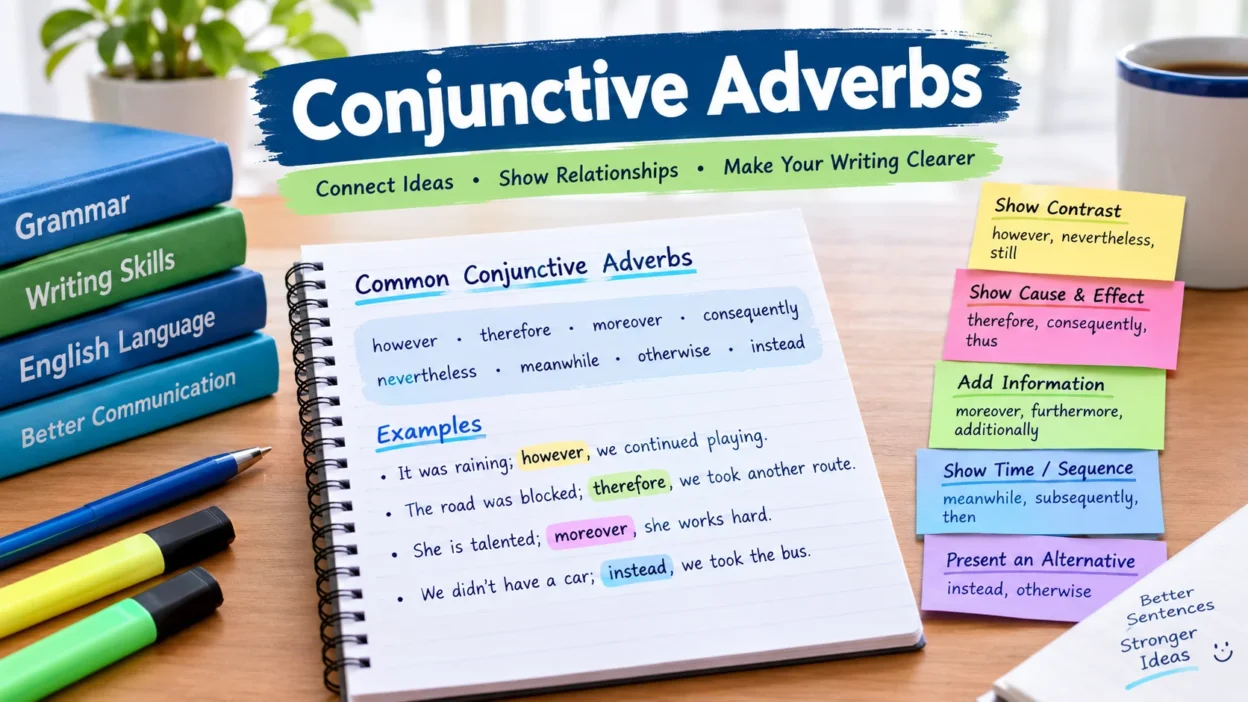
Conjunctive adverbs are words that connect ideas and show the relationship between two independent clauses. They help writers express contrast, addition, cause and effect, sequence, and other connections clearly. Common conjunctive adverbs include however, therefore, moreover, consequently, nevertheless, meanwhile, and otherwise. Learning how to use them correctly can make your English writing more organized, natural, and effective.
Many students confuse conjunctive adverbs with coordinating conjunctions because both can connect ideas. However, they follow different punctuation rules. For example, but is a coordinating conjunction, while however is a conjunctive adverb. Understanding this difference helps you avoid comma splices and other common grammar mistakes. if you are writing school assignments, emails, essays, or everyday messages, conjunctive adverbs can help you express your thoughts more precisely. In this guide, you will learn their meaning, types, punctuation rules, practical examples, and the differences between conjunctive adverbs and other connecting words.
Quick Answer
A conjunctive adverb is a word or phrase that connects ideas by showing relationships such as contrast, cause and effect, addition, or sequence. Examples include however, therefore, furthermore, and consequently. When connecting two independent clauses, place a semicolon before the conjunctive adverb and a comma after it.
Why Do People Confuse Conjunctive Adverbs?
People often confuse conjunctive adverbs with conjunctions because both help connect ideas. The main difference is how they function grammatically and how they are punctuated.
Consider these examples:
- Coordinating conjunction: I was tired, but I finished my homework.
- Conjunctive adverb: I was tired; however, I finished my homework.
Both sentences express contrast, but but is a coordinating conjunction, whereas however is a conjunctive adverb.
Another common source of confusion is punctuation. Writers sometimes use a comma alone to join two independent clauses with however or therefore. This creates a comma splice.
Incorrect: She studied hard, therefore, she passed the exam.
Correct: She studied hard; therefore, she passed the exam.
Correct: She studied hard. Therefore, she passed the exam.
Understanding these differences makes your writing grammatically correct and easier to read.
First Word: What Is a Conjunctive Adverb?
A conjunctive adverb is an adverb that connects clauses or sentences by expressing a logical relationship between their ideas. It can indicate contrast, consequence, addition, time, comparison, or another connection.
Conjunctive adverbs are sometimes called linking adverbs or transitional adverbs.
Common Examples of Conjunctive Adverbs
- Contrast: however, nevertheless, nonetheless, still
- Cause and effect: therefore, consequently, thus, accordingly
- Addition: moreover, furthermore, besides, additionally
- Time and sequence: meanwhile, subsequently, afterward, then
- Alternative or condition: otherwise, instead
- Emphasis: indeed, certainly
- Comparison: similarly, likewise
How Do Conjunctive Adverbs Work?
Conjunctive adverbs show how one idea relates to another.
Examples:
- It was raining; however, we continued playing.
- The road was blocked; therefore, we took another route.
- She is talented; moreover, she works hard.
- The store was closed; instead, we went to the market.
In each sentence, the conjunctive adverb clarifies the relationship between the two ideas.
Punctuation Rules for Conjunctive Adverbs
When a conjunctive adverb connects two independent clauses, use a semicolon before it and usually a comma after it.
Pattern: Independent clause; conjunctive adverb, independent clause.
Example: The test was difficult; nevertheless, everyone completed it.
You can also use a period to separate the clauses:
The test was difficult. Nevertheless, everyone completed it.
When a conjunctive adverb appears at the beginning of a sentence, place a comma after it.
Example: However, we decided to continue.
When it interrupts a clause, commas often set it off.
Example: The plan, therefore, needs further discussion.
Second Word: What Is an Adverb?
An adverb is a word that modifies a verb, an adjective, another adverb, or sometimes an entire sentence. Adverbs can explain how, when, where, how often, or to what extent something happens.
Examples:
- She speaks clearly.
- We arrived early.
- The weather is extremely cold.
- Fortunately, nobody was injured.
A conjunctive adverb is a particular type of adverb that also signals a relationship between ideas.
Examples of Ordinary Adverbs and Conjunctive Adverbs
| Ordinary adverb | Conjunctive adverb |
|---|---|
| She runs quickly. | She was tired; nevertheless, she continued. |
| He arrived yesterday. | We arrived late; consequently, we missed the opening. |
| They worked carefully. | The task was difficult; however, they finished it. |
| She speaks softly. | The first option was expensive; therefore, we chose the second. |
The distinction depends on the word’s function in the sentence. Many conjunctive adverbs can also appear in other adverbial roles.
Conjunctive Adverbs vs. Conjunctions: Comparison Table
| Feature | Conjunctive adverb | Coordinating conjunction |
|---|---|---|
| Examples | However, therefore, moreover | And, but, so, or |
| Main function | Shows a logical relationship between ideas | Connects words, phrases, or clauses |
| Between independent clauses | Usually follows a semicolon or period | Usually follows a comma when joining two independent clauses |
| Example | It was late; however, we stayed. | It was late, but we stayed. |
| Can begin a sentence? | Yes | Sometimes, depending on the conjunction and context |
| Can appear in different positions? | Yes, depending on meaning and structure | Generally follows the structure it connects |
Remember that so can function as a coordinating conjunction, while therefore is a conjunctive adverb in its usual transitional use.
When Should You Use Conjunctive Adverbs?
Use conjunctive adverbs when you want to explain the relationship between two ideas clearly and smoothly.
1. To Show Contrast
Use however, nevertheless, nonetheless, or still when the second idea contrasts with the first.
Examples:
- The hotel was expensive; however, the service was excellent.
- He was nervous; nevertheless, he delivered a good speech.
- The task was challenging. Still, she did not give up.
2. To Show Cause and Effect
Use therefore, consequently, thus, or accordingly to show a result.
Examples:
- The roads were flooded; therefore, school was closed.
- She missed several classes; consequently, she fell behind.
- The evidence was incomplete; thus, the decision was delayed.
3. To Add Information
Use moreover, furthermore, additionally, or besides to introduce another supporting idea.
Examples:
- The course is affordable; moreover, it offers flexible schedules.
- The apartment is spacious; furthermore, it is close to public transport.
- He is experienced; additionally, he has excellent communication skills.
4. To Show Time or Sequence
Use meanwhile, subsequently, afterward, or then to explain when events occur.
Examples:
- I prepared dinner; meanwhile, my sister set the table.
- The application was approved; subsequently, the documents were issued.
- We visited the museum. Afterward, we had lunch.
5. To Present an Alternative
Use instead or otherwise to introduce a different choice or a possible consequence.
Examples:
- We did not take a taxi; instead, we walked home.
- You should leave now; otherwise, you may miss the train.
15 Examples of Conjunctive Adverbs in Sentences
The following examples show how conjunctive adverbs work in everyday English.
- However: I wanted to attend the meeting; however, I was feeling unwell.
- Therefore: The shop was closed; therefore, we returned home.
- Moreover: She is intelligent; moreover, she is very hardworking.
- Furthermore: The book is informative; furthermore, it is easy to understand.
- Nevertheless: The weather was terrible; nevertheless, they continued the journey.
- Consequently: He forgot to set an alarm; consequently, he arrived late.
- Meanwhile: My father cooked dinner; meanwhile, I cleaned the kitchen.
- Otherwise: Finish your work now; otherwise, you may have to stay late.
- Instead: We decided not to drive; instead, we took the bus.
- Similarly: My brother enjoys reading; similarly, my sister loves books.
- Likewise: She thanked her teacher; likewise, the other students expressed their gratitude.
- Thus: The company reduced its expenses; thus, it improved its financial position.
- Accordingly: The requirements changed; accordingly, we revised the plan.
- Nonetheless: The task was difficult; nonetheless, he completed it successfully.
- Subsequently: The team reviewed the proposal; subsequently, it approved the project.
Examples at the Beginning of a Sentence
Conjunctive adverbs can also begin a sentence and connect it to the preceding context.
- However, we need more information.
- Therefore, the meeting has been postponed.
- Moreover, the new system is easier to use.
- Consequently, everyone must follow the updated procedure.
- Meanwhile, the children waited outside.
Notice that each introductory conjunctive adverb is followed by a comma.
Common Mistakes When Using Conjunctive Adverbs
Even experienced English learners sometimes make mistakes with conjunctive adverbs. Here are the most common problems and how to correct them.
Mistake 1: Using a Comma Instead of a Semicolon
Incorrect: The weather was cold, however, we went swimming.
Correct: The weather was cold; however, we went swimming.
A comma alone cannot normally join two independent clauses in this structure.
Mistake 2: Forgetting the Comma After the Conjunctive Adverb
Incorrect: She was tired; however she continued working.
Correct: She was tired; however, she continued working.
The comma after however helps separate the transitional word from the following clause.
Mistake 3: Treating Every Conjunctive Adverb Like a Conjunction
Incorrect: He was ill, therefore he stayed home.
Correct: He was ill; therefore, he stayed home.
Alternatively, write: He was ill, so he stayed home.
Therefore does not function like the coordinating conjunction so in this sentence.
Mistake 4: Using the Wrong Conjunctive Adverb
Incorrect: The road was blocked; moreover, we took another route.
Better: The road was blocked; therefore, we took another route.
Moreover adds information, while therefore indicates a result.
Mistake 5: Overusing Conjunctive Adverbs
Incorrect: The food was delicious; moreover, it was fresh; furthermore, it was affordable; additionally, the service was excellent.
Better: The food was delicious and fresh. It was also affordable, and the service was excellent.
Use conjunctive adverbs when they improve clarity, not in every sentence.
What Is an Easy Memory Trick for Conjunctive Adverbs?
Use the relationship-and-punctuation trick.
First, identify the relationship between the ideas:
- Contrast: however
- Result: therefore
- Addition: moreover
- Time: meanwhile
- Alternative: instead
Next, check the punctuation. If the word connects two independent clauses, use a semicolon before it and a comma after it.
For example:
The bus was delayed; therefore, we arrived late.
Remember: semicolon before, comma after is a useful rule when a conjunctive adverb connects two independent clauses in the middle of a sentence.
Conjunctive Adverbs in American vs. British English
Conjunctive adverbs are used in both American and British English. Words such as however, therefore, moreover, consequently, and nevertheless have essentially the same meanings in both varieties.
The main differences are usually matters of writing style, punctuation preferences, and formality rather than different grammatical rules.
| Feature | American English | British English |
|---|---|---|
| Common words | However, therefore, moreover | However, therefore, moreover |
| Meaning | Generally the same | Generally the same |
| Semicolon usage | Common in formal writing | Common in formal writing |
| Comma after an introductory conjunctive adverb | Usually used | Usually used |
| Overall usage | Formal, academic, and everyday writing | Formal, academic, and everyday writing |
Examples:
- American English: The store was closed; however, we found another one.
- British English: The shop was closed; however, we found another one.
The vocabulary differs slightly in this example, but the conjunctive adverb and its punctuation work the same way.
What Words Are Similar to Conjunctive Adverbs?
Several grammatical terms describe words or expressions that connect ideas. Although they can have similar purposes, they are not always interchangeable.
1. Transitional Words
Transitional words and expressions help readers understand how ideas relate to each other. Many conjunctive adverbs are also transitional words.
Examples: however, therefore, consequently, and meanwhile.
2. Linking Adverbs
Linking adverb is another name often used for a conjunctive adverb. Both terms describe adverbs that connect ideas or clauses.
Example: It was getting dark; nevertheless, we continued walking.
3. Coordinating Conjunctions
Coordinating conjunctions connect words, phrases, and independent clauses. The seven traditional coordinating conjunctions are for, and, nor, but, or, yet, and so.
Example: I was tired, but I finished the assignment.
4. Subordinating Conjunctions
Subordinating conjunctions introduce dependent clauses and show relationships such as time, reason, condition, or contrast.
Examples include because, although, while, if, and when.
Example: Although it was raining, we went outside.
5. Conjunctive Adverbs vs. Transition Phrases
Some expressions, such as as a result, in addition, on the other hand, and for this reason, also connect ideas. These are transitional phrases rather than single-word conjunctive adverbs.
Example: The flight was canceled. As a result, we stayed another night.
Frequently Asked Questions About Conjunctive Adverbs
1. What are the 10 most common conjunctive adverbs?
Ten common conjunctive adverbs are however, therefore, moreover, furthermore, consequently, nevertheless, meanwhile, otherwise, instead, and similarly. They express contrast, results, addition, time, alternatives, and comparisons.
2. Is “however” a conjunctive adverb?
Yes. However is a conjunctive adverb when it connects ideas by showing contrast. Example: I was tired; however, I finished my work. It can also have other meanings and functions in different sentence contexts.
3. Do conjunctive adverbs need a comma?
It depends on their position and function. When a conjunctive adverb connects two independent clauses, a semicolon usually precedes it and a comma follows it. When it begins a sentence, a comma usually follows it.
4. Can a conjunctive adverb start a sentence?
Yes. Conjunctive adverbs can begin sentences, particularly when they connect the sentence to a previous idea.
Example: The weather was poor. Nevertheless, the event continued.
5. Is “therefore” a conjunction?
In its usual use, therefore is a conjunctive adverb, not a coordinating conjunction. It indicates a result or conclusion. Example: The evidence was convincing; therefore, the jury reached a decision.
6. What is the difference between “however” and “but”?
Both can express contrast, but they have different grammatical functions. But is a coordinating conjunction and can join two independent clauses with a comma. However is a conjunctive adverb and typically requires a semicolon or period when connecting independent clauses.
7. What is the difference between conjunctive adverbs and transition words?
Conjunctive adverbs are a specific grammatical category of adverbs that connect ideas. Transition words is a broader term for words and expressions that guide readers between ideas. Many conjunctive adverbs also function as transition words.
8. Can you use two conjunctive adverbs in one sentence?
Yes, when each word has a clear purpose and the punctuation is correct. However, using too many can make writing unnecessarily complicated.
Example: The task was difficult; nevertheless, we completed it. Consequently, the team met its deadline.
Remember This
- A conjunctive adverb connects ideas and shows their relationship.
- Common examples include however, therefore, moreover, and consequently.
- Use a semicolon before a conjunctive adverb when it connects two independent clauses, and usually place a comma after it.
- Use a comma after a conjunctive adverb at the beginning of a sentence.
- Do not confuse conjunctive adverbs with coordinating conjunctions.
- Choose a word that expresses the relationship you actually mean.
Conclusion
Conjunctive adverbs are useful tools for making English writing clearer, smoother, and more organized. They help readers understand if ideas contrast, support one another, show a result, or follow a particular sequence. Learning common examples such as however, therefore, moreover, and meanwhile will help you express your thoughts more effectively.
To use conjunctive adverbs correctly, focus on their meaning, grammatical function, and punctuation. Remember the difference between conjunctive adverbs and coordinating conjunctions, and avoid joining independent clauses with a comma alone. With regular practice, you can use these words naturally in essays, emails, academic assignments, and everyday communication.