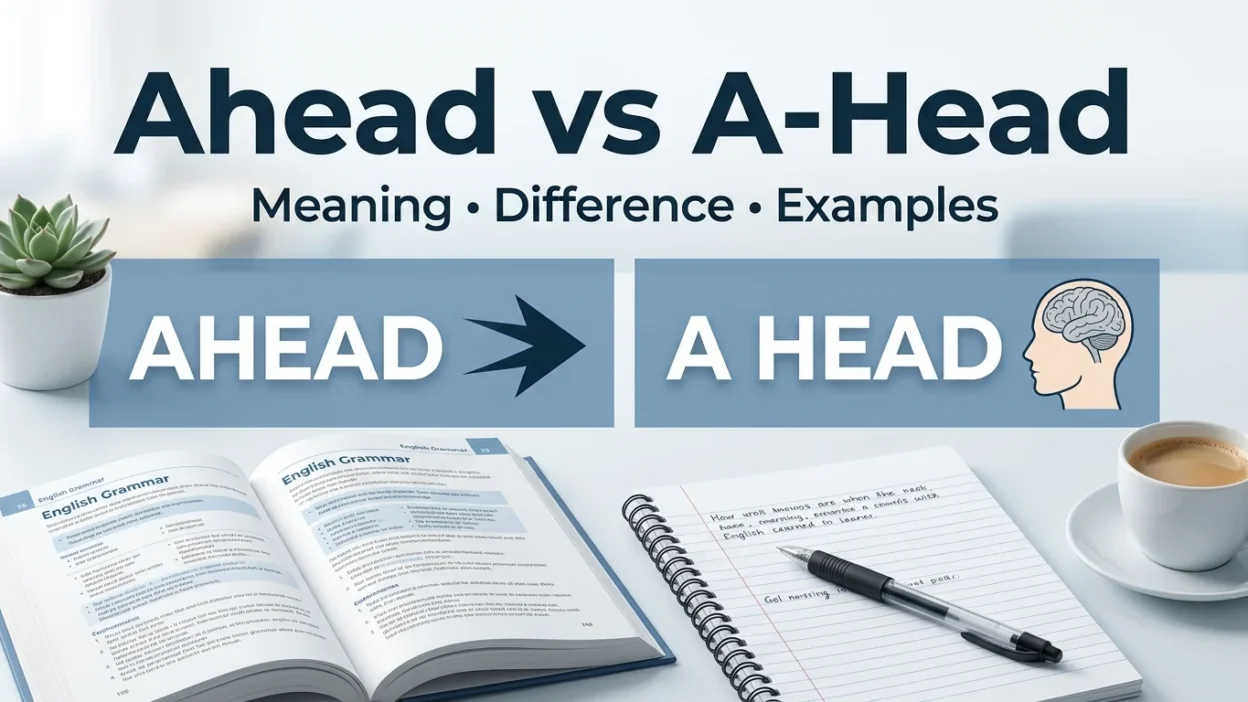
The difference between ahead vs a-head is simple: ahead is the correct standard English word, while a-head is generally not a standard spelling. Ahead is commonly used to mean “in front,” “forward,” “in the future,” or “in a leading position.” For example, “She walked ahead of me” means she walked in front of me.
Many English learners become confused because ahead can sound as though it contains the words “a” and “head.” However, English spelling does not work that way here. A-head is not normally used as a two-word or hyphenated form when you mean the ordinary word ahead. Understanding this distinction will help you write more naturally and avoid a common spelling mistake.
Quick Answer
Ahead is the correct standard English spelling in ordinary usage. It can mean in front, forward, earlier, or in a better position. A-head is not normally correct when you intend to use ahead. Write “The car is ahead of us,” not “The car is a-head of us.”
Why Do People Confuse “Ahead” and “A-Head”?
People often confuse ahead and a-head because the word ahead visually resembles the phrase a head.
The phrase a head, however, has a completely different grammatical function. It consists of the article a followed by the noun head.
For example:
- “There is a head on the statue.”
- “She has a head for mathematics.”
- “He carried a head of lettuce.”
In contrast, ahead is one word:
- “The finish line is ahead.”
- “Walk ahead of me.”
- “We are getting ahead.”
The hyphenated form a-head is generally unnecessary and incorrect for these everyday meanings.
First Word: Ahead
Ahead is an adverb and, in some contexts, part of a phrase describing position, progress, or direction.
It can have several related meanings.
1. In front
When something is physically in front of another person or thing, use ahead.
“There is a truck ahead of us.”
This means the truck is in front of us.
2. Forward
Ahead can describe movement toward the front or forward direction.
“Keep moving ahead.”
Here, ahead means forward.
3. In the future
The word can also refer to a future time.
“We have a busy week ahead.”
The phrase refers to the days or events that will happen in the future.
4. In a leading position
Ahead can describe someone or something that is winning or progressing faster.
“Our team is two points ahead.”
This means the team has a two-point advantage.
Common Expressions With “Ahead”
Some common expressions include:
- ahead of time — earlier than expected or scheduled
- ahead of schedule — progressing faster than planned
- go ahead — proceed
- look ahead — think about the future
- move ahead — progress
- get ahead — become more successful or advanced
- plan ahead — prepare for the future
- straight ahead — directly forward
Second Word: A-Head
A-head is not the normal spelling of ahead.
If you want to describe something that is in front, moving forward, occurring in the future, or leading, use ahead as one word.
However, a head without a hyphen is a legitimate phrase when head is a noun.
For example:
- “The sculpture has a head.”
- “He bought a head of cabbage.”
- “She has a head for business.”
The difference is grammatical:
Ahead = one word, usually an adverb.
A head = article + noun.
The hyphenated form a-head should not normally be inserted between them.
Ahead vs A-Head: Comparison Table
| Form | Correct? | Meaning | Example |
|---|---|---|---|
| ahead | Yes | In front, forward, later, or leading | “The road ahead is clear.” |
| a head | Yes, in the right context | One head; article + noun | “The statue has a head.” |
| a-head | Generally no | Not the standard form of ahead | Avoid “a-head” in ordinary writing |
When Should You Use Each?
Use “Ahead” When You Mean “In Front”
Use ahead when something is located in front of someone or something.
“There is a gas station ahead.”
Use “Ahead” for Future Events
Use it when talking about something that will happen later.
“We have several challenges ahead.”
Use “Ahead” for Progress
Use ahead when someone is progressing or winning.
“The candidate is ahead in the race.”
Use “A Head” for One Head
Use a head when head is literally a noun.
“The drawing shows a head and two shoulders.”
Use “A Head” With Certain Nouns
The phrase can describe one unit of something sold or counted using head.
“The farmer owns a head of cattle.”
The important point is that ahead and a head are not interchangeable.
10+ Examples of “Ahead”
Here are practical examples showing how ahead works in everyday English:
- The car ahead is moving slowly.
- Please walk ahead of me.
- We still have a long journey ahead.
- She arrived ahead of schedule.
- He finished the assignment ahead of time.
- Look ahead before crossing the road.
- Our team is three points ahead.
- The path ahead looks difficult.
- You need to plan ahead for the exam.
- The train station is straight ahead.
- The company is ahead of its competitors.
- Let’s go ahead with the plan.
These examples demonstrate the most common meanings of ahead: physical position, direction, future time, progress, advantage, and continuation.
Examples of “A Head”
Now compare those examples with a head, where head is a noun.
- The character has a large head.
- I saw a head-shaped sculpture.
- She drew a head on the figure.
- The farmer bought a head of lettuce.
- He has a head for numbers.
- The statue has a head made of stone.
In each example, a modifies the noun head. It does not create the adverb ahead.
Common Mistakes
Mistake 1: Writing “a-head” Instead of “ahead”
Incorrect:
“The store is a-head.”
Correct:
“The store is ahead.”
Mistake 2: Confusing “ahead” With “a head”
Incorrect:
“There is a head of us.”
If you mean something is in front of us, the correct sentence is:
“There is something ahead of us.”
Mistake 3: Separating “ahead of”
The phrase ahead of is normally written as three separate words:
“She is ahead of me.”
Do not write:
“She is a-head of me.”
Mistake 4: Assuming the Sound Determines the Spelling
English words can sound like combinations of other words without sharing their spelling or meaning.
The fact that ahead sounds somewhat like “a head” does not mean it should be written with a space or hyphen.
Memory Trick
A simple way to remember the difference is:
Ahead = forward or in front.
Think:
AHEAD → A + FORWARD
If you can replace the word with in front, forward, later, or in the lead, you probably need ahead.
If you are literally talking about one head, use a head.
For example:
- “The road is ahead.” → The road is in front.
- “The statue has a head.” → It has one head.
This quick substitution test makes the difference much easier to remember.
American vs British English
There is no major American-versus-British spelling difference between ahead and a-head.
Both American English and British English normally use ahead as one word.
For example:
- American English: “The road ahead is closed.”
- British English: “The road ahead is closed.”
The same applies to common expressions such as:
- ahead of time
- ahead of schedule
- go ahead
- look ahead
- move ahead
The standard spelling remains ahead in both varieties of English.
Similar Words
Understanding related words can make ahead easier to use.
Forward
Forward usually describes movement or direction toward the front.
“Move forward slowly.”
In Front
In front is a phrase rather than a single word.
“The bus is in front of us.”
This can often express a similar idea to ahead.
Before
Before can refer to an earlier time or position.
“Please arrive before noon.”
It is not always interchangeable with ahead, though.
Leading
Leading describes being in front or having an advantage.
“Our team is leading the competition.”
Advance
Advance can mean to move forward or make progress.
“The project continues to advance.”
These words overlap with some meanings of ahead, but each has its own grammatical patterns and uses.
Final Verdict
The correct choice in ordinary English is ahead, not a-head, when you mean “in front,” “forward,” “in the future,” or “in a leading position.”
Use a head as two separate words only when head is a noun preceded by the article a. The hyphenated spelling a-head is generally not appropriate for either meaning.
The easiest rule is simple: ahead = forward/in front; a head = one head.
FAQs
Is “a-head” a correct word?
Generally, no. A-head is not the standard spelling when you mean ahead. Use ahead instead.
Is “ahead” one word or two?
Ahead is one word. It is normally written without a space or hyphen.
What does “ahead” mean?
Ahead can mean in front, forward, later in time, or in a leading position.
What is the difference between “ahead” and “a head”?
Ahead is normally an adverb meaning forward or in front. A head is the article a plus the noun head.
Is “ahead of” correct?
Yes. Ahead of is a common and standard phrase.
“She arrived ahead of me.”
Should I write “a head of me” or “ahead of me”?
Write ahead of me when you mean someone or something is in front of you.
Is “ahead” the same in American and British English?
Yes. Ahead is normally spelled the same in both American and British English.
Can “ahead” refer to the future?
Yes. For example, “We have a difficult year ahead” means the difficult year is in the future.
Remember This
Ahead = in front, forward, later, or leading.
A head = one head.
A-head = generally avoid this spelling in standard English.
A quick test can help: if you can replace the word with “in front” or “forward,” choose ahead.
Conclusion
The difference between ahead vs a-head becomes easy once you focus on meaning and grammar. Ahead is the standard one-word form used for position, direction, future events, progress, and advantage. It appears in many everyday expressions, including ahead of time, ahead of schedule, and go ahead.
When you mean an actual head and are using a as an article, write a head as two words. In ordinary modern English, a-head is not the correct replacement for ahead. Remembering “ahead = forward” and “a head = one head” will help you choose the correct form confidently.