When learning English, some word pairs seem almost identical because they describe events happening at nearly the same time. “Concurrent” and “simultaneous” are two such words. Both can describe things that occur during the same period, but they are not always interchangeable. Understanding the small difference can help you write and speak more precisely.
The key distinction is that concurrent usually emphasizes events, activities, periods, or processes that overlap in time, while simultaneous emphasizes things happening at exactly the same time or at the same moment. In everyday English, the difference can be subtle, so context is important.
Quick Answer
Concurrent means happening or existing during the same period, often with some overlap. Simultaneous means happening at exactly the same time or moment. For example, two courses can be concurrent even if their schedules overlap without starting at precisely the same minute, while two simultaneous actions happen at the same moment.
Why Do People Confuse Concurrent and Simultaneous?
People confuse these words because both relate to time and overlapping events.
For example:
- Two projects can be concurrent if they are being worked on during the same weeks.
- Two explosions occurring at the exact same moment can be simultaneous.
- Two meetings may be concurrent when their schedules overlap.
- Two people saying the same sentence at exactly the same moment are speaking simultaneously.
The important question is:
If you mean an overlapping period, concurrent is often the better choice. If you mean exactly the same moment, simultaneous is usually more precise.
What Does “Concurrent” Mean?
Concurrent is an adjective meaning existing, happening, or occurring during the same period of time.
It often describes activities, events, processes, conditions, or periods that overlap.
Examples of “Concurrent”
- The company is managing concurrent projects.
- She took two concurrent courses at university.
- The two investigations were concurrent.
- He held two concurrent positions.
- Several construction projects are concurrent.
Notice that concurrent does not necessarily mean that everything happens at exactly the same instant.
Simple Definition
Concurrent = happening or existing during the same period.
What Does “Simultaneous” Mean?
Simultaneous is an adjective meaning happening, existing, or being done at the same time, especially at the same moment.
It emphasizes timing that coincides very closely or exactly.
Examples of “Simultaneous”
- The two lights turned on simultaneously.
- They gave simultaneous answers.
- Both teams scored simultaneously.
- The audience erupted into simultaneous laughter.
- She received two simultaneous phone calls.
Simple Definition
Simultaneous = happening at exactly or essentially the same time.
Concurrent vs Simultaneous: Comparison Table
| Feature | Concurrent | Simultaneous |
|---|---|---|
| Basic meaning | Happening during the same period | Happening at the same time or moment |
| Main emphasis | Overlap in time | Exact or near-exact timing |
| Exact same moment required? | No | Usually implied |
| Common with | Projects, courses, processes, events, sentences | Actions, reactions, events, movements |
| Example | Concurrent projects | Simultaneous movements |
| Simple synonym | Overlapping | At the same time |
A useful way to remember the distinction is:
Concurrent focuses on a shared time period; simultaneous focuses on a shared moment.
When Should You Use “Concurrent”?
Use concurrent when two or more things occur during overlapping periods.
It is especially useful when the events or activities last for some time.
Good examples
- She is working on concurrent projects.
- The university offers several concurrent programs.
- The company launched concurrent investigations.
- He has two concurrent responsibilities.
- The software can process concurrent requests.
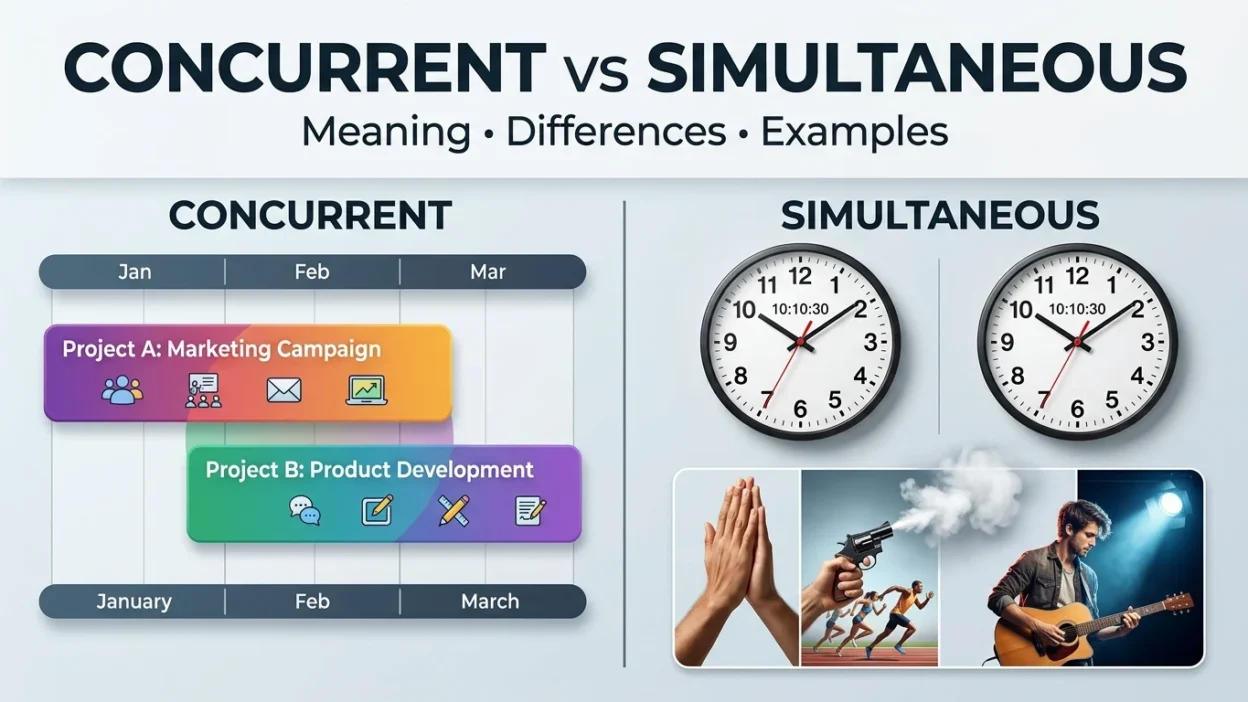
For example, imagine Project A runs from Monday through Friday and Project B runs from Wednesday through the following Monday. These projects are concurrent because their time periods overlap.
They do not need to begin or end together.
When Should You Use “Simultaneous”?
Use simultaneous when you want to emphasize that things happen at the same moment.
Good examples
- The doors opened simultaneously.
- Both players jumped simultaneously.
- The alarms went off simultaneously.
- They gave simultaneous responses.
- The two screens changed simultaneously.
If precision about the exact timing matters, simultaneous is usually the stronger choice.
Concurrent vs Simultaneous: 12 Examples
1. Projects
Concurrent:
The manager is supervising three concurrent projects.
This means the projects are active during overlapping periods.
Simultaneous:
The manager received three simultaneous project updates.
This emphasizes that the updates arrived at the same time.
2. Classes
Concurrent:
I am taking two concurrent courses this semester.
The courses occur during the same semester.
Simultaneous:
Two classes began simultaneously.
They started at the same moment.
3. Meetings
Concurrent:
The organization scheduled several concurrent meetings.
The meetings overlap in their scheduled periods.
Simultaneous:
The two meetings started simultaneously.
Both began at essentially the same moment.
4. Events
Concurrent:
Several concurrent events are taking place throughout the festival.
The events happen during the same general period.
Simultaneous:
Two performances began simultaneously.
They started at the same time.
5. Actions
Concurrent:
The workers performed concurrent tasks.
Their tasks were being carried out during the same period.
Simultaneous:
The workers performed the same action simultaneously.
The action occurred at the same moment.
6. Processes
Concurrent:
The system supports concurrent processes.
Multiple processes can operate during overlapping periods.
Simultaneous:
The devices performed simultaneous measurements.
The measurements were taken at the same time.
7. Phone Calls
Concurrent:
The customer service team handled concurrent calls.
Several calls were being handled during overlapping periods.
Simultaneous:
I received two simultaneous calls.
The calls arrived at the same time.
8. Responsibilities
Concurrent:
She has several concurrent responsibilities.
Her responsibilities exist at the same time over a period.
Simultaneous:
She received simultaneous requests from two departments.
The requests came at the same moment.
9. Reactions
Concurrent:
The audience experienced concurrent feelings of excitement and uncertainty.
The feelings existed together.
Simultaneous:
The audience gave a simultaneous response.
Everyone responded at the same time.
10. Events in a Story
Concurrent:
The novel follows two concurrent storylines.
The storylines develop during overlapping periods.
Simultaneous:
The two characters made simultaneous discoveries.
They discovered something at the same moment.
11. Computer Systems
Concurrent:
The application handles concurrent users.
Multiple users can use the system during overlapping periods.
Simultaneous:
The system processed two requests simultaneously.
The requests were processed at the same time.
12. Movements
Concurrent:
The dancers performed several concurrent routines.
The routines took place during overlapping periods.
Simultaneous:
The dancers raised their hands simultaneously.
They raised them at the same moment.
Common Mistakes
Mistake 1: Assuming They Always Mean Exactly the Same Thing
Although the words are related, concurrent does not necessarily mean exactly the same instant.
Better:
The two projects were concurrent.
This means their schedules overlapped.
Mistake 2: Using “Simultaneous” for Long Overlapping Activities
You might say:
The company ran two simultaneous projects.
This can be understood, but concurrent projects is often more natural when the emphasis is on projects existing during the same period.
Mistake 3: Thinking “Concurrent” Means Identical Timing
Concurrent activities can begin at different times.
For example:
- Project A: January–March
- Project B: February–April
These projects are concurrent because their timelines overlap.
They are not necessarily simultaneous in their starting or ending points.
Mistake 4: Confusing “Simultaneous” With “Similar”
Simultaneous describes timing, not similarity.
They made simultaneous decisions.
This means they made the decisions at the same time, not that the decisions were necessarily the same.
A Simple Memory Trick
Remember:
Concurrent = common period
Simultaneous = same moment
Think of concurrent as two timelines that overlap:
Concurrent: █████
Concurrent: █████
They share part of the same period.
Think of simultaneous as two dots occurring together:
Simultaneous: ● ●
Both happen at the same point in time.
Another quick trick:
- Concurrent → overlap
- Simultaneous → same moment
Concurrent vs Simultaneous in American and British English
Both concurrent and simultaneous are standard English words in both American and British English.
There is no major difference in their basic meanings between the two varieties.
However, word choice depends on context and style. Concurrent is particularly common in formal, academic, business, legal, and technical writing when discussing overlapping periods or activities.
Simultaneous is also common in formal writing but is frequently used when emphasizing events occurring at the same time.
For example:
- American English: The company conducted concurrent investigations.
- British English: The company conducted concurrent investigations.
The meaning is essentially the same.
Similar Words to Concurrent and Simultaneous
Several related words can help you express different shades of timing.
Concurrent
Possible alternatives include:
- Overlapping
- Coexisting
- Co-occurring
- Parallel
- Contemporaneous
- Coincident
However, these words are not always perfect replacements.
Simultaneous
Related words include:
- At the same time
- Synchronous
- Concurrent
- Coincident
- Co-occurring
- Instantaneous
Again, context matters.
Synchronous can suggest events operating in coordinated timing, especially in technical contexts, while simultaneous focuses more directly on occurring at the same time.
Final Verdict: Concurrent vs Simultaneous
The simplest distinction is:
Concurrent means happening during the same or overlapping period, while simultaneous means happening at the same time or moment.
Use concurrent when the duration or overlap of activities matters. Use simultaneous when the exact timing matters.
For example, two university courses can be concurrent because they take place during the same semester. If two students answer a question at exactly the same moment, their answers are simultaneous.
Frequently Asked Questions
Is concurrent the same as simultaneous?
Not exactly. Both describe events related in time, but concurrent usually emphasizes overlapping periods, while simultaneous emphasizes events occurring at the same moment.
Can concurrent mean at the same time?
Yes. Concurrent can mean happening at the same time, especially when activities overlap. However, it does not necessarily mean they occur at exactly the same instant.
Does simultaneous mean exactly at the same time?
Yes, generally. Simultaneous emphasizes that two or more things happen at the same time or moment.
Which is better: concurrent or simultaneous?
It depends on what you want to emphasize. Choose concurrent for overlapping periods and simultaneous for the same moment.
Are concurrent and simultaneous synonyms?
They can be synonyms in some contexts, but they are not always interchangeable. Concurrent has a stronger sense of temporal overlap, while simultaneous has a stronger sense of exact timing.
What is an example of concurrent?
“Several concurrent projects are being managed by the company.” The projects are active during overlapping periods.
What is an example of simultaneous?
“The two alarms sounded simultaneously.” The alarms sounded at the same moment.
Is “concurrent” more formal than “simultaneous”?
Both can sound formal. Concurrent is especially common in technical, academic, business, and legal contexts, while simultaneous is widely used in both everyday and formal English.
Remember This
Concurrent = overlapping in time.
Simultaneous = happening at the same moment.
If two things share part of a timeline, think concurrent. If they happen together at one specific point, think simultaneous.
Conclusion
Understanding concurrent vs simultaneous becomes much easier when you focus on the type of timing being described. Concurrent generally refers to activities, events, or conditions that happen during the same or overlapping period. They may start and finish at different times.
Simultaneous, on the other hand, highlights events occurring at the same moment. When you need to emphasize exact or nearly exact timing, it is usually the clearer choice. Remember “concurrent = overlapping period” and “simultaneous = same moment,” and you can confidently choose the right word.