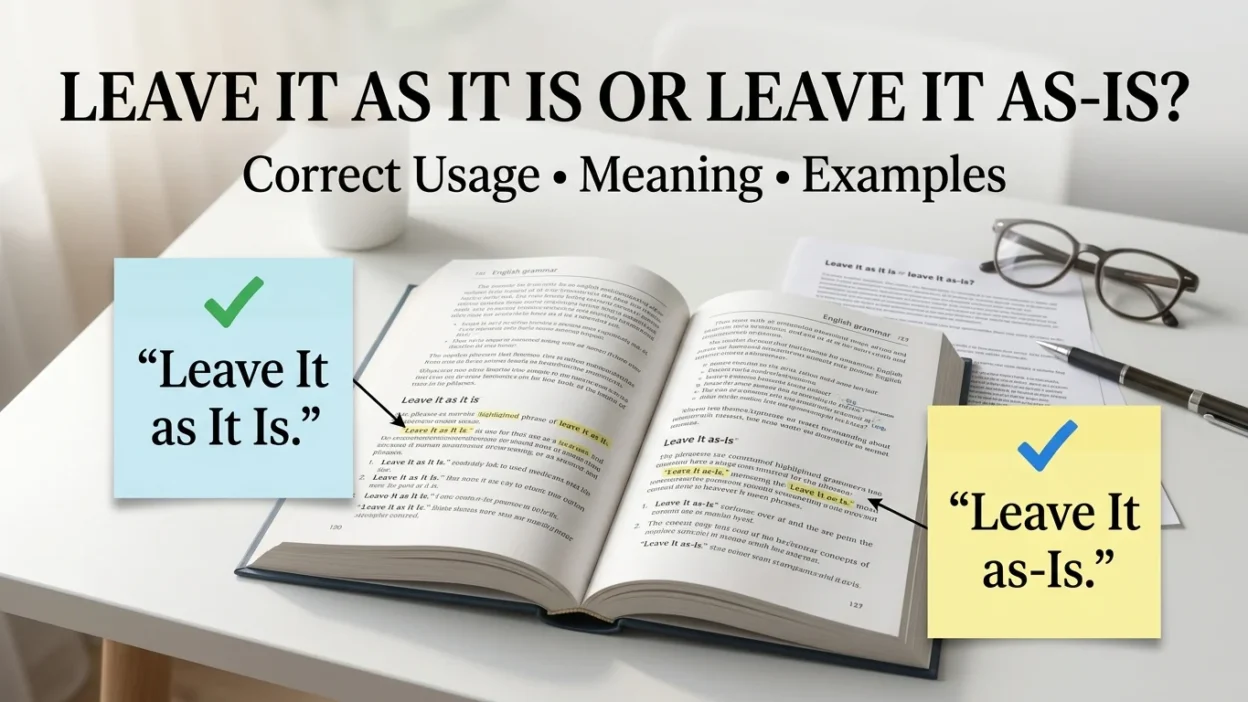
If you are wondering if to write “leave it as it is” or “leave it as-is,” the standard choice is usually “leave it as it is.” This phrase means to keep something in its current condition without changing, correcting, or modifying it. It is natural and widely used in everyday English.
“As-is” is also a valid expression, but its use is different. It is most commonly used as an adjective before a noun or in contexts where something is offered or accepted in its existing condition. For example, you might say, “The furniture is being sold as-is.” Understanding this small difference can help you choose the right form in writing and conversation.
Quick Answer
“Leave it as it is” is the best and most natural form when you mean “do not change it.” “As-is” is commonly used as a modifier meaning “in its present condition,” especially before a noun or in phrases such as “sold as-is.” The two expressions are related but not always interchangeable.
Why Do People Confuse It?
People often confuse “leave it as it is” and “leave it as-is” because both expressions communicate the basic idea of keeping something unchanged.
The confusion comes from the word “as.” English uses both open phrases and hyphenated forms in different grammatical situations. The difference is not simply a matter of personal spelling preference.
Compare these examples:
- Leave the document as it is.
- The document was accepted as-is.
- We will leave the original design as it is.
- The product is sold as-is.
The first and third examples use “as it is” as a phrase following the verb “leave.” The second and fourth use “as-is” to describe something in its existing condition.
First Word: “Leave It as It Is”
“Leave it as it is” is a complete and very common expression.
It means do not change it, alter it, repair it, move it, or otherwise interfere with its current state.
The structure is:
leave + object + as + subject + be
For example:
Please leave the room as it is.
This means that the room should remain in its current condition.
You can use the phrase with different subjects and objects:
- Leave it as it is.
- Leave them as they are.
- Leave the machine as it is.
- Leave the files as they are.
- Leave the painting as it is.
- Leave everything as it is.
The phrase is especially natural when giving instructions or expressing a preference not to make changes.
Examples of “Leave It as It Is”
- Leave the picture as it is; it looks great.
- Please leave the settings as they are.
- I think we should leave the design as it is.
- Don’t fix that button. Leave it as it is.
- The teacher told us to leave the paragraph as it is.
Second Word: “Leave It as-Is”
“As-is” is also used in English, but it generally works differently from “as it is.”
The hyphenated form “as-is” is particularly common when it functions as a modifier meaning in its current or existing condition, without changes or guarantees of improvement.
For example:
The car is being sold as-is.
Here, “as-is” describes the condition in which the car is being sold.
You may also see it in expressions such as:
- sold as-is
- accepted as-is
- provided as-is
- used as-is
- purchased as-is
- supplied as-is
The exact punctuation can vary depending on grammatical position and style guide, so “as is” and “as-is” should not automatically be treated as interchangeable in every sentence.
Leave It as It Is vs Leave It as-Is: Comparison Table
| Expression | Main Use | Meaning | Example |
|---|---|---|---|
| leave it as it is | Verb phrase | Do not change something | Leave the room as it is. |
| as it is | Phrase | In its current condition | The system is working as it is. |
| as-is | Modifier | In the existing condition | The property is sold as-is. |
| leave it as-is | Informal/compact construction | Leave something unchanged | You can leave the setting as-is. |
| as they are | Phrase | Keep multiple things unchanged | Leave the files as they are. |
The most important point is that “leave it as it is” is the clearest choice when you are directly telling someone not to change something.
When Should You Use Each?
Use “Leave It as It Is” When You Mean “Do Not Change It”
This is the safest and most natural expression in ordinary English.
Use it when someone is considering changing, correcting, moving, repairing, or modifying something.
Examples:
- Leave the furniture as it is.
- Leave the sentence as it is.
- Leave the schedule as it is.
- Leave the photograph as it is.
Use “As-Is” to Describe Existing Condition
Use “as-is” when you want to describe something as being offered, accepted, or used in its present condition.
Examples:
- The computer is sold as-is.
- The item was purchased as-is.
- The software is provided as-is.
- The house is being offered as-is.
What About “Leave It As-Is”?
You will also encounter “leave it as-is.” This construction is common, especially in informal writing.
For example:
Just leave the design as-is.
It means:
Just leave the design in its current condition.
However, “leave it as it is” is often the clearer and more traditional choice, particularly in formal writing.
10+ Examples of “Leave It as It Is”
Here are practical examples showing how the phrase works in different situations.
- Leave the door as it is.
- I like the picture, so leave it as it is.
- Please leave the document as it is.
- We decided to leave the original plan as it is.
- Don’t move the chair. Leave it as it is.
- The teacher said to leave the sentence as it is.
- I think the room looks perfect, so leave it as it is.
- You don’t need to change the design. Leave it as it is.
- The doctor advised us to leave the area as it is for now.
- Let’s leave the schedule as it is until tomorrow.
- If the machine is working properly, leave it as it is.
- The editor decided to leave the author’s wording as it is.
- Don’t adjust the settings. Leave them as they are.
- The photograph already looks natural, so leave it as it is.
- We should leave the original version as it is.
Common Mistakes
Mistake 1: Assuming “As-Is” Is Always Correct
Some writers believe that because “as-is” is a recognized expression, it can replace “as it is” everywhere.
That is not always true.
Correct and natural: Leave it as it is.
The sentence clearly tells someone not to change something.
Mistake 2: Using “As It Is” Before Every Noun
The opposite mistake also happens. Writers sometimes use “as it is” where a compact modifier is more appropriate.
For example:
The product is sold as-is.
Here, “as-is” efficiently describes the condition in which the product is sold.
Mistake 3: Confusing Meaning With Punctuation
The difference is not simply about adding or removing a hyphen.
Compare:
- Leave the computer as it is.
- The computer is sold as-is.
The grammar and sentence structure determine which form is more natural.
Mistake 4: Changing “It” When the Subject Is Plural
If the thing being discussed is plural, use “they are” rather than “it is.”
- Leave the books as they are.
- Leave the documents as they are.
- Leave the chairs as they are.
Not:
- Leave the books as it is.
Memory Trick
A simple way to remember the difference is:
“Leave it as it is” = Don’t change it.
Think of “it is” as describing the thing’s present state.
“As-is” = In the condition it currently has.
This is especially useful in expressions involving sales, products, services, property, software, or acceptance.
Remember:
Instruction: Leave it as it is.
Description: It is sold as-is.
This quick distinction will help you choose the right expression in most situations.
American vs British English
Both American and British English commonly use “leave it as it is.” The phrase is widely understood and natural in both varieties.
The expression “as is” is also widely used in both forms of English, particularly when describing something that remains in its existing condition.
You may encounter “as-is” in commercial, technical, legal, and informal contexts, especially when it functions as a modifier.
For example:
- The equipment is sold as-is.
- The software is provided as-is.
- Leave the equipment as it is.
There is therefore no major American-versus-British difference that requires learners to choose one form exclusively. The more important issue is how the expression functions in the sentence.
Similar Words and Expressions
Several other phrases can express a similar idea.
Keep It as It Is
This means to maintain something in its current condition.
Let’s keep the design as it is.
Leave It Alone
This means not to interfere with something.
Leave the machine alone.
Depending on context, it can sound stronger than “leave it as it is.”
Don’t Change It
This is the simplest direct alternative.
Don’t change the original version.
In Its Current State
This is more formal and descriptive.
The equipment should remain in its current state.
Unchanged
This is a concise adjective or participle.
The original document remained unchanged.
As It Stands
This phrase can mean in its present condition or situation.
As it stands, the proposal is acceptable.
These expressions are related, but they are not exact replacements in every sentence.
Final Verdict
If you are choosing between “leave it as it is” and “leave it as-is,” use “leave it as it is” when you are directly telling someone to keep something unchanged. It is clear, natural, and appropriate for both everyday and formal English.
“As-is” is also correct in suitable contexts, especially when describing something that is offered, sold, accepted, or provided in its existing condition. You may also see “leave it as-is” in informal usage. The key is to consider the grammatical role of the expression rather than treating the hyphen as optional decoration.
FAQs
Is “leave it as it is” grammatically correct?
Yes. “Leave it as it is” is grammatically correct and very common. It means to keep something in its present condition and not make any changes.
Is “leave it as-is” correct?
Yes, “leave it as-is” is used in English, especially in informal writing. It means to leave something in its current condition. However, “leave it as it is” is often the clearer standard choice.
Should I write “as is” or “as-is”?
It depends on how the expression is being used. “As is” is commonly used as a phrase, while “as-is” is often used as a modifier, especially before or around a noun in expressions such as “sold as-is.”
Which is better: “leave it as it is” or “leave it as-is”?
For a general instruction, “leave it as it is” is the safest choice. It clearly means “do not change it.”
What does “leave it as it is” mean?
It means to keep something in its current condition without changing, repairing, moving, or modifying it.
What does “as-is” mean?
“As-is” means that something is being provided, sold, accepted, or used in its existing condition, without being changed to a different condition.
Can I say “leave them as they are”?
Yes. When referring to plural things, “leave them as they are” is correct.
For example:
Leave the books as they are.
Remember This
- Leave it as it is = do not change it.
- Leave them as they are = do not change multiple things.
- As-is = in its existing condition.
- Sold as-is = sold in its current condition.
- Provided as-is = provided without being changed or modified.
- For a straightforward instruction, “leave it as it is” is usually the clearest choice.
Conclusion
The difference between “leave it as it is” and “leave it as-is” is mainly grammatical and contextual. “Leave it as it is” is the standard, natural expression when you want to tell someone not to change something. It works well in everyday conversation, education, professional communication, and formal writing.
“As-is” has a closely related meaning but is commonly used to describe something in its existing condition. Once you remember that “leave it as it is” means “don’t change it,” while “as-is” describes an existing condition, the distinction becomes much easier.