
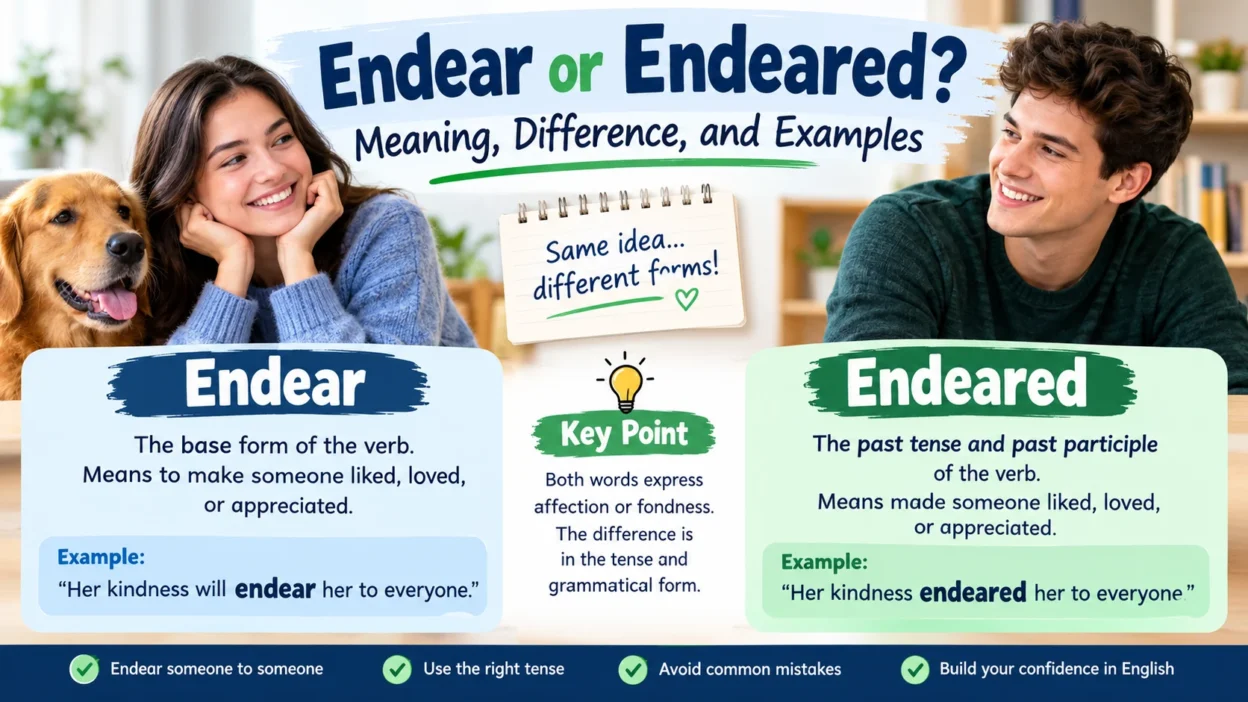
English learners often confuse endear and endeared because both words express affection, fondness, or a positive emotional connection. However, they have different grammatical functions and are used in different sentence structures. Understanding the difference will help you choose the correct word when describing how someone becomes liked or develops a special place in another person’s heart.
The key is to recognize that endear is the base form of a verb, while endeared is its past-tense and past-participle form. The expression “endear someone to someone” is especially important because it explains how a person’s actions, qualities, or behavior make them more lovable or appealing. Once you understand this pattern, you can use both words confidently in everyday conversation, formal writing, and storytelling.
Quick Answer: Endear vs. Endeared
Endear is a verb meaning to make someone liked or loved by another person. Endeared is the past-tense or past-participle form of endear. For example, “Her kindness will endear her to everyone” describes a future effect, while “Her kindness endeared her to everyone” describes something that happened in the past.
Why Do People Confuse Endear and Endeared?
People confuse these words because they share the same root and express the same basic idea of affection or fondness.
The main difference is grammatical:
- Endear: The base form of the verb.
- Endeared: The past-tense and past-participle form of the verb.
Both words commonly appear in the structure endear someone to someone. The verb describes the process of making a person more liked, trusted, or appreciated.
For example:
- Present: Her honesty endears her to her colleagues.
- Past: Her honesty endeared her to her colleagues.
- Future: Her honesty will endear her to her colleagues.
1. What Does Endear Mean?
Endear means to make someone feel affection, fondness, or admiration for another person. It is a verb that describes how someone’s qualities or actions cause other people to like them.
The word is most often used in the expression “endear someone to someone.”
Examples of Endear in Sentences
- Her cheerful personality helps endear her to new friends.
- His honesty will endear him to the community.
- Small acts of kindness can endear a teacher to students.
- Her sense of humor continues to endear her to her audience.
- The puppy’s playful behavior began to endear it to the family.
How to Use Endear Correctly
Use endear when describing an action or effect that makes someone more likable.
Common forms include:
- Endear: I hope to endear myself to the team.
- Endears: Her kindness endears her to others.
- Endearing: His endearing smile made everyone happy.
- Endeared: Her honesty endeared her to her classmates.
Notice that endearing is another form of the same verb, often used as an adjective to describe something charming or lovable.
2. What Does Endeared Mean?
Endeared is the simple past tense and past participle of endear. It describes how someone or something made a person feel affection or become more appreciated.
It frequently appears in the past-tense structure “endeared someone to someone.”
Examples of Endeared in Sentences
- Her kindness endeared her to the entire neighborhood.
- His dedication endeared him to his teammates.
- The little boy’s honesty endeared him to his grandparents.
- Their generosity has endeared them to the local community.
- She quickly endeared herself to her new colleagues.
How to Use Endeared Correctly
Use endeared when talking about an effect that occurred in the past or when forming a perfect tense with has, have, or had.
Examples:
- Simple past: His humor endeared him to everyone.
- Present perfect: His humor has endeared him to everyone.
- Past perfect: His humor had endeared him to everyone before he became famous.
The word can also appear in the expression “endeared himself or herself to,” which means that a person behaved in a way that made others like or appreciate them.
Endear vs. Endeared: Comparison Table
| Feature | Endear | Endeared |
|---|---|---|
| Word type | Verb, base form | Verb, past tense and past participle |
| Main meaning | To make someone liked or loved | Made someone liked or loved |
| Time reference | Depends on the sentence | Usually past or perfect tense |
| Example | Her kindness will endear her to us. | Her kindness endeared her to us. |
| Common structure | Endear someone to someone | Endeared someone to someone |
| Related adjective | Endearing | Not usually used as a standalone adjective |
When Should You Use Each Word?
Choose endear or endeared according to the tense and structure of your sentence.
Use Endear for the Base Verb
Use endear after modal verbs such as will, can, may, and might, or after to when an infinitive is needed.
Examples:
- Her helpful attitude can endear her to customers.
- He hopes to endear himself to his neighbors.
- Their generosity may endear them to the public.
- A sincere apology could endear him to his colleagues.
Use Endeared for Past Actions
Use endeared when describing something that made a person more likable in the past.
Examples:
- His patience endeared him to his students.
- Her thoughtful message endeared her to the family.
- The actor’s humility endeared him to fans.
Use Endeared After Has, Have, or Had
Use endeared as the past participle in perfect-tense constructions.
Examples:
- She has endeared herself to the entire team.
- Their kindness has endeared them to the community.
- His actions had endeared him to the villagers.
Remember that the correct form depends on the auxiliary verb and the sentence’s grammatical structure.
12 Examples of Endear and Endeared in Sentences
Here are practical examples to help you understand the difference.
- Her kindness will endear her to the new students.
- His honesty endeared him to his coworkers.
- A friendly smile can endear a salesperson to customers.
- Her generosity has endeared her to many people.
- He tried to endear himself to his new neighbors.
- Her courage endeared her to everyone who knew her.
- Their helpful attitude may endear them to the community.
- His simple gestures have endeared him to his followers.
- The teacher’s patience helped endear her to the children.
- His willingness to listen endeared him to his friends.
- She hopes her work will endear her to a wider audience.
- His humility had endeared him to the team long before he became its leader.
These examples show that endear describes the action in its base form, while endeared fits past-tense and perfect-tense constructions.
Common Mistakes with Endear and Endeared
Even advanced English learners sometimes make mistakes with these forms. Here are the most common ones to avoid.
Mistake 1: Using Endeared After Will
Incorrect: Her kindness will endeared her to everyone.
Correct: Her kindness will endear her to everyone.
Why? A modal verb such as will is followed by the base form of the verb.
Mistake 2: Using Endear for a Completed Past Action
Incorrect: His generosity endear him to the community last year.
Correct: His generosity endeared him to the community last year.
Why? The sentence describes a completed event in the past.
Mistake 3: Forgetting the Word To
Incorrect: Her kindness endeared her everyone.
Correct: Her kindness endeared her to everyone.
Why? The standard construction is endear someone to someone.
Mistake 4: Confusing Endear with Endearing
Incorrect: Her endear personality made everyone smile.
Correct: Her endearing personality made everyone smile.
Why? Endearing is commonly used as an adjective meaning charming or lovable.
Mistake 5: Using Endeared Without Considering the Tense
Incorrect: She has endear herself to her colleagues.
Correct: She has endeared herself to her colleagues.
Why? The present perfect uses has or have followed by the past participle.
Memory Trick: How to Remember Endear vs. Endeared
Use this simple memory trick:
- Endear = make someone like you.
- Endeared = made someone like you.
Think of the ending -ed as a clue that the action happened in the past, although endeared also appears with perfect-tense helping verbs.
For example:
- “I want to endear myself to my classmates.” The action is desired.
- “I endeared myself to my classmates.” The action happened in the past.
- “I have endeared myself to my classmates.” The action has relevance to the present.
You can also remember the pattern: endear someone to someone. Once you learn this structure, it becomes easier to form correct sentences.
American vs. British English
There is no significant spelling difference between endear and endeared in American and British English. Both varieties use the same spellings and grammatical forms.
| Feature | American English | British English |
|---|---|---|
| Base form | Endear | Endear |
| Past tense | Endeared | Endeared |
| Past participle | Endeared | Endeared |
| Example | His kindness endeared him to us. | His kindness endeared him to us. |
The words are understood in both varieties. Differences in pronunciation may occur between speakers, but the spelling and standard usage remain the same.
Similar Words to Endear and Endeared
Several words express related ideas, but their meanings and grammatical patterns are not identical.
- Charm: To attract or please someone. Example: Her confidence charmed the audience.
- Appeal: To attract or interest someone. Example: The idea appeals to young readers.
- Captivate: To hold someone’s attention strongly. Example: The speaker captivated the crowd.
- Attract: To draw someone’s interest or attention. Example: His personality attracts new friends.
- Enamour: To fill someone with admiration or love. Example: The scenery enamored her with the countryside.
- Endearing: Charming or lovable. Example: His endearing laugh made us smile.
- Beloved: Deeply loved or cherished. Example: She was a beloved member of the community.
Although these words are related, endear is particularly useful when explaining how a person’s actions or qualities cause others to develop affection for them.
Final Verdict: Endear or Endeared?
Both endear and endeared are correct words, but they serve different grammatical purposes.
Use endear when you need the base form of the verb, such as after will, can, may, or to. Use endeared for a past action or after has, have, or had.
For example:
- Correct: Her kindness will endear her to everyone.
- Correct: Her kindness endeared her to everyone.
- Correct: Her kindness has endeared her to everyone.
The key is to match the verb form to the tense and sentence structure.
Frequently Asked Questions
1. Is endear or endeared correct?
Both are correct. Endear is the base form of the verb, while endeared is its simple past and past participle.
2. What does endear mean in simple English?
Endear means to make someone like, love, or appreciate another person. For example, “Her kindness endeared her to the children.”
3. Is endeared past tense?
Yes. Endeared is the simple past tense and past participle of endear. For example, “His honesty endeared him to his friends.”
4. How do you use endear in a sentence?
Use endear to describe an action that makes someone more likable. For example, “Her cheerful personality will endear her to the team.”
5. What does endeared herself mean?
“Endeared herself” means that a woman behaved in a way that made other people like or appreciate her. For example, “She endeared herself to her coworkers by helping them.”
6. What is the difference between endear and endearing?
Endear is a verb meaning to make someone feel affection. Endearing can function as a verb form or an adjective meaning charming or lovable. For example, “His honesty endeared him to us” and “He has an endearing smile.”
7. What preposition follows endear?
The standard construction uses to: “Her kindness endeared her to the community.” The same pattern applies to endear, endears, and endeared.
Remember This
- Endear = the base form of the verb.
- Endeared = the past-tense and past-participle form.
- Endearing = often an adjective meaning charming or lovable.
- Use endear someone to someone as the standard sentence pattern.
- After will, can, may, and to, use the base form when grammatically required.
Conclusion
The difference between endear and endeared is mainly a matter of verb form and tense. Both words describe the process of making someone more likable or appreciated, but endear is the base form, while endeared describes a past action or appears in perfect-tense constructions.
To use these words confidently, remember the sentence pattern “endear someone to someone” and pay attention to the verbs that come before them. With a little practice, you can use endear, endeared, and endearing naturally in everyday English and formal writing.