
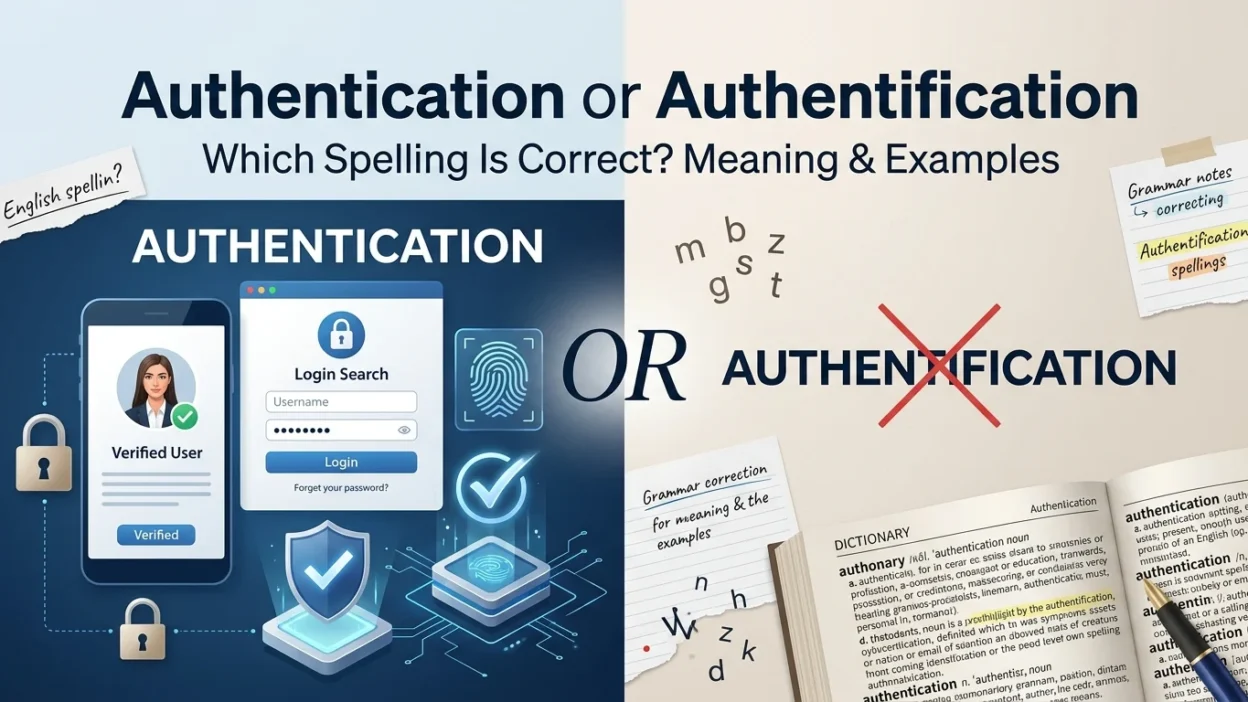
If you are wondering if- “authentication” or “authentification” is the correct English word, the standard English spelling is authentication. It means the process of verifying someone’s identity, a document, a message, or the validity of something. For example, Two-factor authentication protects your account.
Authentification is not the standard spelling used in modern English. It may appear because English speakers confuse the word with related terms such as authenticate and authentic, or because authentification is used in some other languages. For English writing, especially in technology, cybersecurity, business, and academic contexts, authentication is the form you should use.
Quick Answer
Authentication is the correct and standard English word. It refers to verifying identity, access, or genuineness. Authentification is generally considered incorrect or nonstandard in English, although it can occur as a word in other languages. Write authentication in English sentences, such as “The website requires authentication.”
Why Do People Confuse It?
The confusion comes mainly from the similarity between authenticate, authentic, and the incorrect-looking form authentification.
The verb is authenticate, meaning to verify that someone or something is genuine.
From this verb, English forms the noun authentication:
- authenticate → authentication
- authenticate → authenticated
- authenticate → authenticating
Because authenticate contains the ending -ate, some writers naturally assume that its noun should be authentification. However, standard English uses authentication.
Another source of confusion is that similar-looking forms exist in other languages. A word that resembles authentification may therefore seem natural to multilingual English learners.
First Word: Authentication
Authentication is the correct standard English noun.
It means the process of checking or proving that someone or something is genuine, valid, or authorized.
Examples
- The website requires authentication before you can log in.
- Two-factor authentication adds another layer of security.
- The bank uses biometric authentication.
- Your identity must pass authentication before access is granted.
In computing, authentication usually means verifying who a user is.
For example, when you enter a username and password, the system checks whether those credentials belong to the person attempting to access the account.
Second Word: Authentification
Authentification is generally not the standard English spelling for this meaning.
If you are writing in English, replace it with authentication.
For example:
- ❌ The application requires authentification.
- ✅ The application requires authentication.
The same applies in professional documents, websites, technical instructions, school assignments, and business communication.
Authentication vs Authentification: Comparison Table
| Word | Standard English? | Meaning | Recommended? |
|---|---|---|---|
| Authentication | Yes | Verification of identity, validity, or genuineness | ✅ Yes |
| Authentification | No, generally nonstandard in English | Often intended to mean authentication | ❌ Avoid in standard English |
| Authenticate | Yes | To verify or prove something is genuine | ✅ Yes |
| Authentic | Yes | Genuine, real, or trustworthy | ✅ Yes |
The key distinction is simple: authentication is the standard English noun, while authentification should generally be avoided in English.
When Should You Use Authentication?
Use authentication whenever you are talking about a process of verification.
In technology
- user authentication
- password authentication
- biometric authentication
- two-factor authentication
- multi-factor authentication
In cybersecurity
Authentication is an important security process because systems need to determine whether someone attempting to access an account is actually the authorized user.
In banking
Banks may use passwords, security codes, fingerprints, facial recognition, or other methods for customer authentication.
In general English
The word is not limited to computers.
You can also use it when discussing the verification of documents, identities, signatures, or information.
10+ Examples of Authentication
Here are practical examples showing how authentication works in different contexts:
- The website requires authentication before allowing access.
- Two-factor authentication helps protect online accounts.
- The employee completed authentication using a security code.
- The bank uses biometric authentication for some transactions.
- Authentication failed because the password was incorrect.
- The application uses secure authentication methods.
- The system requests authentication before displaying private information.
- Facial recognition can be used for authentication.
- The administrator enabled multi-factor authentication.
- The document requires authentication before it can be accepted.
- The service sends a verification code during authentication.
- Strong authentication can help prevent unauthorized account access.
Notice that authentication works naturally in both technical and nontechnical contexts.
Common Mistakes
Mistake 1: Writing “authentification”
❌ The system requires authentification.
✅ The system requires authentication.
The second sentence uses the standard English form.
Mistake 2: Confusing authentication with authorization
These words are related but have different meanings.
Authentication asks:
“Who are you?”
Authorization asks:
“What are you allowed to do?”
For example, a website may authenticate you by checking your password. After identifying you, it can authorize you to view certain files.
Mistake 3: Confusing authentication with verification
Verification is a broad term for checking whether something is correct, valid, or true.
Authentication specifically focuses on establishing identity, genuineness, or legitimacy.
The exact distinction can depend on context, but the words should not automatically be treated as interchangeable.
Mistake 4: Assuming “authentification” follows “authenticate”
English word formation is not always completely predictable. Although authenticate is the verb, its standard noun form is authentication, not authentification.
Memory Trick
Use this simple trick:
Authenticate → Authentication
Think:
Authenticate + ion = Authentication
Remember the spelling with “cation” at the end:
authenti + cation → authentication
If you see authentification in your English writing, stop and check it. In standard English, authentication is almost certainly the word you need.
American vs British English
There is no important American-versus-British spelling difference between authentication and authentification.
Both American English and British English use:
authentication
For example:
- American English: The account requires two-factor authentication.
- British English: The account requires two-factor authentication.
So changing from American to British English does not normally change this spelling.
Similar Words
Understanding related words can make the spelling easier to remember.
Authenticate
Authenticate is a verb meaning to verify or establish that something is genuine or that someone is who they claim to be.
The system will authenticate the user.
Authentication
Authentication is the noun describing the process.
The system requires user authentication.
Authenticated
Authenticated is the past participle or adjective form.
The user is authenticated successfully.
Authentic
Authentic means genuine, real, or not fake.
The museum confirmed that the painting is authentic.
Authenticity
Authenticity means the quality or condition of being genuine.
Experts questioned the authenticity of the document.
These words are related, but they do not have identical meanings.
Final Verdict
For standard English writing, choose authentication.
Authentification is generally not the standard English form and should be avoided when you mean the process of verifying an identity, account, document, or other entity.
A useful word family to remember is:
authentic → authenticate → authentication → authenticated
FAQs
Is authentication the correct spelling?
Yes. Authentication is the standard English spelling for the process of verifying identity, validity, or genuineness.
Is authentification a real word?
Authentification can occur in some other languages and contexts, but it is generally not the standard English noun. In English, use authentication.
What is the difference between authentication and authorization?
Authentication verifies who you are. Authorization determines what you are allowed to access or do.
Is it two-factor authentication or authentification?
The standard phrase is two-factor authentication (2FA).
What is the verb form of authentication?
The verb is authenticate.
The system authenticates the user.
What adjective comes from authenticate?
Authenticated can describe something or someone that has been successfully verified.
Is authentication the same as verification?
Not always. Verification is a broader concept involving checking whether something is correct or valid, while authentication commonly concerns establishing identity or genuineness.
Remember This
- ✅ Authentication = standard English
- ❌ Authentification = generally avoid in English
- ✅ Authenticate = verb
- ✅ Authenticated = verified
- ✅ Authentic = genuine
- ✅ Authenticity = quality of being genuine
The easiest rule is:
Authenticate → Authentication
If you are writing in English and need the noun for the process of verifying identity or genuineness, authentication is the safe and standard choice.
Conclusion
The choice between authentication or authentification is straightforward in standard English: use authentication. It is the established noun for the process of confirming identity, access, validity, or genuineness. You will commonly see it in phrases such as user authentication, password authentication, and two-factor authentication.
Although authentification may look logical because of the verb authenticate and may appear in other languages, it is generally not the form you should use in English. Remember the word family authenticate → authentication, and you can avoid this spelling mistake in everyday, academic, and professional writing.