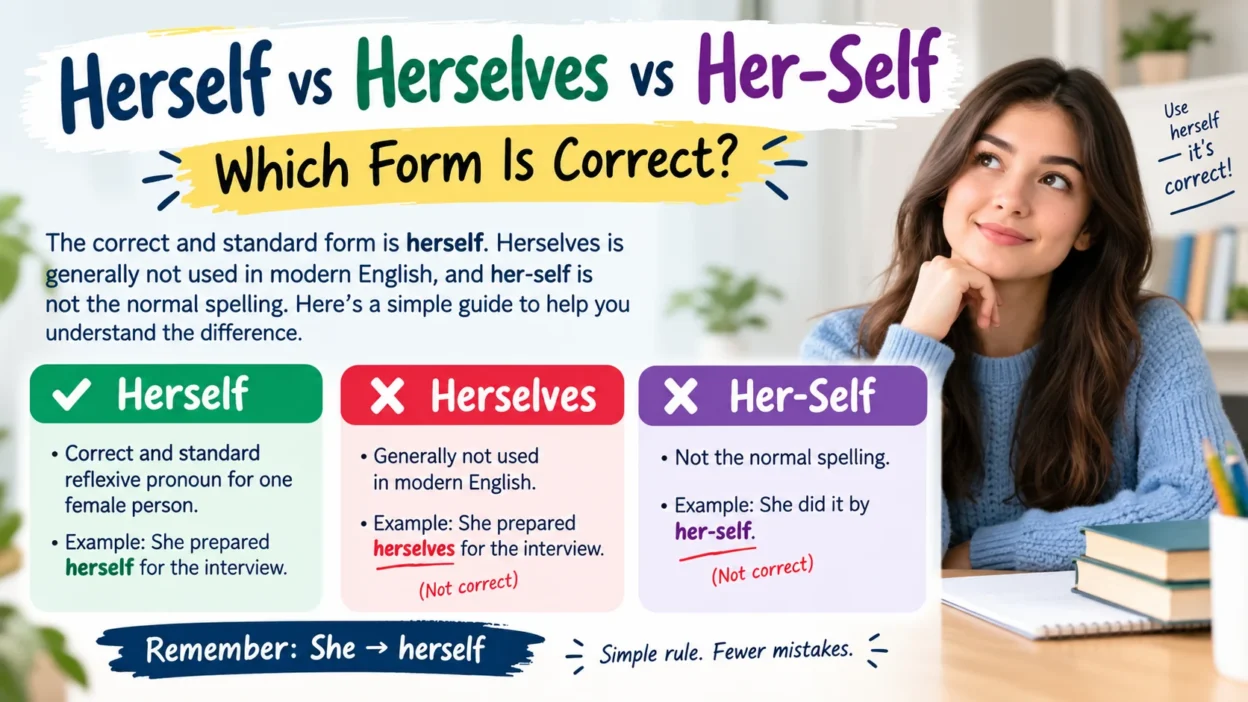
When choosing between herself, herselves, and her-self, the correct form in standard modern English is usually herself. It is a reflexive pronoun used when a female person refers back to herself. For example, “She prepared herself for the interview.”
Herselves is generally not standard modern English, while her-self is not normally written with a hyphen. Understanding this difference is important because these forms may look similar but do not have the same grammatical status.
Quick Answer
Herself is the standard and correct reflexive pronoun for one female person: “She blamed herself.” Herselves is generally incorrect in modern standard English, and her-self is not the normal spelling. Use herself when referring back to a singular female subject or object.
Why Do People Confuse It?
The confusion usually comes from the way reflexive pronouns are formed:
- I → myself
- you → yourself
- he → himself
- she → herself
- it → itself
- we → ourselves
- you → yourselves
- they → themselves
Because ourselves and yourselves have plural forms ending in -selves, some learners assume that herselves should also exist.
However, English does not form the reflexive pronoun of she/her that way. The correct singular form is herself.
First Word: Herself
Herself is the standard reflexive pronoun corresponding to she and her.
It refers to one female person and is commonly used when the subject and the person affected by the action are the same.
Examples
- She taught herself Spanish.
- Maria looked at herself in the mirror.
- She bought herself a new laptop.
- Jane introduced herself to the group.
Herself can also be used for emphasis:
She herself designed the entire project.
Here, herself emphasizes that she personally did the work.
Second Word: Herselves
Herselves is generally not a standard English reflexive pronoun.
The problem is that her refers to one female person, while -selves is associated with plural reflexive forms such as ourselves, yourselves, and themselves.
If you are talking about one woman or girl, use herself.
If you are talking about several people, use the appropriate plural reflexive pronoun, usually themselves when referring to people generally.
Incorrect
She prepared herselves for the competition.
Correct
She prepared herself for the competition.
Comparison Table
| Form | Standard English? | Meaning/Use | Example |
|---|---|---|---|
| herself | ✅ Yes | Reflexive or emphatic pronoun for one female person | She introduced herself. |
| herselves | ❌ Generally no | Not the standard plural form of herself | Avoid it in standard English. |
| her-self | ❌ Normally no | Nonstandard hyphenated spelling | Use herself instead. |
When to Use Each
When to Use “Herself”
Use herself when referring to a singular female person.
Reflexive use:
She hurt herself while cooking.
Emphatic use:
The manager herself called me.
After a preposition:
She kept the secret to herself.
When Not to Use “Herselves”
Do not use herselves simply because you are talking about more than one female person.
For example:
❌ The women prepared herselves.
Better:
✅ The women prepared themselves.
The standard plural reflexive pronoun is themselves, regardless of whether the group consists entirely of women.
When Not to Use “Her-Self”
In ordinary modern English, write herself as one word.
❌ She did it by her-self.
✅ She did it by herself.
The hyphenated form may occasionally appear in unusual stylistic, historical, or deliberately emphatic writing, but it is not the normal spelling.
10+ Examples of “Herself”
- She introduced herself to the new teacher.
- Emma taught herself how to play the guitar.
- She looked at herself in the mirror.
- Sarah bought herself a beautiful dress.
- She blamed herself for the mistake.
- The girl hurt herself while playing.
- She prepared herself for the examination.
- Maria kept the information to herself.
- She completed the entire assignment herself.
- The actress herself answered the question.
- She reminded herself to call her mother.
- Jane was proud of herself after finishing the race.
Common Mistakes
Mistake 1: Using “Herselves” for One Woman
❌ She looked after herselves.
✅ She looked after herself.
Mistake 2: Using “Herselves” for Several Women
❌ The women introduced herselves.
✅ The women introduced themselves.
English uses themselves for plural people.
Mistake 3: Adding a Hyphen
❌ She completed the work her-self.
✅ She completed the work herself.
Mistake 4: Confusing “Her” and “Herself”
Her is an object pronoun or possessive determiner:
I called her.
I read her book.
Herself is a reflexive or emphatic pronoun:
She called herself.
She herself made the decision.
Memory Trick
Remember this simple pattern:
She → herself
Think:
She + self = herself
For plural people, remember:
They → themselves
So:
- One woman → herself
- Several people → themselves
- Never automatically create herselves
A useful sentence to remember is:
She did it herself.
American vs British English
There is essentially no standard American-versus-British difference in the normal use of herself.
Both American English and British English use:
She made the decision herself.
Both varieties also use themselves for plural people:
The women introduced themselves.
Herselves is not the normal standard reflexive pronoun in either variety.
Similar Words
Understanding related pronouns makes herself easier to remember.
- myself — refers back to “I”
- yourself — refers to one “you”
- himself — refers to one male person
- herself — refers to one female person
- itself — refers to a thing, animal, or other singular non-human referent depending on context
- ourselves — refers back to “we”
- yourselves — refers to plural “you”
- themselves — refers to plural people or things
Examples
I taught myself.
He taught himself.
She taught herself.
We taught ourselves.
They taught themselves.
This pattern shows why herself is the correct form rather than herselves.
Final Verdict
The correct standard form is herself.
Herselves is generally not used in standard modern English, and her-self is not the normal spelling. If you are referring to one female person, choose herself.
For example:
✅ She completed the project herself.
If the subject is plural, use the appropriate plural reflexive pronoun:
✅ They completed the project themselves.
Frequently Asked Questions
Is “herself” one word?
Yes. Herself is normally written as one word.
Is “herselves” grammatically correct?
Generally, no. Herselves is not the standard modern English reflexive pronoun.
Is “her-self” correct?
Normally, no. The standard spelling is herself, without a hyphen.
What is the plural of “herself”?
English does not normally form the plural of herself as herselves. For multiple people, themselves is generally used.
Is “herself” a pronoun?
Yes. Herself is a reflexive pronoun and can also function as an emphatic pronoun.
Which is correct: “she herself” or “she herselves”?
She herself is correct.
She herself organized the event.
Can “herself” be used for emphasis?
Yes. It can emphasize that the female person personally performed an action.
The author herself signed the book.
Remember This
Herself = correct standard form for one female person.
Herselves = generally incorrect in standard English.
Her-self = normally incorrect spelling.
The easiest rule is:
She → herself
If you remember that pair, you will avoid most mistakes with these three forms.
Conclusion
The choice between herself, herselves, and her-self is straightforward once you understand how English reflexive pronouns work. Herself is the standard form used for one female person, whether it refers back to the subject or adds emphasis.
Avoid herselves in standard English and normally avoid the hyphenated her-self. When referring to multiple people, use themselves instead. With the simple rule “she herself,” you can confidently choose the correct form in writing and conversation.