
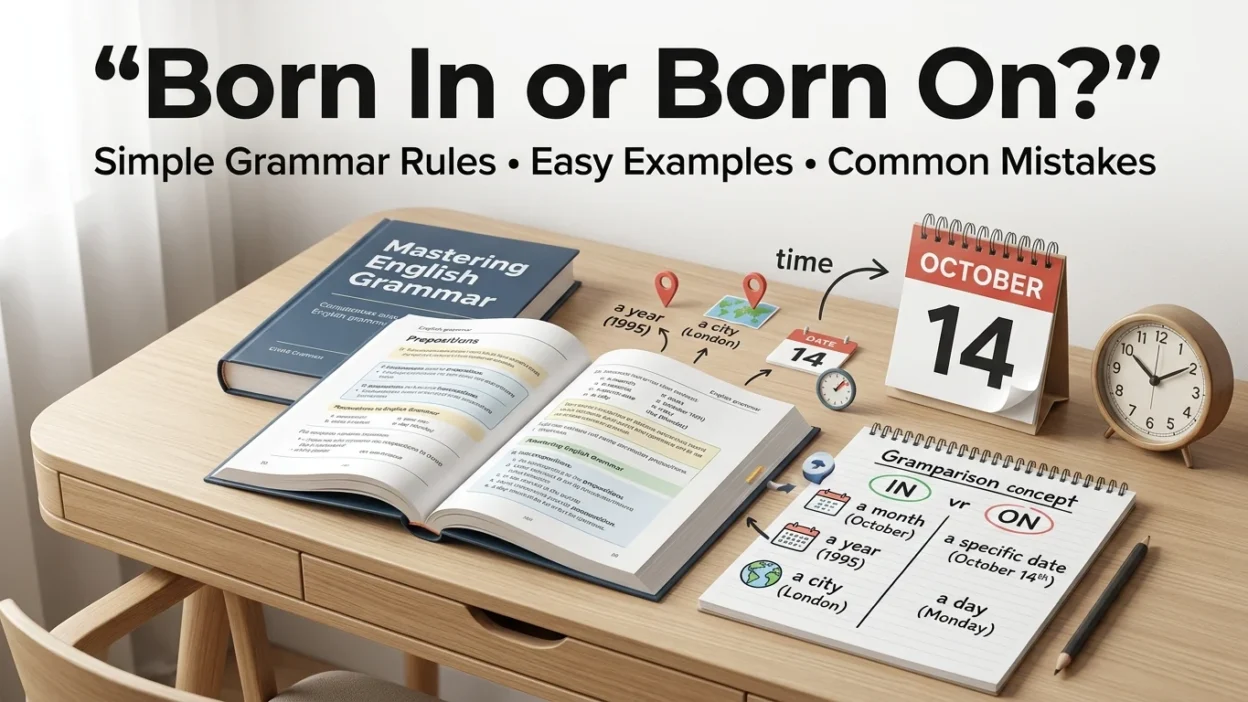
If you are unsure if to say “born in” or “born on,” you are not alone. English learners often confuse these two expressions because both are used to talk about someone’s birth. The good news is that the rule is simple once you understand the difference between places and specific dates. In general, we use “born in” with years, months, and places, while “born on” is used with specific days and dates.
For example, you can say, “She was born in 1998,” “He was born in July,” or “They were born in London.” However, when you mention an exact day or date, use “born on”: “She was born on July 15, 1998.” This guide explains the difference between these expressions, shows you when to use each one, and gives you plenty of practical examples.
Quick Answer
Use “born in” for a year, month, or place: “I was born in 2000,” “She was born in May,” or “He was born in Canada.” Use “born on” for a specific day or date: “I was born on Monday” or “She was born on May 10.”
Why People Confuse It
People confuse “born in” and “born on” because both prepositions can appear before information about someone’s birth.
The key is to look at the type of information that follows the preposition.
- in → a general period or location
- on → a particular day or exact date
Compare these sentences:
- I was born in 1995.
- I was born on June 12, 1995.
- She was born in Pakistan.
- She was born on Friday.
The first sentence uses in because 1995 is a year. The second uses on because June 12 is a specific date.
Another reason for confusion is that an exact birth date can contain both a month and a day. For example:
She was born on March 8, 2001.
Although we normally use in with a month or year separately, the complete date is treated as a specific day, so on is correct.
First Word: “Born In”
“Born in” is used when talking about a place, year, month, season, or other longer/general period.
1. Born in + Place
Use “born in” when saying where someone was born.
Examples:
- I was born in Pakistan.
- She was born in Lahore.
- He was born in Canada.
- They were born in London.
- My grandmother was born in a small village.
- The actor was born in New York.
The place can be a country, city, town, village, region, or other geographical area.
2. Born in + Year
Use “born in” with a year.
Examples:
- I was born in 2002.
- She was born in 1997.
- He was born in 1985.
- My father was born in 1970.
- They were born in 2010.
You should not normally say:
- I was born on 2002.
Instead, say:
- I was born in 2002.
3. Born in + Month
Use “born in” when you mention only a month.
Examples:
- I was born in January.
- She was born in August.
- He was born in December.
- My sister was born in April.
However, if you give the exact date, use on:
- I was born in April.
- I was born on April 17.
4. Born in + Season
You can also use “born in” with seasons.
Examples:
- She was born in spring.
- He was born in summer.
- My brother was born in winter.
- I was born in the fall.
Second Word: “Born On”
“Born on” is used for a specific day or exact date.
1. Born on + Day of the Week
Use “born on” when you mention a particular day.
Examples:
- I was born on Monday.
- She was born on Friday.
- He was born on a Sunday.
- My daughter was born on Saturday.
The important idea is that the day is specific.
2. Born on + Exact Date
Use “born on” before a complete date.
Examples:
- I was born on May 12, 2000.
- She was born on January 3, 1995.
- He was born on October 21, 1988.
- They were born on July 4, 2010.
Even though the date contains a month and year, the whole expression identifies one particular day. Therefore, on is correct.
3. Born on + Special Day
You can also use “born on” when referring to a particular special day.
Examples:
- She was born on Christmas Day.
- He was born on New Year’s Day.
- My cousin was born on Valentine’s Day.
- The baby was born on her mother’s birthday.
Born In vs. Born On: Comparison Table
| Expression | Use | Example |
|---|---|---|
| born in + country | Place | She was born in Pakistan. |
| born in + city | Place | He was born in Karachi. |
| born in + year | Year | I was born in 2001. |
| born in + month | Month | She was born in June. |
| born in + season | Season | He was born in winter. |
| born on + weekday | Specific day | I was born on Tuesday. |
| born on + exact date | Specific date | She was born on June 15, 1999. |
| born on + special day | Particular day | He was born on Christmas Day. |
When to Use Each
A simple way to decide between “born in” and “born on” is to ask yourself what information you are giving.
Use “born in” for:
- Countries
- Cities
- Towns
- Villages
- Years
- Months
- Seasons
- General periods of time
For example:
- She was born in India.
- He was born in 1990.
- I was born in September.
- They were born in winter.
Use “born on” for:
- Days of the week
- Specific calendar dates
- Particular named days
For example:
- She was born on Monday.
- He was born on March 20.
- I was born on Christmas Day.
A useful rule is:
General time or place → in
Specific day or date → on
10+ Examples of “Born In” and “Born On”
Here are practical examples to make the difference easier to remember.
Examples with “Born In”
- I was born in Pakistan.
- She was born in Islamabad.
- He was born in 1998.
- My mother was born in March.
- They were born in 2005.
- My grandfather was born in winter.
- The writer was born in England.
- She was born in a small town.
- He was born in the twentieth century.
- My brother was born in December.
- The famous scientist was born in Germany.
- I was born in the early 2000s.
Examples with “Born On”
- I was born on Monday.
- She was born on June 15, 2000.
- He was born on a Friday.
- My daughter was born on September 2.
- They were born on Christmas Day.
- My brother was born on Sunday morning.
- She was born on April 10, 1995.
- He was born on New Year’s Day.
- The twins were born on the same day.
- I was born on a cold winter morning.
- She was born on her father’s birthday.
- He was born on July 4.
Notice how in describes a broader time or location, while on identifies a particular day or date.
Common Mistakes
Learning the rule is easy, but several mistakes are common among English learners.
Mistake 1: Using “on” with a year
She was born on 1995.
She was born in 1995.
A year is a longer period, so use in.
Mistake 2: Using “on” with a month alone
He was born on August.
He was born in August.
But if you mention the exact date:
He was born on August 14.
Mistake 3: Using “in” with an exact date
I was born in May 20, 2000.
I was born on May 20, 2000.
The complete date refers to one specific day.
Mistake 4: Using “on” for a city
She was born on Lahore.
She was born in Lahore.
Cities and countries take in in this construction.
Mistake 5: Forgetting the preposition
In standard English, we normally say:
I was born in 2000.
Not:
I was born 2000.
The preposition is an important part of the expression.
Mistake 6: Confusing “born in” with “born on” in complete sentences
Consider:
I was born in May.
and:
I was born on May 10.
Both are correct because the first gives only the month, while the second gives a specific date.
Memory Trick
Here is a quick trick to remember the difference:
IN = inside a larger space or period.
ON = on one specific day.
Think of a year as a large box. A month fits inside that year, and a particular day fits inside the month.
So:
in 2000 → in May → on May 15
You can also remember:
Place or period = IN
Day or date = ON
For example:
- in Pakistan
- in 2000
- in May
- on Monday
- on May 15
This simple pattern works in most everyday sentences about birth.
American vs. British English
The basic rule for “born in” and “born on” is essentially the same in American and British English.
Both varieties use:
- born in 1990
- born in June
- born in London
- born on Monday
- born on June 10
There can be differences in how dates are written.
American English commonly uses:
June 10, 2000
British English commonly uses:
10 June 2000
However, the preposition remains on when referring to the specific date:
- American English: She was born on June 10, 2000.
- British English: She was born on 10 June 2000.
So, the date format may change, but the basic in/on rule does not.
Similar Words
Several expressions are closely related to “born in” and “born on.”
Born at
“Born at” can be used when referring to a specific institution or location, especially a hospital or other birth location.
Example:
She was born at the city hospital.
Compare:
She was born in London.
Here, in identifies the city, while at identifies a particular place or facility.
Born during
Use “born during” when talking about a period or event.
Examples:
- He was born during the war.
- She was born during the summer.
- They were born during a period of rapid change.
Born before
Use “born before” to compare someone’s birth with another event or time.
Example:
My grandfather was born before 1950.
Born after
Use “born after” when referring to a later point in time.
Example:
She was born after the family moved to Canada.
Date of birth
“Date of birth” means the exact day, month, and year when a person was born.
Example:
Please enter your date of birth on the form.
When you state that date in a sentence, you can use on:
I was born on March 14, 2001.
Final Verdict
The difference between “born in” and “born on” is mainly about whether you are talking about a general period/place or a specific day/date.
Use born in with places, years, months, seasons, and broader periods: “born in Pakistan,” “born in 1999,” and “born in July.”
Use born on with specific days and dates: “born on Monday,” “born on July 10,” or “born on Christmas Day.”
If you remember just one rule, remember this:
Born in = place or general time.
Born on = specific day or date.
FAQs About “Born In” or “Born On”
1. Is it “I was born in 2000” or “I was born on 2000”?
The correct sentence is “I was born in 2000.” Use in with a year.
2. Is it “born in June” or “born on June”?
Say “born in June” when you mention the month by itself. For an exact date, say “born on June 15.”
3. Is it “born in Monday” or “born on Monday”?
The correct expression is “born on Monday.” Days of the week normally take on.
4. Do you say “born in a date” or “born on a date”?
Use “born on” with a specific date. For example: “She was born on April 12, 1998.”
5. Is “born in Pakistan” correct?
Yes. “Born in Pakistan” is correct because Pakistan is a country, and countries normally take in in this expression.
6. Is it “born on July” or “born in July”?
Use “born in July” when July is the only time information given. Use “born on July 20” when you give a specific date.
7. Can I say “born on Christmas”?
It depends on what you mean. “Born on Christmas Day” is the clearest form for the specific holiday. You can also hear “born at Christmas” in British English when referring more generally to the Christmas period.
8. What is the easiest way to remember born in vs. born on?
Remember: in = place or longer/general period, while on = particular day or exact date. For example, “born in 2000” but “born on May 5, 2000.”
Remember This
Use “born in” for:
- A place → born in Pakistan
- A city → born in Islamabad
- A year → born in 2000
- A month → born in May
- A season → born in winter
Use “born on” for:
- A day → born on Monday
- An exact date → born on May 5, 2000
- A specific holiday/day → born on Christmas Day
The easiest formula is:
IN → place, month, year, season
ON → day, exact date
Conclusion
Choosing between “born in” and “born on” becomes much easier when you focus on the information after the preposition. Use in for places and broader periods such as years, months, and seasons. Use on when you identify a particular day or exact date.
For example, “I was born in 2001” and “I was born in Pakistan” are correct, while “I was born on Saturday” and “I was born on June 16, 2001” are also correct. Once you learn the simple distinction between a general period and a specific day, you can use both expressions confidently.