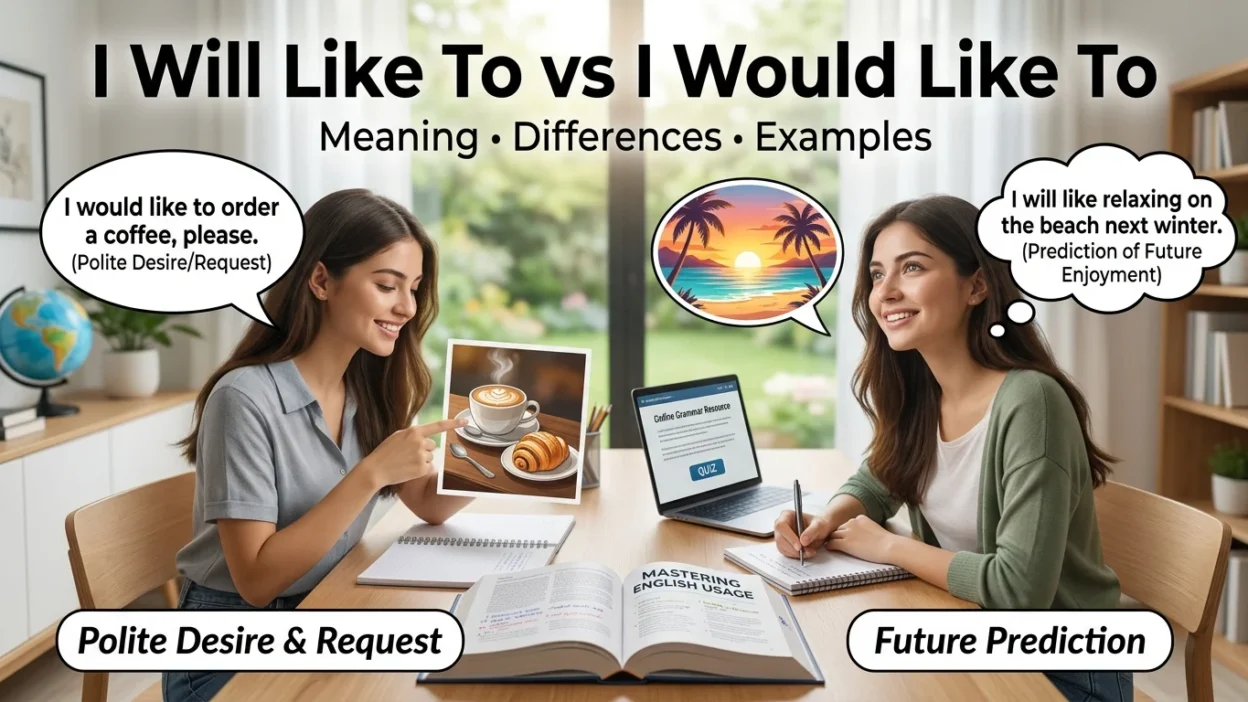
When learning English, “I will like to” and “I would like to” can look very similar, but they are not normally interchangeable. The important difference is that “would like to” is the natural and polite way to express a present desire, request, or preference, while “will like” usually refers to something someone is expected to enjoy in the future.
Understanding this distinction can help students and ESL learners sound more natural in conversations, emails, classrooms, restaurants, and professional situations. In this guide, you’ll learn when to use each expression, why “I will like to” is often incorrect, and how to choose the right phrase with simple examples.
Quick Answer
“I would like to” means “I want to” or “I wish to” and is commonly used for polite requests and present desires. “I will like” usually means that you will enjoy or prefer something in the future. For example, “I would like to order” is correct for a polite request, while “You will like this movie” predicts future enjoyment.
Why Do People Confuse “I Will Like To” and “I Would Like To”?
The confusion comes from the words will and would. Both are modal verbs, but they perform different functions.
“Will” commonly talks about the future, decisions, promises, predictions, or willingness:
- I will call you tomorrow.
- She will help us.
- You will like this book.
“Would” has several uses, but “would like” is a fixed and very common expression meaning “want” in a polite or softer form:
- I would like some coffee.
- I would like to speak with the manager.
- We would like to visit London.
This is why English speakers normally say “I would like to…” rather than “I will like to…” when making a polite request.
First Word: “Will”
Will is commonly used to talk about the future.
For example:
I will study tonight.
Here, the speaker is saying that studying will happen in the future.
“Will” can also express a prediction:
You will like this restaurant.
This means the speaker predicts that you will enjoy the restaurant.
However, “I will like to…” is generally not the natural way to say “I want to…” in present-day standard English.
Examples with “Will”
- I will visit you tomorrow.
- She will call later.
- They will arrive soon.
- You will enjoy the movie.
- He will probably like the new restaurant.
Notice that “will like” can be perfectly correct when like means enjoying something in the future.
Second Word: “Would”
Would is frequently used to make statements softer, more polite, or less direct.
The expression “would like” means “want” in a polite way.
For example:
I would like to ask a question.
This is more polite and formal than:
I want to ask a question.
The same pattern works with many situations:
- I would like to order lunch.
- I would like to learn English.
- I would like to speak with you.
- We would like to make a reservation.
- She would like to join the meeting.
“Would Like To” Formula
The basic structure is:
Subject + would like to + base verb
Examples:
- I would like to learn.
- He would like to travel.
- She would like to apply.
- We would like to discuss the problem.
Do not use a past-tense verb after “would like to.”
I would like to went home.
I would like to go home.
“I Will Like To” vs “I Would Like To”: Comparison Table
| Expression | Main Meaning | Typical Use | Example |
|---|---|---|---|
| I would like to | I want to | Polite requests or desires | I would like to ask a question. |
| I will like | I will enjoy/prefer | Future prediction or preference | I will like the new design. |
| I will like to | Usually unnatural for “I want to” | Rare or context-dependent | Usually replace it with “I would like to.” |
| I would like | I want | Polite statement | I would like some tea. |
| You will like | You will enjoy | Prediction | You will like this movie. |
The key distinction is simple: “would like” = want, while “will like” = will probably enjoy/prefer.
When Should You Use Each?
Use “I Would Like To” for Polite Requests
Use “I would like to” when you want to politely ask for something or express what you want to do.
Examples:
- I would like to order a coffee.
- I would like to make an appointment.
- I would like to ask something.
- I would like to speak with the teacher.
This is especially common in restaurants, workplaces, schools, customer service, and formal conversations.
Use “Will Like” for Future Enjoyment
Use “will like” when you are saying that someone is expected to enjoy something later.
Examples:
- I think you will like this book.
- She will like her birthday present.
- They will like the new restaurant.
- He will like his new job.
Here, like has its normal meaning of “enjoy” or “have a positive opinion of.”
Use “Would Like” for Present Wants
You can also use “would like” without “to” when the next word is a noun.
- I would like some water.
- I would like a sandwich.
- She would like a new phone.
- We would like more information.
Compare:
I would like some tea.
I would like to drink some tea.
Both are natural.
10+ Examples of “I Would Like To”
Here are practical examples showing how native and proficient English speakers commonly use the expression.
- I would like to learn Spanish.
- I would like to ask you a question.
- I would like to visit Canada someday.
- I would like to improve my English.
- I would like to order a pizza.
- I would like to make an appointment.
- I would like to join your team.
- I would like to discuss this matter.
- I would like to buy a new laptop.
- I would like to speak with the manager.
- I would like to thank everyone for coming.
- I would like to know more about the course.
In each example, “would like to” expresses a desire or intention politely.
Examples of “Will Like”
Now compare those sentences with situations where “will like” describes future enjoyment.
- You will like this restaurant.
- I think she will like the gift.
- He will like his new teacher.
- They will like the changes.
- I’m sure you will like this song.
- She will like the new apartment.
- You will like working with this team.
- We think customers will like the new product.
- He will like the movie.
- I’m certain they will like the idea.
The meaning is different from “would like to.”
Common Mistakes
Mistake 1: Using “I Will Like To” for a Polite Request
A common learner sentence is:
I will like to order a coffee.
In standard conversational English, the natural form is:
I would like to order a coffee.
Mistake 2: Confusing “Would Like” With “Will Like”
Consider:
I would like to see the movie.
This means:
I want to see the movie.
But:
I will like the movie.
This means:
I expect that I will enjoy the movie.
The two sentences have different meanings.
Mistake 3: Adding “To” After “Would Like” Incorrectly
When followed by a verb, use:
I would like to go.
When followed by a noun, don’t add “to”:
I would like some coffee.
Not:
I would like to some coffee.
Mistake 4: Using the Wrong Verb Form
After would like to, use the base form of the verb.
I would like to learn English.
I would like to learned English.
She would like to visit Paris.
She would like to visited Paris.
Memory Trick
Remember this simple rule:
Would like = want politely.
Will like = enjoy in the future.
You can also remember:
Would like to = want to.
So:
I would like to travel.
= I want to travel.
But:
I will like the trip.
= I will probably enjoy the trip.
This quick substitution test is useful whenever you are unsure.
American vs British English
The expression “would like to” is standard and natural in both American and British English.
You can use it in:
- Everyday conversations
- Formal emails
- Business communication
- Restaurants
- Schools
- Interviews
- Customer-service situations
For example:
American English:
“I would like to make an appointment.”
British English:
“I would like to make an appointment.”
There is no major American-versus-British difference in this basic usage.
The expression “I will like to” is not normally the preferred replacement for “I would like to” in either variety.
Similar Words and Expressions
Several expressions are related to “would like to.”
Want to
“I want to” is direct and very common.
I want to learn English.
Would like to
“I would like to” is softer and more polite.
I would like to learn English.
Wish to
“Wish to” is more formal and can sound official.
I wish to speak with the director.
Plan to
“Plan to” focuses on intention or a future plan.
I plan to study abroad.
Hope to
“Hope to” expresses a desired future possibility.
I hope to visit Japan someday.
These expressions are related, but they are not always interchangeable.
Final Verdict: “I Will Like To” or “I Would Like To”?
For most situations where you mean “I want to,” use “I would like to.”
I would like to ask a question.
I would like to order dinner.
I would like to learn English.
Use “will like” when you mean that someone is expected to enjoy or prefer something in the future:
I think you will like this book.
She will like her new job.
So the easiest rule is:
“Would like to” = want to
“Will like” = will enjoy
If you are making a polite request beginning with “I…”, “I would like to…” is usually the correct choice.
FAQs
Is “I will like to” grammatically correct?
It can occur in unusual or highly context-dependent constructions, but it is generally not the natural way to express a present desire. Use “I would like to” when you mean “I want to.”
Is “I would like to” polite?
Yes. “I would like to” is a common polite way to express a desire, make a request, or state what you want to do.
What is the difference between “I will like” and “I would like”?
“I will like” generally refers to future enjoyment or preference. “I would like” usually means “I want” and makes the statement softer or more polite.
Should I say “I would like to ask” or “I will like to ask”?
Say “I would like to ask.” For example: “I would like to ask you a question.”
Is “I would like to” formal?
It can sound polite and somewhat more formal than “I want to,” but it is also extremely common in everyday English.
Can “would like” be followed by a noun?
Yes. You can say “I would like some water” or “I would like a ticket.” When followed by a verb, use “would like to + base verb.”
What is an easy way to remember the difference?
Think “would like = want” and “will like = will enjoy.” This simple substitution usually makes the correct choice clear.
Remember This
- I would like to = I want to
- I will like = I will probably enjoy
- Use would like to for polite requests.
- Use will like for predictions about future enjoyment.
- After would like to, use the base form of the verb.
- Would like can be followed directly by a noun.
- “I would like to” is natural in both American and British English.
Conclusion
The difference between “I will like to” and “I would like to” becomes much easier once you focus on meaning. When you want to politely express a desire or request, choose “I would like to.” When you predict that someone will enjoy something later, “will like” is appropriate.
For everyday English, remember the simple formula: would like to = want to, while will like = will enjoy. Practicing these patterns in real sentences will help you communicate more naturally and confidently.