People often use inequity and inequality as if they mean exactly the same thing, but there is an important difference. Inequality generally describes a difference or uneven distribution between people or groups, while inequity usually refers to an unfair or unjust difference. Understanding this distinction can make your English more precise.
These words are especially common in discussions about education, healthcare, income, opportunity, social conditions, and public policy. In simple terms, an inequality can be observed as a difference, whereas an inequity emphasizes that the difference is unfair or unjust. However, the exact distinction can depend on the context and the field in which the words are used.
Quick Answer
Inequality means a difference or lack of equality between people, groups, or things. Inequity means an unfair or unjust difference, especially when people do not have equal opportunities or resources. Therefore, every inequity involves an unequal situation, but not every inequality is necessarily inequitable.
Why Do People Confuse It?
The confusion is understandable because both words come from equal and refer to situations in which things are not equal.
The main distinction is the idea of fairness:
- Inequality = a difference or unequal condition.
- Inequity = an unfair or unjust inequality.
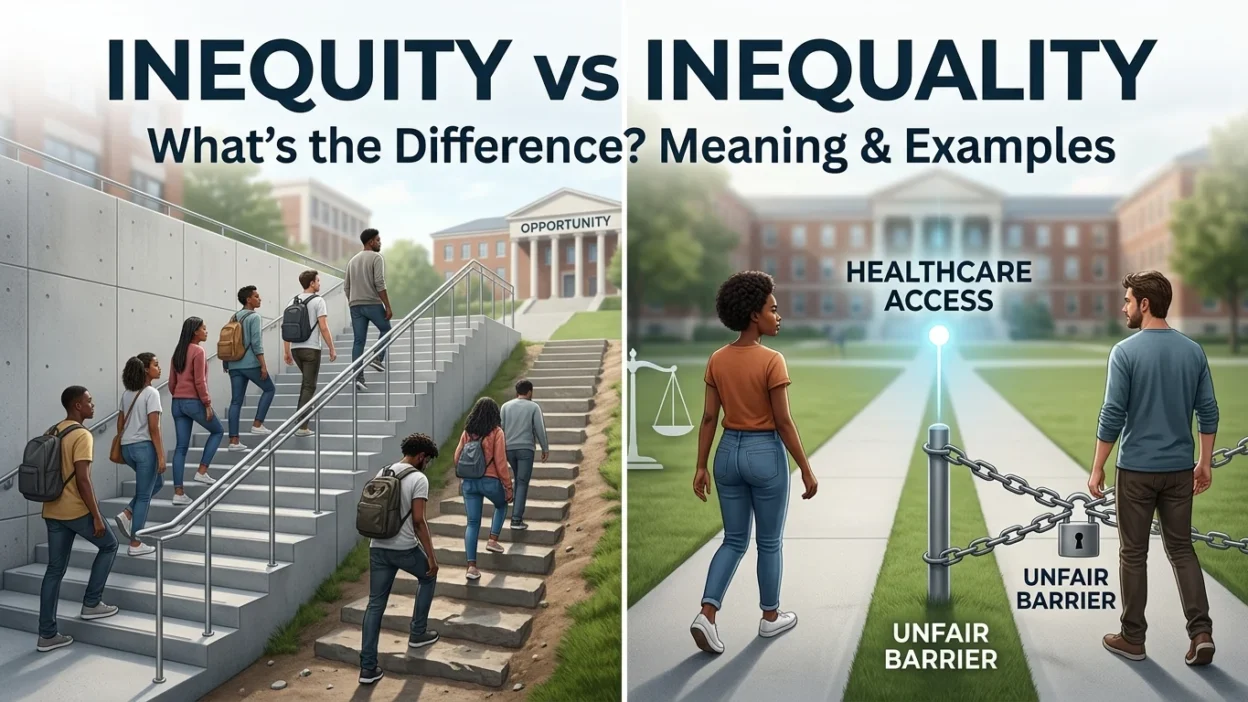
For example, two people may have different incomes. That difference is an income inequality. If the difference results from unfair barriers that prevent one group from accessing opportunities, it may also be described as an inequity.
In everyday English, the two words can sometimes overlap, but inequity carries a stronger sense of unfairness.
First Word: Inequity
Inequity is a noun meaning unfairness, injustice, or an unfair difference between people or groups.
It is commonly used when discussing situations where people do not receive fair treatment, opportunities, resources, or outcomes.
Examples of “inequity”
- The policy created an inequity between rural and urban students.
- Healthcare inequities can affect disadvantaged communities.
- The organization is working to reduce educational inequity.
- The report identified serious inequities in access to housing.
A useful way to remember it is:
Inequity focuses on unfairness.
Second Word: Inequality
Inequality is a noun meaning a lack of equality or a difference in size, amount, status, opportunity, or condition.
It does not automatically mean that the difference is unfair.
Examples of “inequality”
- The country has significant income inequality.
- Researchers studied gender inequality in the workplace.
- There is considerable inequality in access to education.
- The graph shows an inequality between the two groups.
A useful way to remember it is:
Inequality focuses on difference or lack of equality.
Inequity vs Inequality: Comparison Table
| Word | Basic meaning | Main idea | Does it imply unfairness? | Example |
|---|---|---|---|---|
| Inequity | An unfair or unjust difference | Fairness and justice | Usually yes | Inequity in healthcare access |
| Inequality | A difference or lack of equality | Unequal conditions | Not necessarily | Income inequality |
| Equity | Fairness according to circumstances | Fair treatment | No, it describes fairness | Promoting equity in education |
| Equality | The same treatment, amount, or status | Sameness or equal distribution | Not necessarily | Equality before the law |
The easiest distinction is difference versus unfairness. Inequality tells us that two situations are not equal; inequity highlights that the unequal situation is unfair.
When Should You Use Each?
Use “inequality” for measurable differences
Use inequality when you are describing a difference between people, groups, quantities, or conditions.
For example:
- income inequality
- wealth inequality
- gender inequality
- economic inequality
- social inequality
- inequality of opportunity
Example:
“Researchers examined income inequality across different regions.”
The sentence identifies a difference in income without necessarily explaining why that difference exists or whether it is unjust.
Use “inequity” when fairness is central
Use inequity when the situation involves unfair treatment, unequal access, discrimination, or an unjust distribution of opportunities or resources.
For example:
- healthcare inequity
- educational inequity
- racial inequity
- social inequity
- inequity in access to resources
Example:
“The program was designed to address inequities in access to healthcare.”
Here, the emphasis is not simply that access differs but that the difference is considered unfair.
10+ Examples of Inequity vs Inequality
1. Income
Inequality:
“There is significant income inequality between households.”
Inequity:
“The policy was criticized for creating greater economic inequity.”
2. Education
Inequality:
“There is an inequality in educational outcomes between the two regions.”
Inequity:
“The school system is working to address educational inequity.”
3. Healthcare
Inequality:
“The study measured inequality in healthcare access.”
Inequity:
“The researchers investigated healthcare inequities affecting low-income communities.”
4. Employment
Inequality:
“The report examined gender inequality in employment.”
Inequity:
“The organization wants to reduce inequity in hiring practices.”
5. Housing
Inequality:
“Housing inequality has increased in some major cities.”
Inequity:
“The report describes inequities in access to affordable housing.”
6. Technology
Inequality:
“Digital inequality can affect students who lack reliable internet access.”
Inequity:
“The project aims to address digital inequity among underserved communities.”
7. Opportunity
Inequality:
“There is inequality in access to educational opportunities.”
Inequity:
“The researchers identified inequities that prevent some students from receiving the same opportunities.”
8. Resources
Inequality:
“The study found an unequal distribution of resources.”
Inequity:
“The unequal distribution created an inequity between the communities.”
9. Social conditions
Inequality:
“Social inequality can be observed in differences in income and education.”
Inequity:
“The organization focuses on reducing social inequity.”
10. Workplace
Inequality:
“The company is examining gender inequality in leadership positions.”
Inequity:
“The company introduced policies to address inequities in promotion.”
11. Access
Inequality:
“There is inequality in access to public transportation.”
Inequity:
“Transportation inequity leaves some communities with fewer practical travel options.”
12. General difference
Inequality:
“The data show inequality between the two groups.”
Inequity:
“The researchers argue that this inequality represents an inequity.”
Common Mistakes
Mistake 1: Assuming they are always interchangeable
Although the words overlap, they do not have exactly the same emphasis.
Better:
Use inequality for an unequal condition and inequity when unfairness is an important part of the meaning.
Mistake 2: Thinking every inequality is unfair
An inequality can simply describe a difference.
For example:
“There is an inequality in the sizes of the two buildings.”
This is simply a difference in size. Calling it an inequity would suggest an issue of fairness that may not exist.
Mistake 3: Thinking inequity only means financial inequality
Inequity can involve many areas, including:
- healthcare
- education
- employment
- housing
- transportation
- technology
- legal access
- social opportunities
Mistake 4: Confusing equity with equality
Equality generally means giving people the same treatment, amount, or status.
Equity focuses on fairness and may involve responding to different circumstances.
For example, giving every student exactly the same resource is equality. Providing additional support to students facing particular barriers may be described as an equity-based approach.
Memory Trick
Use this simple memory trick:
Inequality = unequal.
Inequity = unfair.
Think of the extra “qu” sound in inequity as a reminder to ask:
“Is this unequal situation unfair?”
If the answer is simply “things are different,” inequality is usually the more appropriate word.
If the main point is that the difference is unfair or unjust, inequity is usually more precise.
American vs British English
Both inequity and inequality are used in American and British English.
There is no simple American-versus-British spelling distinction like color/colour or center/centre.
The difference is primarily one of meaning and context, not regional spelling.
Both varieties of English commonly use expressions such as:
- income inequality
- social inequality
- gender inequality
- healthcare inequity
- educational inequity
However, usage can vary between academic disciplines and organizations. In fields such as public health and social policy, inequity is often deliberately used when the writer wants to emphasize unfair or avoidable differences.
Similar Words
Inequity vs Equity
These are opposites in terms of fairness.
- Equity = fairness or justice.
- Inequity = unfairness or injustice.
Inequality vs Equality
These are direct contrasts concerning equality.
- Equality = being equal.
- Inequality = not being equal.
Inequity vs Injustice
These words are closely related.
- Inequity emphasizes an unfair condition or distribution.
- Injustice emphasizes unfair treatment or violation of what is considered just.
Inequality vs Disparity
Disparity means a noticeable difference or gap between things or groups.
For example:
“There is a disparity in educational outcomes.”
Depending on the context, that disparity may be an inequality and may also be considered an inequity.
Final Verdict
Inequality is the broader term for a lack of equality or a difference between people, groups, or conditions. It describes the unequal situation itself without necessarily saying that the situation is unfair.
Inequity is more specific because it normally emphasizes unfairness or injustice. When writing about social, economic, educational, or healthcare differences, choose the word that best reflects whether you are describing an unequal condition or highlighting its unfairness.
Frequently Asked Questions
Is inequity the same as inequality?
Not exactly. Inequality refers broadly to an unequal condition or difference, while inequity generally emphasizes an unfair or unjust difference.
Is inequity always negative?
Yes, inequity normally carries a negative meaning because it refers to unfairness or injustice. Inequality, however, can simply describe a difference without making a judgment about fairness.
What is an example of inequality but not inequity?
A simple difference in height between two people is an inequality, but it is not normally an inequity because there is no issue of fairness involved.
What is an example of inequity?
If one group has less access to essential healthcare because of an unfair barrier, that difference can be described as a healthcare inequity.
Which is correct: income inequity or income inequality?
Both expressions can be correct, but they emphasize different ideas. Income inequality describes differences in income, while income inequity emphasizes that those differences are unfair or unjust.
What is the difference between equity and equality?
Equality generally focuses on equal treatment or distribution, while equity focuses on fairness and may account for different circumstances or barriers.
Can inequality cause inequity?
Yes. An unequal condition may be considered an inequity when the difference results from or represents an unfair or unjust situation.
Remember This
- Inequality = difference or lack of equality.
- Inequity = unfair or unjust difference.
- Not every inequality is an inequity.
- Inequity puts greater emphasis on fairness and justice.
- Equality and inequality focus on equal versus unequal conditions.
- Equity and inequity focus more strongly on fairness versus unfairness.
Conclusion
The difference between inequity vs inequality becomes much easier when you focus on the idea of fairness. Inequality describes a difference or lack of equality, while inequity generally describes an unfair or unjust difference.
When you are simply describing an unequal situation, inequality is usually appropriate. When you want to emphasize that the difference is unfair, inequity is often the better choice. Remember: inequality means unequal; inequity means unfair.