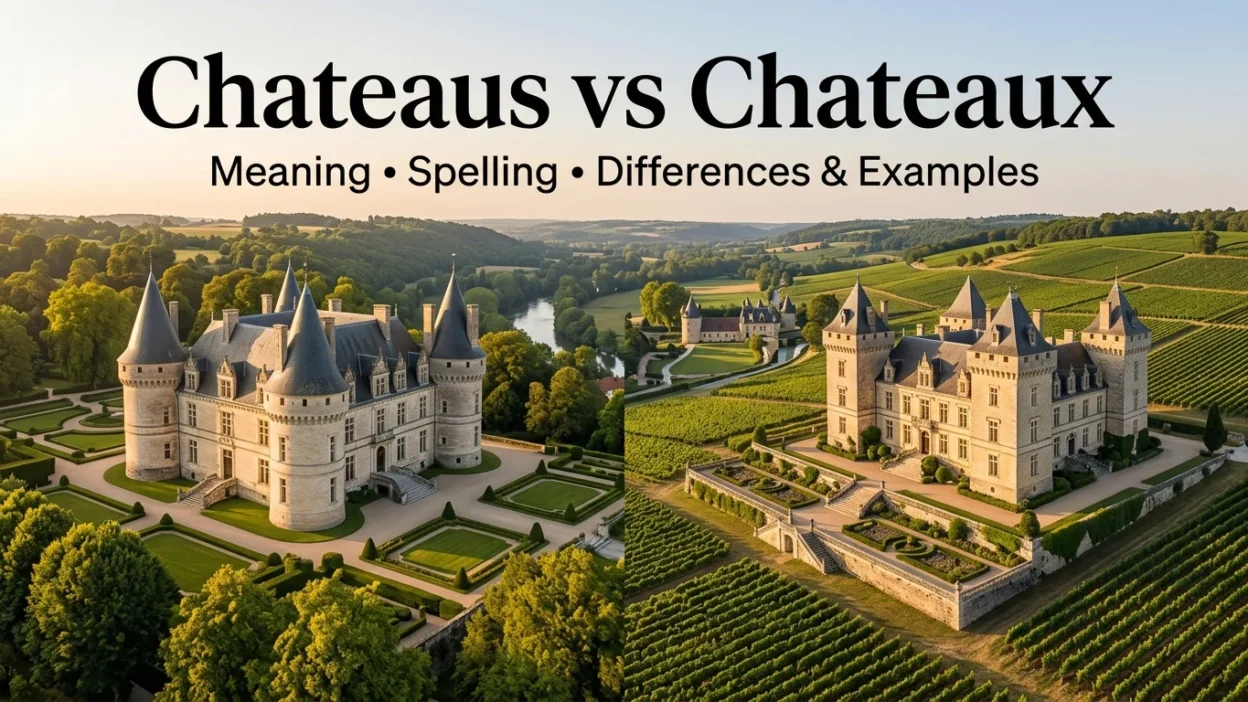
The words chateaus vs chateaux often confuse English learners because they are both plural forms associated with the French word château. The main difference is spelling and usage: chateaus is an accepted English plural, while chateaux is the traditional French-style plural. Both can refer to more than one château, but they may suggest slightly different linguistic contexts.
Understanding which form to use becomes easier when you know how English handles borrowed French words. Chateaus follows a more regular English plural pattern, while chateaux preserves the French plural ending. This guide explains the meaning, pronunciation, differences, examples, common mistakes, and when each form is appropriate.
Quick Answer
Chateaus and chateaux are both plural forms of château, meaning large French country houses, castles, or manor houses. Chateaux is the traditional French-style plural, while chateaus is an accepted English plural. In English, either can be correct, although chateaux is more common in contexts emphasizing French language or culture.
Why People Confuse It
The confusion comes from the unusual plural form chateaux. English speakers are generally familiar with adding -s to make a noun plural, so chateaus seems natural.
However, English has borrowed many words from French while retaining some of their original spelling patterns. The word château is one example.
In French, the plural is châteaux, with the circumflex accent over the a. In English, you may see the accent omitted, producing chateaux.
The important point is that chateaus is not simply a spelling mistake. It is a recognized English plural form.
First Word: Chateaus
Chateaus is the regularized English plural of chateau or château.
It follows the familiar English pattern of adding -s to a singular noun.
Meaning of Chateaus
Chateaus means more than one château. Depending on context, the word can describe:
- French castles
- Large country houses
- Historic manor houses
- Grand estates
- Wine-producing estates in some contexts
Examples
- The valley is surrounded by beautiful chateaus.
- Several historic chateaus are open to visitors.
- We photographed three elegant chateaus during our trip.
- The region contains hundreds of old chateaus.
For an English-language audience, chateaus is straightforward and easy to understand.
Second Word: Chateaux
Chateaux is the traditional plural form derived from French châteaux.
The singular French word is château, and its French plural is châteaux. When used in English, the plural is often written chateaux, with the French accent removed.
Meaning of Chateaux
Chateaux has essentially the same basic meaning as chateaus: more than one château.
Examples include:
- French castles
- Grand country residences
- Historic estates
- Loire Valley castles
- Wine estates known as châteaux
Examples
- The Loire Valley is famous for its magnificent chateaux.
- We visited several chateaux in France.
- The guidebook features historic chateaux and gardens.
- The wine region is home to many prestigious chateaux.
Chateaux can sound or look more traditionally French, especially in writing about French history, architecture, travel, or wine.
Chateaus vs Chateaux: Comparison Table
| Feature | Chateaus | Chateaux |
|---|---|---|
| Singular | Chateau / Château | Chateau / Château |
| Plural | Chateaus | Chateaux |
| Origin | English pluralization | French-style plural |
| Meaning | More than one château | More than one château |
| Correct in English? | Yes | Yes |
| French spelling | No | Close to French |
| Common context | General English | French-related contexts |
| Pronunciation | Usually similar | Usually similar |
The two forms generally refer to the same thing. The main difference is how the plural is formed.
When to Use Each
Use Chateaus in General English
Choose chateaus when writing informal or general English and you want the plural to follow a familiar English pattern.
For example:
We visited several beautiful chateaus.
This form is easy for English readers to recognize.
Use Chateaux in French-Related Contexts
Chateaux is especially natural when discussing French culture, architecture, history, tourism, or wine.
For example:
The Loire Valley contains some of France’s most famous chateaux.
Here, the French-style plural fits the subject particularly well.
Is One More Correct?
Not necessarily. In English, both chateaus and chateaux can be correct plural forms.
If you’re writing for a particular publication, however, follow its preferred dictionary or style guide consistently.
10+ Examples of Chateaus and Chateaux
Here are examples showing how both forms work in sentences.
- The countryside is dotted with historic chateaus.
- Tourists often visit the magnificent chateaux of the Loire Valley.
- We spent a week exploring old chateaus.
- France is famous for its beautiful chateaux.
- Several chateaus have been converted into hotels.
- The travel magazine featured ten spectacular chateaux.
- These chateaus were built centuries ago.
- Visitors can explore many royal chateaux throughout the region.
- The estate includes gardens, vineyards, and several chateaus.
- The famous chateaux attract visitors from around the world.
- We compared photographs of different chateaus.
- The region’s historic chateaux are important architectural landmarks.
- Several chateaus overlook the river.
- The tour includes visits to three Renaissance chateaux.
Notice that the meaning does not substantially change when you switch between the two plural forms.
Common Mistakes
Mistake 1: Thinking Chateaus Is Always Wrong
Some people assume that chateaux is the only correct plural.
That’s not true in English. Chateaus is an accepted English plural.
Mistake 2: Using Chateau’s for a Plural
Avoid writing:
We visited several chateau’s.
The apostrophe does not make a noun plural.
Use:
We visited several chateaus.
or:
We visited several chateaux.
Mistake 3: Confusing Plural and Possessive Forms
A plural tells you there is more than one:
The chateaux are beautiful.
A possessive indicates ownership:
The chateau’s garden is beautiful.
Here, chateau’s means the garden belongs to one château.
Mistake 4: Mixing Forms Carelessly
Avoid switching between chateaus and chateaux randomly in the same piece of writing.
Either form can work, but consistency usually makes your writing cleaner.
Memory Trick
A simple way to remember the difference is:
Chateaus = English-style plural
Chateaux = French-style plural
Think of -s as the familiar English ending.
Think of -eaux as the French-looking ending.
If you’re writing about French castles or estates and want to retain a French flavor, chateaux is a natural choice.
American vs British English
There is no major American-versus-British distinction that makes one form universally correct and the other incorrect.
Both chateaus and chateaux can appear in English-language writing on both sides of the Atlantic.
The choice is more closely related to style, context, and editorial preference than to national variety.
In formal writing about France, chateaux may feel more traditional because it preserves the appearance of the French plural. In ordinary English prose, chateaus may feel more naturally anglicized.
Similar Words
The singular word château has several related terms that may appear in English.
Chateau
Chateau is the singular form commonly used in English.
Example:
We stayed in a historic chateau.
Château
Château is the original French spelling, including the circumflex accent.
Example:
The château overlooks the vineyards.
Châteaux
Châteaux is the French plural spelling, including the circumflex accent.
Example:
The Loire Valley’s châteaux attract many visitors.
Castle
A castle is a broader English term. Not every château is exactly equivalent to the medieval fortresses English speakers usually imagine when they hear “castle.”
Manor
A manor generally refers to a large country house or estate, particularly in historical British contexts.
Final Verdict
So, chateaus vs chateaux is not really a question of right versus wrong. Both are acceptable plural forms in English.
Use chateaus when you want a regular English plural. Use chateaux when you prefer the traditional French-style plural or are writing in a strongly French-related context.
If you’re writing about French architecture, tourism, history, or wine, chateaux is often the more natural-looking choice. For general English writing, chateaus is perfectly understandable and acceptable.
FAQs
Is chateaus a correct word?
Yes. Chateaus is an accepted English plural of chateau.
Is chateaux the plural of chateau?
Yes. Chateaux is the traditional French-style plural used in English.
Which is correct, chateaus or chateaux?
Both can be correct in English. Chateaus uses an English plural ending, while chateaux follows the French plural pattern.
What is the singular of chateaux?
The singular is chateau or château.
What is the French plural of château?
The French plural is châteaux, with a circumflex accent.
Should I write chateaus or chateaux?
Choose according to context and style. Chateaux works especially well in French-related writing, while chateaus is a straightforward English plural.
Do chateaus and chateaux mean the same thing?
Generally, yes. Both refer to multiple chateaus or châteaux.
Remember This
Chateau / château = singular
Chateaus = English plural
Chateaux = French-style plural
Châteaux = French plural with the accent
The key is simple: chateaus and chateaux can both be correct in English.
Conclusion
Understanding chateaus vs chateaux is easier once you recognize that English has more than one way to pluralize borrowed words. Chateaus follows a regular English pattern, while chateaux preserves the traditional French-style ending. Both forms can refer to multiple grand French houses, castles, or estates.
When choosing between them, consider your audience and context. For French history, architecture, travel, and wine, chateaux may feel especially appropriate. For straightforward English writing, chateaus is a perfectly valid choice. Most importantly, avoid the common mistake of using an apostrophe to form the plural.