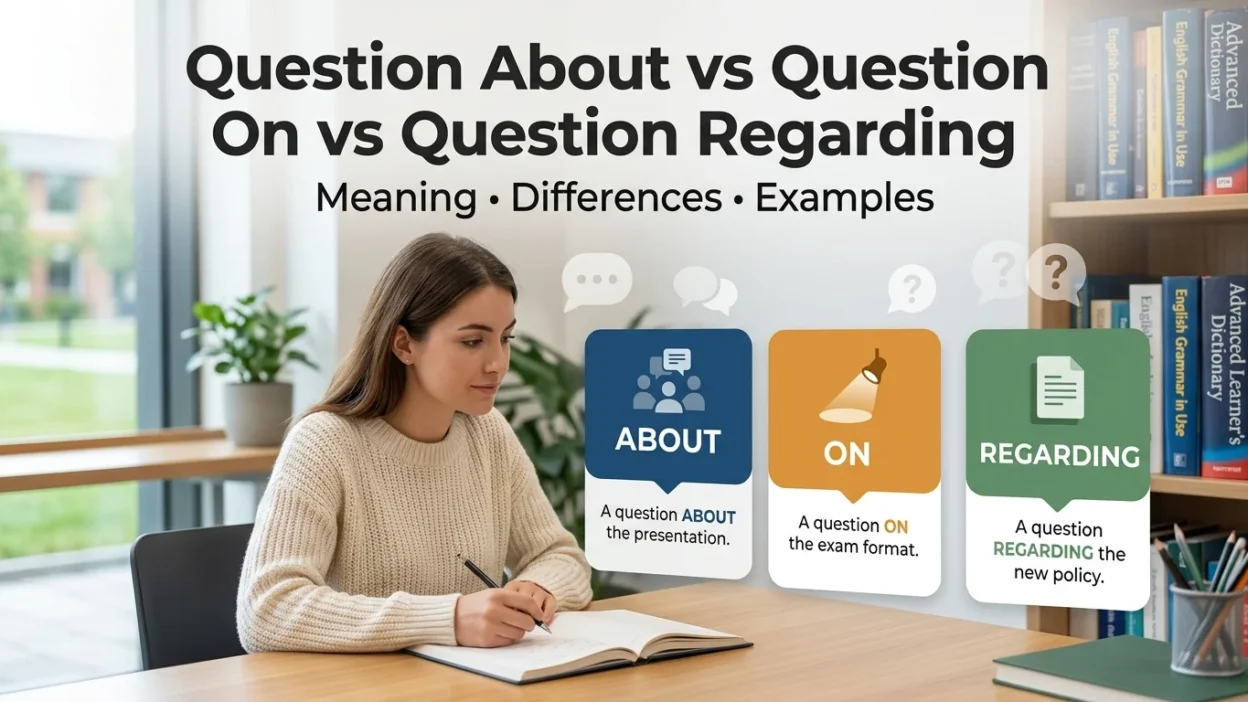
When you want to describe the topic of a question, question about, question on, and question regarding can all be correct. However, they differ slightly in tone, formality, and natural usage. Question about is the most common and natural choice in everyday English. Question regarding is more formal, while question on is often used in academic, professional, or topic-specific contexts.
Quick Answer
Question about is the most natural and widely used expression for asking about a topic. Question regarding means nearly the same thing but sounds more formal. Question on is also correct, especially in academic, professional, or subject-focused contexts. Choose based on context and tone.
Why Do People Confuse “Question About,” “Question On,” and “Question Regarding”?
The confusion happens because about, on, and regarding can all introduce the subject of a question.
For example:
- I have a question about your project.
- I have a question on your project.
- I have a question regarding your project.
All three can be grammatically possible, but they do not sound equally natural in every situation.
The biggest difference is usage and tone. “About” is neutral and conversational. “Regarding” is more formal. “On” often suggests a particular subject, area of study, issue, or topic.
What Does “Question About” Mean?
Question about is the most common expression when you want to say that something is the subject or topic of your question.
It works naturally in everyday conversations, emails, classrooms, customer service, and professional communication.
Examples
- I have a question about the assignment.
- She asked a question about the new policy.
- Do you have any questions about this lesson?
- I have a question about your product.
In most situations, question about is the safest and most natural choice.
What Does “Question On” Mean?
Question on can mean a question concerning a particular subject or topic. It is especially common when discussing academic subjects, examinations, research, reports, or specific areas of knowledge.
Examples
- The teacher asked a question on Shakespeare.
- I have a question on this topic.
- The exam contains several questions on grammar.
- She raised an important question on climate policy.
However, in ordinary conversation, question about will often sound more natural.
For example:
I have a question about your website.
is generally more conversational than:
I have a question on your website.
What Does “Question Regarding” Mean?
Question regarding means essentially “question about” or “question concerning.” It has a more formal tone.
It is common in business emails, official correspondence, customer service, workplace communication, and formal writing.
Examples
- I have a question regarding my application.
- We received several questions regarding the new regulations.
- I am writing with a question regarding your services.
- She contacted the office with a question regarding her account.
“Regarding” is useful when you want your writing to sound professional, but it can sound unnecessarily formal in casual conversation.
Question About vs Question On vs Question Regarding: Comparison Table
| Expression | Meaning | Tone | Common Context |
|---|---|---|---|
| question about | a question concerning something | Neutral | Everyday and general English |
| question on | a question concerning a particular subject | Neutral/Formal | Academic and subject-specific contexts |
| question regarding | a question concerning something | Formal | Business and official writing |
When Should You Use Each Expression?
Use “Question About” for General English
Choose question about when you are simply asking about something.
- I have a question about the meeting.
- Can I ask a question about this sentence?
- She has a question about the payment.
This is usually the best choice for everyday communication.
Use “Question On” for Subjects and Topics
Use question on when the question relates to a particular academic, professional, or specialized subject.
- The exam has five questions on grammar.
- He asked a question on modern history.
- The professor answered a question on linguistics.
Use “Question Regarding” in Formal Situations
Use question regarding when writing a formal email, letter, notice, or professional message.
- I have a question regarding my application.
- We received your question regarding the contract.
- Please contact us if you have any questions regarding your order.
10+ Examples of “Question About,” “Question On,” and “Question Regarding”
Everyday Examples
- I have a question about your new book.
- Can I ask a question about this word?
- She asked a question about the meeting.
- Do you have any questions about the lesson?
Academic Examples
- The teacher asked a question on verb tenses.
- The exam includes several questions on world history.
- He raised an interesting question on language development.
- The students answered questions on the reading material.
Formal Examples
- I am writing with a question regarding my application.
- We received your question regarding the payment.
- She sent an email regarding the project schedule.
- Please contact our office with any questions regarding your account.
Common Mistakes
Mistake 1: Thinking Only One Expression Is Correct
It is incorrect to assume that only question about is grammatically possible.
Depending on context, question on and question regarding can also be correct.
Mistake 2: Using “Question On” in Every Situation
“Question on” is not always the most natural choice.
For example:
I have a question about your car.
sounds more natural in ordinary conversation than:
I have a question on your car.
Mistake 3: Using “Regarding” in Very Casual Situations
“Regarding” is grammatically fine, but it can sound formal.
Instead of:
I have a question regarding your weekend plans.
a casual speaker would usually say:
I have a question about your weekend plans.
Mistake 4: Assuming “About” Is Always Informal
“About” is not limited to casual English. It is perfectly acceptable in professional and academic writing when the context calls for a straightforward style.
Memory Trick
Use this simple rule:
ABOUT = general
ON = a specific subject
REGARDING = formal
For example:
- Question about your job → general topic
- Question on mathematics → specific subject
- Question regarding your application → formal communication
This is not an absolute grammar rule, but it is a useful guide for choosing the most natural expression.
American vs British English
There is no major American-versus-British grammar difference that makes one of these expressions exclusively American or British.
Question about is widely understood and commonly used in both varieties.
Question on is also used in both, particularly when referring to a subject, examination, or specialized topic.
Question regarding is likewise understood in both varieties and is especially suitable for formal or professional contexts.
The main difference is therefore context and register, rather than a strict difference between American and British English.
Similar Words and Expressions
Several other words can introduce the subject of a question.
Question Concerning
“Concerning” is similar to “regarding” and has a formal tone.
- I have a question concerning the contract.
Question About
This is the simplest and most versatile choice.
- I have a question about the contract.
Question Related To
This expression emphasizes a connection with a particular subject.
- I have a question related to the new policy.
Question Involving
“Involving” is useful when something or someone is part of the issue.
- She asked a question involving several departments.
Final Verdict
Question about, question on, and question regarding can all be correct, but they are not equally natural in every situation.
For general communication, question about is usually the best choice. For a particular academic or specialized subject, question on can work well. For formal or professional communication, question regarding is a useful alternative.
Which one should you choose?
- Everyday English: question about
- Academic or subject-focused context: question on
- Formal or professional context: question regarding
FAQs
Is “question about” correct?
Yes. Question about is grammatically correct and is the most common and natural choice for general English.
Is “question on” grammatically correct?
Yes. Question on is correct when referring to a particular subject, topic, or area of study. It is especially common in academic contexts.
Is “question regarding” correct?
Yes. Question regarding is correct and means approximately “question about.” It has a more formal or professional tone.
Which is more natural: “question about” or “question regarding”?
Question about is generally more natural in everyday English. Question regarding is more formal and is often preferred in professional or official writing.
Which is correct: “a question about” or “a question on”?
Both can be correct. A question about is more general, while a question on often refers to a particular subject or topic.
Can I use “question regarding” in an email?
Yes. It is especially suitable for formal or professional emails, such as questions regarding an application, account, order, contract, or policy.
Is “question on” more formal than “question about”?
Not necessarily. “Question on” can sound more academic or subject-specific, but formality depends on the sentence and context.
Remember This
Question about → the safest general choice
Question on → a particular subject or academic topic
Question regarding → a formal way to say “question about”
When you are unsure, question about is usually the most natural option.
Conclusion
“Question about,” “question on,” and “question regarding” all express the idea of asking about a subject, but their typical contexts differ. About is broad and natural, on is often subject-focused, and regarding is more formal.
For everyday English, start with question about. Use question on when discussing a specific field or topic, and choose question regarding when you want a more formal or professional tone.