
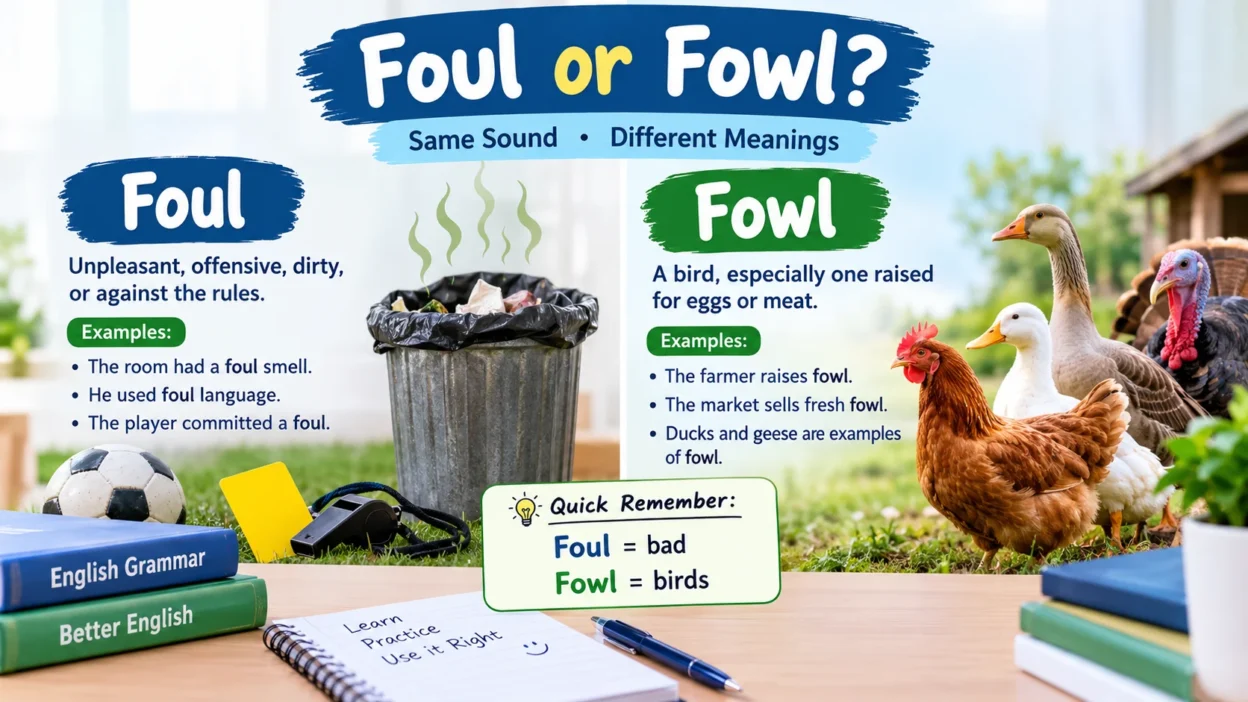
The words foul and fowl sound exactly the same, but they have different meanings and uses. If you are learning English, understanding the difference between these two words can help you avoid spelling mistakes and communicate more clearly. Although both words are pronounced alike, they are not interchangeable.
Foul usually describes something unpleasant, offensive, unfair, or against the rules. It can also refer to an illegal action in a sport. Fowl, on the other hand, refers to birds, especially birds kept for their eggs or meat, such as chickens, ducks, and turkeys. The main difference is that foul relates to something bad, dirty, or prohibited, while fowl relates to birds.
In this guide, you will learn the definitions of foul and fowl, how to use them correctly, common mistakes to avoid, and practical examples to help you remember the difference.
Quick Answer: Foul vs. Fowl
Foul means offensive, unpleasant, dirty, or against the rules. For example, “The player committed a foul.” Fowl means a bird, especially a bird raised for food, such as a chicken or turkey. For example, “The farmer raises fowl.” Both words are pronounced the same, but their meanings and spellings are different.
Why Do People Confuse Foul and Fowl?
People often confuse foul and fowl because they are homophones. Homophones are words that sound alike but have different meanings and spellings.
Both words are pronounced /faʊl/, which rhymes with howl and owl. When speaking, listeners usually understand which word someone means from the context. However, when writing, choosing the wrong spelling can change the meaning of a sentence.
For example:
- “The referee called a foul.” This means a player broke a rule.
- “The farmer keeps fowl.” This means the farmer keeps birds.
Remember that pronunciation alone cannot help you distinguish these words. You need to understand their meanings and the context in which they appear.
What Does Foul Mean?
Foul can function as an adjective, a noun, or a verb. Its meaning depends on how it is used in a sentence.
Foul as an Adjective
As an adjective, foul describes something unpleasant, offensive, dirty, or morally wrong.
Examples:
- The room had a foul smell.
- He used foul language during the argument.
- The river was polluted with foul water.
- The food tasted foul.
In these sentences, foul describes something undesirable or unpleasant.
Foul as a Noun
As a noun, foul often refers to an action that breaks the rules of a sport or game.
Examples:
- The referee called a foul.
- The basketball player committed a personal foul.
- The team received a penalty after the foul.
Foul as a Verb
As a verb, foul means to make something dirty, obstruct someone unfairly, or commit an illegal action in a sport.
Examples:
- The players fouled their opponents.
- Oil fouled the water near the shore.
- The defender fouled the attacking player.
What Does Fowl Mean?
Fowl is a noun that refers to birds, especially birds that are raised for their eggs or meat. The word is often used when discussing poultry, farming, cooking, and wildlife.
Examples of fowl include:
- Chickens
- Ducks
- Turkeys
- Geese
The word can also refer more broadly to certain birds, including wild birds used for food or game.
Fowl in Everyday English
Here are some examples of how to use fowl correctly:
- The farmer raises fowl on his property.
- The restaurant serves roasted fowl.
- Wild fowl gathered near the lake.
- The farm has several types of domestic fowl.
In everyday conversation, people often use more specific words such as chicken, duck, or turkey. The word fowl is especially useful when referring to birds as a group.
Foul vs. Fowl: Comparison Table
| Feature | Foul | Fowl |
|---|---|---|
| Part of speech | Adjective, noun, verb | Noun |
| Main meaning | Unpleasant, offensive, dirty, or against rules | A bird, especially one raised for food |
| Pronunciation | /faʊl/ | /faʊl/ |
| Common context | Sports, smells, language, behavior | Farming, cooking, birds |
| Example | The player committed a foul. | The farmer raises fowl. |
| Memory clue | Foul = something bad | Fowl = feathered bird |
The easiest way to remember the difference is to connect foul with bad behavior or unpleasant things and fowl with birds.
When Should You Use Foul or Fowl?
Choose the word according to the meaning you want to express.
Use Foul When Talking About Something Bad
Use foul when describing unpleasant smells, offensive language, dirty conditions, unfair behavior, or rule violations.
Examples:
- The garbage produced a foul odor.
- The referee penalized the player for a foul.
- The coach warned the team against foul play.
- He apologized for using foul language.
Use Fowl When Talking About Birds
Use fowl when referring to birds, particularly domestic birds raised for eggs or meat.
Examples:
- The farmer bought new fowl.
- The market sells fresh poultry and other fowl.
- Wild fowl flew over the wetlands.
- The cook prepared a traditional fowl dish.
A Simple Decision Rule
Ask yourself what you are describing:
- If you mean something unpleasant, offensive, or against the rules, use foul.
- If you mean a bird, use fowl.
12 Examples of Foul and Fowl in Sentences
These examples show how both words work in everyday English.
- Foul: A foul smell came from the kitchen.
- Fowl: The farmer raises fowl for their eggs.
- Foul: The referee stopped the game after a foul.
- Fowl: Several wild fowl rested beside the lake.
- Foul: The player was criticized for using foul language.
- Fowl: The restaurant served roasted fowl for dinner.
- Foul: The water became foul after the pollution spread.
- Fowl: Ducks and geese are common examples of waterfowl.
- Foul: The defender committed a foul during the match.
- Fowl: The farmer built a shelter for the fowl.
- Foul: The company was accused of foul play.
- Fowl: The children watched the fowl walking around the farm.
Notice that foul describes something unpleasant or an improper action, whereas fowl identifies birds.
Common Mistakes When Using Foul and Fowl
Even fluent English speakers can make spelling mistakes when writing homophones. Here are some common errors and their corrections.
Mistake 1: Writing Fowl Smell Instead of Foul Smell
Incorrect: The kitchen had a fowl smell.
Correct: The kitchen had a foul smell.
Why? The sentence describes an unpleasant odor, so foul is the correct word.
Mistake 2: Writing Foul for Birds
Incorrect: The farmer raises foul.
Correct: The farmer raises fowl.
Why? The sentence refers to birds raised on a farm.
Mistake 3: Confusing a Foul with Fowl Play
Incorrect: The team was accused of fowl play.
Correct: The team was accused of foul play.
Why? Foul play is an established expression meaning dishonest, unfair, or potentially criminal behavior.
Mistake 4: Assuming the Words Are Interchangeable
Incorrect: The farmer bought several foul for the farm.
Correct: The farmer bought several fowl for the farm.
Why? The intended meaning is birds, not something unpleasant.
Mistake 5: Forgetting the Sports Meaning of Foul
Incorrect: The referee called a fowl.
Correct: The referee called a foul.
Why? In sports, foul refers to an action that violates the rules.
Memory Trick: How to Remember Foul vs. Fowl
Use these simple memory tricks to keep the two words separate.
- Foul = Fault or something unpleasant. Think of a foul smell, foul language, or a foul in basketball.
- Fowl = Feathered birds. Think of chickens, ducks, geese, and turkeys.
You can also remember this sentence:
“A foul smell came from the fowl farm.”
In this sentence, foul describes the smell, while fowl refers to the birds.
The words sound the same, but their meanings are easy to distinguish once you connect each spelling with a specific idea.
Foul vs. Fowl in American and British English
The distinction between foul and fowl is essentially the same in American and British English.
| Word | American English | British English |
|---|---|---|
| Foul | Unpleasant, offensive, or against the rules | Unpleasant, offensive, or against the rules |
| Fowl | A bird, especially one raised for food | A bird, especially one raised for food |
Both varieties of English use foul for expressions such as foul language, foul smell, and foul play. Both also use fowl when referring to birds.
There is no American-versus-British spelling difference between these two words. The correct choice depends on the meaning, not the country.
Similar Words to Foul and Fowl
Learning related words can help you understand these terms more clearly.
Words Related to Foul
- Offensive: Causing someone to feel upset or insulted.
- Unpleasant: Not enjoyable or agreeable.
- Dirty: Covered with dirt or contamination.
- Illegal: Against the law or a particular rule.
- Unsportsmanlike: Not showing fair or respectful behavior in sports.
Example: The referee punished the player for unsportsmanlike behavior.
Words Related to Fowl
- Poultry: Domestic birds raised for eggs, meat, or other agricultural purposes.
- Chicken: A common domestic bird raised for eggs and meat.
- Waterfowl: Birds such as ducks, geese, and swans that are associated with water.
- Game bird: A bird hunted for sport or food.
- Turkey: A large bird commonly raised for meat.
Example: The farm raises poultry, including chickens and turkeys.
Although fowl and poultry overlap in meaning, they are not always exact synonyms. Fowl can refer to wild birds as well as domestic birds, depending on the context.
Final Verdict: Foul or Fowl?
The difference between foul and fowl is simple once you remember their meanings.
Use foul when you mean something unpleasant, offensive, dirty, unfair, or against the rules. It can describe a smell, language, behavior, or an illegal action in a sport.
Use fowl when you mean birds, particularly those raised for their eggs or meat.
Both words are pronounced the same, but their spellings and meanings are different. When writing, pay attention to the context to select the right word.
Frequently Asked Questions
1. What is the main difference between foul and fowl?
Foul means unpleasant, offensive, dirty, or against the rules. Fowl refers to birds, especially those raised for food. For example, a foul smell is unpleasant, while chickens are a type of fowl.
2. Are foul and fowl pronounced the same?
Yes. Foul and fowl are homophones, meaning they have the same pronunciation but different spellings and meanings. Both are pronounced /faʊl/, rhyming with howl.
3. Is it foul smell or fowl smell?
The correct expression is foul smell. The adjective foul describes an unpleasant or offensive odor. Fowl refers to birds and does not describe a smell in this expression.
4. Is it foul play or fowl play?
The correct expression is foul play. It refers to dishonest, unfair, or potentially criminal behavior. Fowl play is sometimes used as a joke or pun, but it is not the standard expression.
5. Is a chicken a fowl?
Yes. A chicken is a type of domestic fowl. The word fowl can refer to birds such as chickens, ducks, geese, and turkeys, although its exact scope depends on the context.
6. Is foul a noun or an adjective?
Foul can be an adjective, noun, or verb. It describes something unpleasant as an adjective, refers to a rule-breaking action as a noun, and can mean to make something dirty or commit an infraction as a verb.
7. Do American and British English use foul and fowl differently?
No significant difference exists in their standard meanings or spellings. Both American and British English use foul for unpleasant things or rule violations and fowl for birds.
8. What is an easy way to remember foul and fowl?
Remember foul = bad and fowl = birds. A foul smell is unpleasant, while a chicken or duck can be called a fowl. This simple association helps you choose the correct spelling.
Remember This
- Foul = unpleasant, offensive, dirty, or against the rules.
- Fowl = a bird, especially one raised for food.
- Both words sound the same but have different meanings.
- Use context to choose the correct spelling.
- Write foul smell and foul play, but farm fowl.
Conclusion
Understanding the difference between foul and fowl helps you improve your spelling, vocabulary, and everyday communication. Although the two words sound alike, their meanings are quite different. Foul describes something unpleasant or a violation of rules, while fowl refers to birds such as chickens, ducks, and turkeys.
To remember the distinction, connect foul with something bad and fowl with feathered birds. Practice using both words in your own sentences, and always consider the context before choosing a spelling. With a little practice, you can use foul and fowl correctly and confidently.