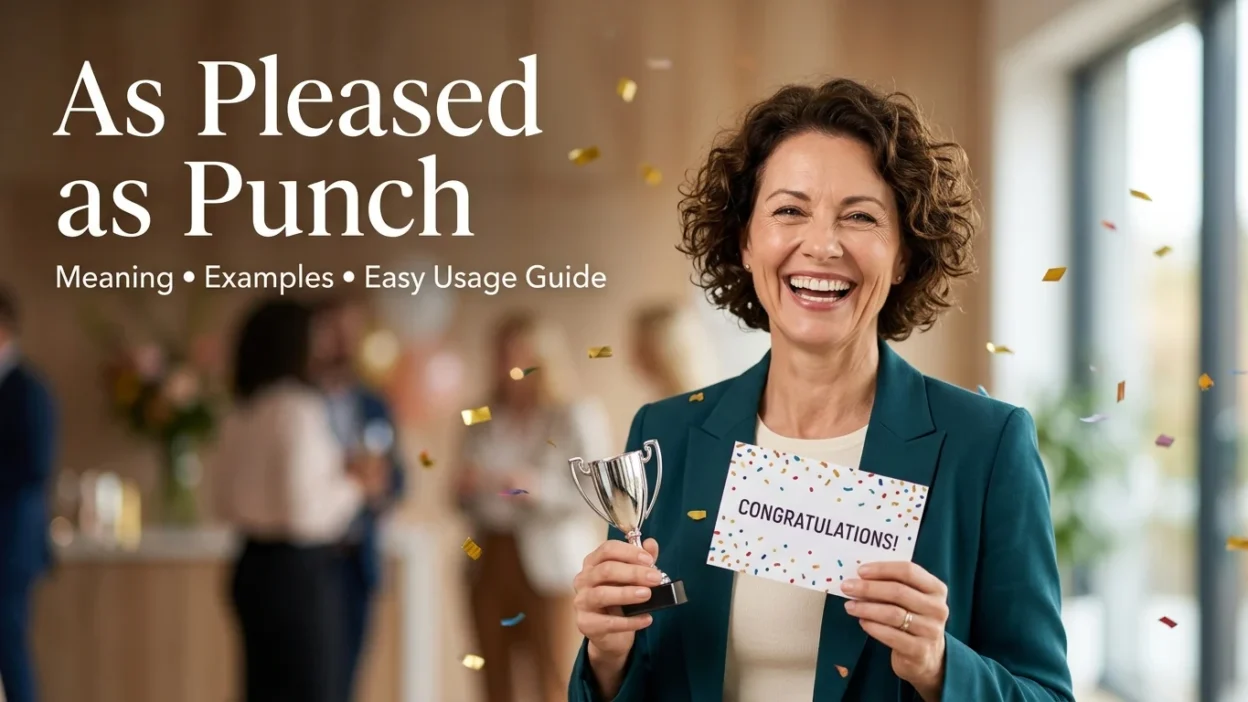
“As pleased as punch” is a common English idiom that means extremely happy, delighted, or satisfied about something. It is often used when someone feels especially proud or pleased because something good has happened. For example, if a student gets the highest grade in the class, you might say, “She was as pleased as punch with her result.”
The expression can describe people in many everyday situations, including success at school or work, receiving good news, achieving a personal goal, or being proud of someone else. Although the phrase contains the word “pleased,” it does not simply mean “a little happy.” It usually emphasizes a strong feeling of satisfaction and delight.
Quick Answer
“As pleased as punch” means very happy, delighted, or satisfied. It is an informal English idiom used to describe someone who is extremely pleased about something. For example: “He was as pleased as punch when he won the competition.” The phrase is commonly used in everyday conversation and writing.
Why People Confuse It
People sometimes find “as pleased as punch” confusing because its literal meaning does not clearly explain its idiomatic meaning.
If you read the phrase word by word, it sounds like someone is being compared with “punch.” However, punch is part of the fixed expression, and the phrase is not normally intended as a literal comparison.
The expression follows the familiar English pattern “as + adjective + as + noun.” Similar expressions include:
- as happy as a lark
- as busy as a bee
- as quiet as a mouse
- as proud as a peacock
- as cool as a cucumber
In “as pleased as punch,” the important word is pleased, while punch completes the established idiom.
First Word: “Pleased”
Pleased is an adjective meaning happy, satisfied, or glad about something.
For example:
- I am pleased with your work.
- She was pleased to hear the news.
- They were pleased with the results.
- He looked pleased after receiving the award.
The word can describe a mild or strong feeling depending on the context.
When used in “as pleased as punch,” however, it contributes to the stronger meaning of being very happy or delighted.
Second Word: “Punch”
In this idiom, punch does not mean hitting someone.
The word punch has several meanings in English. It can refer to a physical blow, a mixed drink, or a character from the traditional Punch and Judy puppet shows.
In the idiom “as pleased as punch,” punch is simply part of the established expression. You should not interpret the phrase literally as meaning someone is as happy as a physical punch or a drink.
Comparison Table
| Expression | Meaning | Example |
|---|---|---|
| pleased | happy or satisfied | I am pleased with my work. |
| very pleased | very happy or satisfied | She was very pleased with the result. |
| delighted | extremely happy | He was delighted to hear the news. |
| as pleased as punch | extremely pleased or delighted | She was as pleased as punch after winning. |
| overjoyed | extremely happy | They were overjoyed by the announcement. |
When to Use “As Pleased as Punch”
Use “as pleased as punch” when you want to emphasize that someone is particularly happy or satisfied.
It works well in situations such as:
- winning something
- receiving good news
- accomplishing a goal
- getting praise
- being proud of an achievement
- receiving a gift
- seeing someone succeed
- completing an important task
- getting a desired opportunity
- celebrating a positive result
It is generally informal and conversational, so it can sound warmer and more expressive than simply saying “happy.”
10+ Examples of “As Pleased as Punch”
1. After Winning a Competition
Tom was as pleased as punch when he won the science competition.
He was extremely happy and proud of his achievement.
2. After Getting Good Grades
Maya was as pleased as punch with her exam results.
The expression shows that Maya was very satisfied with her performance.
3. Receiving a Promotion
James was as pleased as punch when his manager offered him a promotion.
Here, the idiom emphasizes his excitement about the good news.
4. A Proud Parent
Her mother was as pleased as punch when she saw her daughter perform on stage.
The phrase can describe happiness about another person’s achievement.
5. Getting a New Job
Ali was as pleased as punch after receiving the job offer.
The expression makes his happiness sound especially strong.
6. Completing a Difficult Project
We were as pleased as punch when we finally finished the project.
The idiom highlights the satisfaction that came with completing something challenging.
7. Receiving a Gift
Sarah was as pleased as punch when she opened her birthday present.
This is a natural way to describe someone’s delight.
8. Winning an Award
The young author was as pleased as punch to receive the award.
The phrase emphasizes her happiness and pride.
9. Getting Positive Feedback
He was as pleased as punch when his teacher praised his essay.
The expression works well when someone receives unexpected or meaningful praise.
10. Achieving a Personal Goal
I was as pleased as punch when I finally learned how to play the song.
The idiom can describe personal satisfaction, not just major achievements.
11. Good News at Work
The team was as pleased as punch with the successful launch.
It can describe a group as well as an individual.
12. A Successful Event
The organizers were as pleased as punch with how well the event went.
Here, the phrase means extremely satisfied.
Common Mistakes
Mistake 1: Taking the Phrase Literally
Incorrect understanding:
“As pleased as punch” means being pleased with punch.
That is not what the idiom means.
Correct meaning:
“As pleased as punch” means extremely pleased or delighted.
Mistake 2: Using “Pleased as Punch” for Anger
The phrase describes happiness or satisfaction.
Incorrect:
He was as pleased as punch because he lost his wallet.
Unless the context is deliberately humorous or ironic, this does not make sense.
Mistake 3: Changing the Phrase Too Much
The established expression is:
as pleased as punch
Avoid unnecessarily changing it to forms such as “as pleased as a punch” when you intend to use the standard idiom.
Mistake 4: Assuming It Means Only “Satisfied”
“Pleased” can sometimes mean satisfied, but “as pleased as punch” usually communicates a noticeably stronger feeling of happiness or delight.
Memory Trick
Think:
Pleased = happy
As pleased as punch = VERY happy
A simple memory sentence is:
You can also remember the phrase as a fixed three-part unit:
AS + PLEASED + AS PUNCH
Do not try to interpret punch literally.
American vs British English
“As pleased as punch” is understood in both British and American English.
However, it can have a particularly traditional or distinctly British feel. In everyday American conversation, people may more often say:
- very happy
- really pleased
- delighted
- thrilled
- overjoyed
- excited
That does not mean Americans cannot use or understand “as pleased as punch.” It is a recognizable English idiom, although its frequency and tone can vary depending on the speaker and context.
Similar Words
Several words and expressions can communicate a similar idea.
Delighted
Delighted means extremely pleased.
She was delighted with her new job.
Thrilled
Thrilled describes a very strong feeling of excitement and happiness.
He was thrilled to hear the news.
Overjoyed
Overjoyed means extremely happy.
They were overjoyed when their team won.
Ecstatic
Ecstatic describes an exceptionally intense feeling of happiness.
She was ecstatic about the opportunity.
Very pleased
This is a straightforward alternative.
He was very pleased with the result.
On Cloud Nine
This idiom means extremely happy.
She has been on cloud nine since receiving the good news.
Final Verdict
“As pleased as punch” is a correct English idiom meaning extremely pleased, happy, or delighted. It is especially useful when you want to express strong satisfaction or pride about a positive event.
Remember that punch is not meant literally in this expression. Treat “as pleased as punch” as one fixed phrase, and you will be able to use it naturally.
FAQs
What does “as pleased as punch” mean?
It means extremely happy, pleased, or satisfied about something.
Is “as pleased as punch” an idiom?
Yes. It is a fixed English idiomatic expression whose meaning cannot be understood simply by interpreting each word literally.
Is “as pleased as punch” positive or negative?
It is normally positive. It describes strong happiness, satisfaction, or delight.
Can I use “as pleased as punch” in a sentence?
Yes. For example: “She was as pleased as punch when she received the award.”
Is “pleased as punch” formal?
It is generally informal and conversational. It can also appear in friendly or lighthearted writing.
Is “as pleased as punch” British or American?
It is used and understood in both varieties of English, although it may have a somewhat traditional or British flavor.
What is another way to say “as pleased as punch”?
You could say delighted, thrilled, extremely pleased, overjoyed, or very happy, depending on the context.
Remember This
As pleased as punch = extremely pleased or very happy.
Use it when someone feels especially delighted about a good result, achievement, piece of news, gift, opportunity, or another positive experience.
Example:
“She was as pleased as punch when she passed her driving test.”
Conclusion
The idiom “as pleased as punch” is a colorful way to say that someone is extremely happy, delighted, or satisfied. Although the word “punch” may seem confusing, it is simply part of the established expression and should not be interpreted literally.
When you see or use “as pleased as punch,” think “very pleased.” Whether someone has won a competition, received good news, achieved a goal, or feels proud of someone else, this friendly idiom can add warmth and personality to everyday English.