
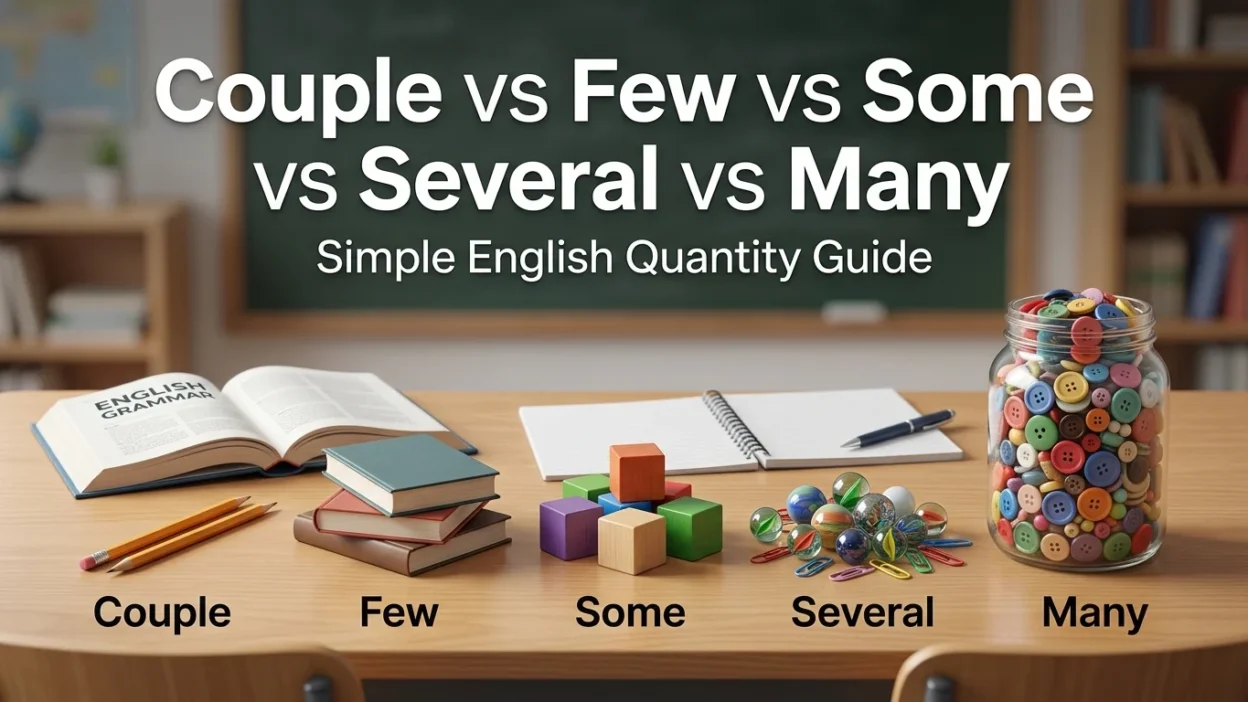
When talking about an unspecified number of people or things, English speakers often use words such as couple, few, some, several, and many. These words are related, but they do not mean exactly the same thing. The main difference is the size or precision of the number they suggest.
In general, a couple usually means two, a few means a small number, some means an unspecified number, several means more than two but not a large number, and many refers to a large number. However, context can affect the exact meaning, especially with some, several, and a few. Understanding these differences will help you sound more natural and choose the right word when speaking or writing English.
Quick Answer
Couple usually means two, few means a small number, some means an unspecified number, several means more than two but fewer than many, and many means a large number. These words are generally used with plural countable nouns, although some has additional uses.
Why Do People Confuse Couple, Few, Some, Several, and Many?
These words are confusing because none of them, except couple in its most literal sense, gives an exact number.
For example:
- I bought a couple of books. → Usually two books.
- I bought a few books. → A small number of books.
- I bought some books. → An unspecified number of books.
- I bought several books. → More than two, but not a large number.
- I bought many books. → A large number of books.
The boundaries between these words are not mathematical. What one speaker considers several might be considered a few by another speaker.
Couple: What Does “Couple” Mean?
Couple most commonly means two people or things considered together.
When talking about quantity, English speakers frequently use the expression a couple of + plural noun.
Examples
- I need a couple of minutes.
- She bought a couple of dresses.
- We stayed there for a couple of days.
- He asked me a couple of questions.
In everyday informal English, a couple of can sometimes suggest approximately two rather than exactly two.
For example:
I’ll be there in a couple of minutes.
This normally means approximately two minutes, not necessarily exactly 120 seconds.
Important Point
Couple is normally followed by of when it means a small quantity:
- a couple of books
- a couple of friends
- a couple of hours
However, couple has another meaning: two people in a romantic relationship.
They are a married couple.
Few: What Does “Few” Mean?
Few means a small number of people or things.
It is used with plural countable nouns.
Examples
- I have a few questions.
- Only a few students attended.
- We need a few more chairs.
- She has visited a few countries.
There is an important difference between few and a few.
“Few” vs “A Few”
Few usually emphasizes that the number is smaller than expected or desirable.
Few people understood the difficult question.
This suggests that almost nobody understood it.
A few has a more positive or neutral meaning.
A few people understood the difficult question.
This means some people understood it.
Compare:
- I have few friends. → I have almost no friends.
- I have a few friends. → I have some friends.
That small word a can significantly change the meaning.
Some: What Does “Some” Mean?
Some refers to an unspecified quantity or number. It does not tell us exactly how many.
It can be used with plural countable nouns and uncountable nouns.
With plural countable nouns
- I bought some apples.
- She invited some friends.
- We need some chairs.
With uncountable nouns
- I need some water.
- He bought some rice.
- Would you like some coffee?
Unlike couple, few, several, and many, some is not limited to countable plural nouns.
The important idea is that some gives little information about the exact quantity.
She has some books.
This could mean three books, ten books, or another unspecified number.
Comparison Table
| Word | Basic Meaning | Exact Number? | Typical Use | Example |
|---|---|---|---|---|
| a couple | approximately two | Usually two | Small quantity | I need a couple of days. |
| a few | a small number | No | Small quantity | I have a few questions. |
| some | an unspecified amount/number | No | Countable & uncountable nouns | I bought some books. |
| several | more than two, but not many | No | Moderate small number | She visited several cities. |
| many | a large number | No | Large number of countable things | Many people agreed. |
When Should You Use Each Word?
Choosing the correct word depends on how much information you want to communicate about quantity.
Use “a Couple” for About Two
Use a couple of when you mean two or approximately two.
I need a couple of days to finish it.
Use “A Few” for a Small Number
Use a few when you mean a small number without giving an exact figure.
I made a few changes to the document.
Use “Some” When the Number Is Not Important
Use some when the exact number or amount is unknown, unstated, or unimportant.
I met some interesting people at the conference.
Use “Several” for More Than Two but Not a Large Number
Use several when you want to suggest a number greater than two but still relatively limited.
We discussed the issue with several experts.
Use “Many” for a Large Number
Use many when the number is large or significant.
Many people use smartphones every day.
10+ Examples of Couple, Few, Some, Several, and Many
Here are practical examples showing how these words differ.
- I need a couple of minutes.
→ Approximately two minutes. - She bought a couple of notebooks.
→ Usually two notebooks. - I have a few questions.
→ I have a small number of questions. - A few students stayed after class.
→ A small number stayed. - We invited some neighbors.
→ An unspecified number of neighbors. - Can you give me some advice?
→ An unspecified amount of advice. - He has several books about history.
→ More than two, but not a large collection. - Several people complained about the noise.
→ More than two people complained. - Many students enjoy learning English.
→ A large number of students do so. - Many countries use English as an important language.
→ A large number of countries. - I’ll call you in a couple of hours.
→ About two hours. - We’ve known each other for a few years.
→ A small number of years.
Common Mistakes
1. Treating “Few” and “A Few” as Identical
They are not always interchangeable.
- Few people came. → Almost nobody came.
- A few people came. → Some people came.
2. Using “Many” With Uncountable Nouns
In standard English, many is normally used with plural countable nouns.
Incorrect:
I don’t have many money.
Correct:
I don’t have much money.
But:
I don’t have many coins.
3. Forgetting “Of” After “A Couple”
When couple refers to quantity, the normal construction is:
a couple of + plural noun
Correct:
I bought a couple of shirts.
4. Assuming “Several” Always Means a Specific Number
Several does not have one fixed numerical value.
It generally suggests more than two and fewer than a large number, but the exact quantity depends on context.
5. Thinking “Some” Means “A Few”
Some is broader.
I bought some books.
The speaker does not tell us whether there are three, five, ten, or another number.
Memory Trick
Think of these words as a quantity scale:
A couple → A few → Several → Many
And place some separately because it tells you that there is an amount or number without clearly describing its size:
- A couple = about 2
- A few = small number
- Some = unspecified number/amount
- Several = more than 2, but not many
- Many = large number
A simple memory sentence is:
Couple is tiny, few is small, several is more, and many is large.
American vs British English
The meanings of couple, few, some, several, and many are broadly similar in American and British English.
However, everyday speakers may differ in how they interpret vague quantities such as a few and several.
For example, one person may use several for four or five items, while another may use it for a larger number.
The phrase a couple of is also extremely common in both varieties of English and often means approximately two in informal conversation.
The important point is that these words are generally approximate quantity expressions, not precise mathematical measurements.
Similar Words
Several other words can express quantity.
A Pair
A pair means two things that naturally belong together or are used together.
I bought a pair of shoes.
Unlike a couple of, a pair of strongly emphasizes that the two items form a set.
A Little
A little is used with uncountable nouns.
I need a little water.
Few
Few means a small number of countable things.
Few students complained.
Numerous
Numerous means many or a large number.
Numerous people attended the event.
It is more formal than many.
Plenty of
Plenty of means more than enough.
We have plenty of food.
This expression can be used with both countable and uncountable nouns.
Final Verdict
The easiest way to distinguish these words is to think about approximate quantity.
A couple normally suggests two. A few means a small number. Some gives an unspecified number or amount. Several generally suggests more than two but fewer than many. Many indicates a large number.
Remember that these words do not create an exact numerical scale. Context, expectation, and the speaker’s perspective can influence how few, some, and several are understood.
FAQs
Is “a couple” always exactly two?
Not always. A couple literally means two, but a couple of can mean approximately two in informal English.
What is the difference between “a few” and “few”?
A few means some or a small number and is usually neutral or positive. Few emphasizes that the number is very small or less than expected.
Is “several” more than “a few”?
Usually, yes. Several commonly suggests more than two and often sounds somewhat greater than a few, but there is no fixed numerical boundary.
Does “some” mean a small number?
Not necessarily. Some simply means an unspecified quantity or number. It can refer to a small, moderate, or even relatively large amount depending on context.
Can “many” be used with uncountable nouns?
Generally, many is used with plural countable nouns. For uncountable nouns, use much, a lot of, or similar expressions.
Is “a couple of” grammatically correct?
Yes. A couple of + plural noun is a standard and very common construction.
I need a couple of days.
Which is more: “several” or “many”?
Many generally suggests a considerably larger number than several. However, neither word specifies an exact number.
Remember This
- A couple → usually two
- A few → a small number
- Some → an unspecified number or amount
- Several → more than two, but not many
- Many → a large number
- Few → emphasizes a very small number
- A few → emphasizes that there are some
The most important distinction is between few and a few. Few often has a negative or limiting sense, while a few normally means that there are at least some.
Conclusion
Couple, few, some, several, and many all describe quantity, but they communicate different ideas. Use a couple of for approximately two, a few for a small number, some when the exact quantity is unspecified, several for more than two but not a large number, and many for a large number.
You do not need to memorize an exact numerical scale for these words. Instead, focus on the general size and meaning each word communicates. With regular exposure to natural English examples, choosing between couple vs few vs some vs several vs many will become much easier.