
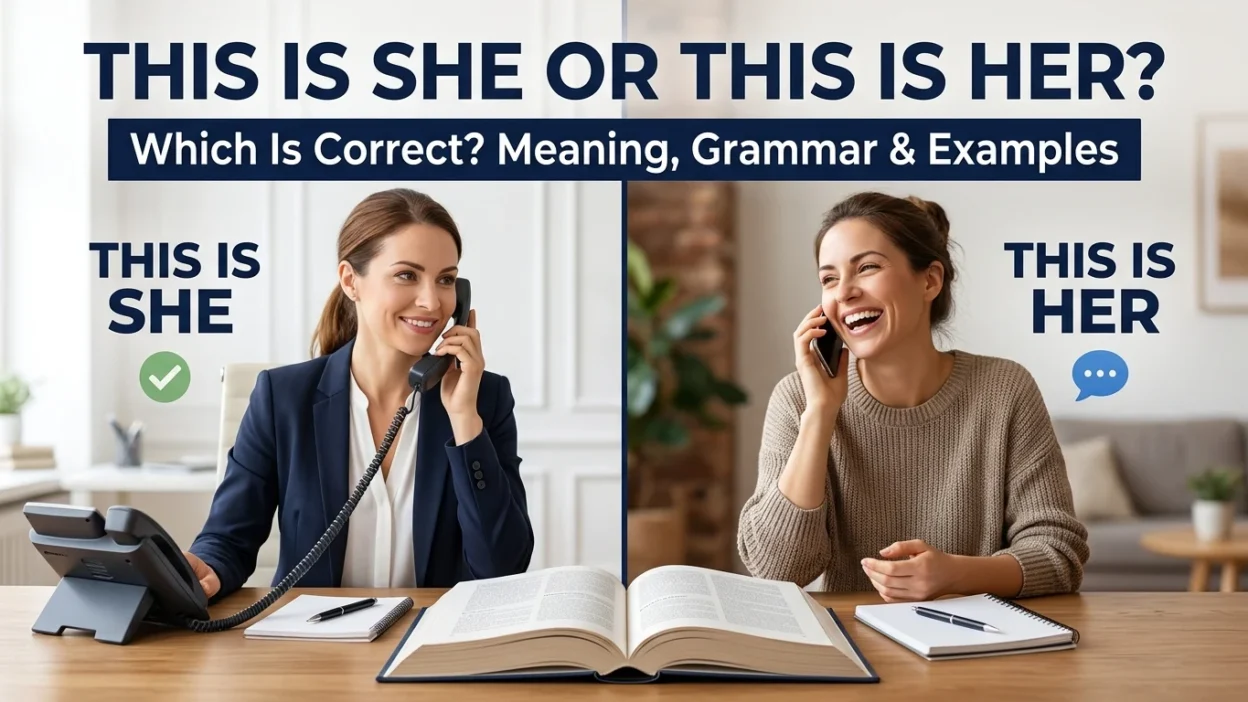
When answering the phone or introducing yourself, should you say “This is she” or “This is her”? Both expressions are used in everyday English, but they differ in grammatical formality and traditional grammar rules. Understanding when to use each expression can help you speak more naturally and confidently.
The choice often depends on the situation, your preferred speaking style, and if you are following traditional formal grammar or conversational English. For example, someone answering a phone call might say “This is she” in a formal conversation or “This is her” in casual speech. Both are widely understood, although some grammar guides prefer one form in formal contexts.
Quick Answer
“This is she” is traditionally considered grammatically correct in formal English when identifying yourself on the telephone because she functions as a subject complement. “This is her” is also widely used in everyday spoken English, especially in informal conversations. The best choice depends on the context, tone, and level of formality.
Why Do People Confuse “This Is She” and “This Is Her”?
People confuse these expressions because the pronouns she and her refer to the same person but serve different grammatical functions.
- She is a subject pronoun, as in “She is my sister.”
- Her is an object pronoun and also a possessive determiner, as in “I called her” and “Her phone is ringing.”
The confusion arises because English speakers often use object pronouns after forms of the verb be in everyday speech. Traditional grammar generally recommends subject pronouns in constructions such as “It is she” and “This is she.”
However, natural spoken English does not always follow the most formal grammatical pattern. That is why both expressions are familiar to English speakers.
1. What Does “This Is She” Mean?
“This is she” means that the female person being asked for or discussed is the person speaking.
It is traditionally preferred in formal English, particularly when answering a telephone call and confirming your identity.
Examples of “This Is She”
- “May I speak to Sarah?” “This is she.”
- “Is this Ms. Johnson?” “Yes, this is she.”
- “I am looking for the manager.” “This is she.”
- “Could I speak with Dr. Williams?” “This is she.”
- “Are you the person who sent the email?” “Yes, this is she.”
Why Is “This Is She” Grammatically Correct?
In traditional grammar, the verb is is a linking verb. It connects the subject this with a word or phrase that identifies it.
A subject complement following a linking verb traditionally takes the subjective case. Therefore, she is preferred over her in formal constructions such as “This is she.”
This rule is also reflected in the traditional expression “It is I,” although “It’s me” is much more common in ordinary conversation.
2. What Does “This Is Her” Mean?
“This is her” is a common expression in conversational English. People often use it when answering a telephone call, confirming their identity, or identifying a woman in a conversation.
Although traditional grammar may prefer “This is she” in formal contexts, “This is her” is natural and widely accepted in everyday speech.
Examples of “This Is Her”
- “May I speak to Emma?” “This is her.”
- “Is this Mrs. Brown?” “Yes, this is her.”
- “Who is the person in charge?” “This is her.”
- “I was told to contact the director.” “This is her.”
- “Are you the person I spoke to yesterday?” “Yes, this is her.”
Why Do People Say “This Is Her”?
Modern spoken English frequently uses object pronouns after linking verbs in expressions such as “It’s me,” “That’s him,” and “This is her.”
These forms sound natural to many speakers because they follow common conversational patterns. They are especially appropriate in relaxed, informal settings.
However, if you are writing a formal grammar exercise or following a traditional style guide, “This is she” may be the expected answer.
3. This Is She vs. This Is Her: Comparison Table
| Feature | This Is She | This Is Her |
|---|---|---|
| Traditional grammar | Preferred in formal usage | Traditionally less preferred |
| Everyday conversation | Correct but may sound formal | Common and conversational |
| Telephone etiquette | Suitable for formal calls | Common in casual calls |
| Grammar explanation | Subject pronoun | Object pronoun used in a conversational construction |
| Formal writing | Often preferred when identifying oneself | Depends on context and style |
| Naturalness | Can sound old-fashioned to some speakers | Often sounds relaxed and natural |
4. When Should You Use Each Expression?
Choosing between “this is she” and “this is her” is easier when you consider the situation.
Use “This Is She” in Formal Situations
Choose this expression when you want to follow traditional grammatical conventions or maintain a formal tone.
Examples:
- Answering a business call: “May I speak to Ms. Carter?” “This is she.”
- Speaking in a formal interview: “Are you the applicant?” “Yes, this is she.”
- Completing a traditional grammar exercise: “Who is calling?” “This is she.”
Use “This Is Her” in Casual Conversations
Use this expression when speaking naturally with friends, family, colleagues, or other people in informal settings.
Examples:
- A friend calls and asks for you: “Is Lisa there?” “This is her.”
- A colleague asks who is speaking: “This is her.”
- Someone confirms your identity during a casual phone conversation: “Yes, this is her.”
Which One Should English Learners Choose?
If you are learning English and need a safe choice for a formal grammar test, use “This is she.” If you are having an ordinary conversation, “This is her” is also common and natural.
The important point is to recognize both forms and understand the difference between traditional grammatical expectations and actual conversational usage.
5. More Than 10 Examples of “This Is She” and “This Is Her”
These examples show how the expressions work in different situations.
Examples Using “This Is She”
- “May I speak to Jennifer?” “This is she.”
- “Is this the new department head?” “Yes, this is she.”
- “Could I speak with Mrs. Taylor?” “This is she.”
- “Are you the person who booked the appointment?” “Yes, this is she.”
- “Is Dr. Miller available?” “This is she.”
- “I need to speak to the team leader.” “This is she.”
Examples Using “This Is Her”
- “Can I talk to Rachel?” “This is her.”
- “Is this the person who called earlier?” “Yes, this is her.”
- “Who is responsible for the project?” “This is her.”
- “May I speak with Anna?” “This is her.”
- “Is this your sister?” “Yes, this is her.”
- “Are you the person I emailed?” “Yes, this is her.”
Usage note: Some examples sound more natural with a direct introduction, such as “Yes, I’m Anna” or “Speaking.” The pronoun choice is only one part of making a conversation sound natural.
6. Common Mistakes to Avoid
English learners can avoid confusion by understanding the grammatical roles of she and her.
Mistake 1: Thinking “This Is Her” Is Always Wrong
This is an overly strict interpretation of traditional grammar. “This is her” is widely used in contemporary spoken English.
Better understanding: Use “This is she” when traditional formal grammar is expected, but recognize “This is her” as a common conversational form.
Mistake 2: Using “She” as an Object
Incorrect: “I called she yesterday.”
Correct: “I called her yesterday.”
The verb called takes an object, so her is the appropriate pronoun.
Mistake 3: Using “Her” as a Subject
Incorrect: “Her is my teacher.”
Correct: “She is my teacher.”
The pronoun performing the action or serving as the subject is she.
Mistake 4: Assuming Every Situation Requires Formal Grammar
Everyday conversation often differs from formal writing. Using a highly formal expression in a relaxed conversation may sound stiff, even if it follows traditional rules.
Tip: Match your language to your audience and situation.
7. Memory Trick: How to Remember the Difference
Use this simple trick:
- She = subject: “She called me.”
- Her = object: “I called her.”
- This is she = traditional formal identification.
- This is her = common conversational identification.
Remember the familiar pair “It is I” and “It’s me.” The first follows traditional formal grammar, while the second is much more common in everyday English.
This comparison helps you understand why “This is she” and “This is her” can both appear in English, even though they reflect different grammatical patterns.
8. American English vs. British English
Both “this is she” and “this is her” are understood in American and British English. The difference is primarily one of formality and conversational style, rather than a strict national distinction.
American English
In American English, “This is her” is common in everyday conversation, particularly when answering a telephone call. “This is she” remains available as a more formal or traditional alternative.
British English
In British English, both expressions are also understood. “This is she” may sound formal or traditional, while “This is her” is familiar in informal speech.
Neither expression is exclusive to one variety of English. The best choice depends on the speaker, audience, and context.
9. Similar Pronoun Expressions
The same grammatical discussion applies to other pronouns used after linking verbs.
| Formal or traditional form | Common conversational form |
|---|---|
| It is I. | It’s me. |
| That is he. | That’s him. |
| This is she. | This is her. |
| It is we. | It’s us. |
| That is they. | That’s them. |
These pairs illustrate a general pattern in English: traditional grammar often favors subject pronouns in identifying constructions, while everyday speech frequently uses object pronouns.
The conversational forms are generally more natural in informal situations. However, the best form may vary depending on the sentence and the intended meaning.
10. Frequently Asked Questions
1. Is “This Is She” grammatically correct?
Yes. “This is she” is traditionally considered correct in formal English when identifying a female speaker. It follows the traditional rule that a subject complement after a linking verb takes the subjective case.
2. Is “This Is Her” grammatically correct?
“This is her” is a common and widely accepted conversational expression. Traditional grammar prefers “This is she” in formal identifying constructions, but everyday English frequently uses object pronouns after linking verbs.
3. Should I say “This Is She” when answering the phone?
You can. “This is she” is a suitable choice for formal telephone conversations, particularly when you want to follow traditional grammar. “Speaking” or “Yes, this is [your name]” can also sound natural and professional.
4. Why do people say “This Is Her” instead of “This Is She”?
People commonly use object pronouns after linking verbs in spoken English. Expressions such as “It’s me,” “That’s him,” and “This is her” are familiar conversational patterns.
5. Is “This Is She” old-fashioned?
It can sound formal or old-fashioned to some speakers, especially in casual conversations. However, it remains a valid traditional form and can be useful in formal contexts.
6. Which expression should I use in a job interview?
Both may be understood, but a direct response such as “Yes, I’m Sarah” or “Speaking” is often more natural and professional. If you specifically need to choose between the two traditional forms, “This is she” follows formal grammar conventions.
7. Is “This Is Her” correct in American English?
Yes. “This is her” is common in American conversational English. “This is she” is also understood and remains an option when a formal or traditional tone is desired.
8. What is the simplest way to distinguish “she” from “her”?
Use she as a subject, as in “She is here.” Use her as an object, as in “I saw her.” In identifying expressions, traditional grammar prefers “This is she,” while conversational English commonly uses “This is her.”
11. Remember This
- This is she: Traditional, formal grammatical choice.
- This is her: Common, natural conversational choice.
- She: Subject pronoun.
- Her: Object pronoun or possessive determiner.
- Best practical alternative: “Speaking” or “Yes, I’m [name].”
Do not assume that a form used in casual conversation is automatically incorrect just because traditional grammar prefers another form.
Conclusion
The difference between “this is she” and “this is her” comes down to traditional grammar and modern conversational usage. “This is she” is the conventional formal choice because she is a subject pronoun used as a subject complement. “This is her” is widely used in everyday English and sounds natural to many speakers.
If you are taking a grammar test or writing in a formal context, choose “this is she” when identifying yourself. In ordinary conversation, “this is her” is also common. When you want a clear and natural response in almost any situation, simply say “Speaking” or “Yes, I’m [your name].”