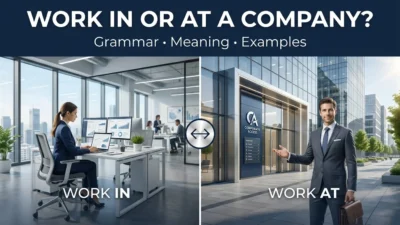
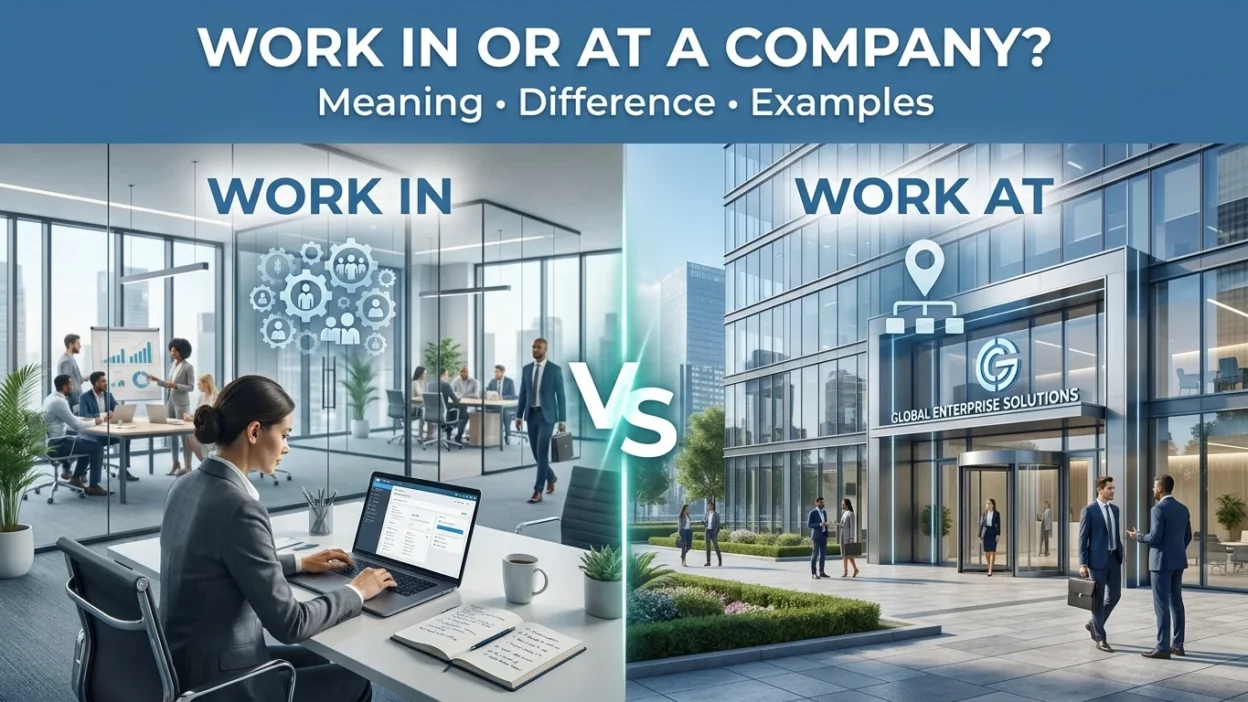
Choosing between “work in a company” and “work at a company” can be confusing for English learners. Both expressions are grammatically correct, but they are used in slightly different ways. The best choice depends on whether you want to emphasize the company as an organization, your workplace, or the department where you work.
In everyday English, people commonly use both expressions when talking about their jobs, careers, and workplaces. For example, you can say, “I work at a software company” or “I work in a software company.” The first expression presents the company as your place of employment, while the second can emphasize working within the organization. In many situations, especially when discussing employment, the two phrases are interchangeable. Understanding their subtle differences will help you speak more naturally, write better sentences, and communicate confidently in professional settings.
Quick Answer
Both “work in a company” and “work at a company” are correct. Use “work at a company” when referring to your employer or workplace, and use “work in a company” when emphasizing working within the organization. In everyday English, both are often acceptable, depending on the context.
Why Do People Confuse “Work in” and “Work at”?
People confuse these expressions because the prepositions “in” and “at” can both describe a person’s workplace. However, they often emphasize different aspects of a situation.
- In commonly suggests being inside something or working within an organization, department, or industry context.
- At commonly identifies a workplace, employer, institution, or specific location.
Consider these examples:
- “I work at a technology company.” This identifies the company where I am employed.
- “I work in the technology company’s marketing department.” This identifies the organizational unit where I work.
The difference is not always strict. Native English speakers regularly use both expressions, and context determines which sounds most natural.
1. What Does “Work in a Company” Mean?
“Work in a company” means to work within an organization. It can emphasize the organization itself, its internal environment, or the work performed within it.
The expression is grammatically correct, although its naturalness depends on the sentence. When simply naming an employer, “work at a company” may sound more natural in many contexts. “Work in a company” can be especially useful when discussing internal roles or contrasting different working environments.
Examples of “Work in a Company”
- I work in a large company with hundreds of employees.
- She works in a company that manufactures medical equipment.
- He works in a company where teamwork is encouraged.
- My sister works in a multinational company.
- I want to work in a company that supports professional development.
When Is “Work in a Company” Natural?
Use this expression when the emphasis is on the organization’s internal environment, structure, or working conditions.
For example:
“My first job was in a company where employees collaborated on every project.”
Here, the speaker emphasizes the working environment rather than simply identifying the employer.
2. What Does “Work at a Company” Mean?
“Work at a company” means to be employed by a particular company or to work at that organization. It is a very common and natural expression in everyday and professional English.
Use “at” when introducing your employer, describing someone’s job, or identifying where a person works.
Examples of “Work at a Company”
- I work at a software company.
- She works at a bank.
- My brother works at a construction company.
- He works at a company in London.
- They work at an international organization.
When Is “Work at a Company” Natural?
This expression is especially useful when answering questions about employment.
For example:
“Where do you work?”
“I work at a publishing company.”
The answer sounds natural because it identifies the employer without focusing on the company’s internal structure.
Work in vs. Work at: Comparison Table
| Feature | Work in a company | Work at a company |
|---|---|---|
| Basic meaning | Work within an organization | Be employed by or work at an organization |
| Main emphasis | Internal environment or organizational context | Employer or workplace |
| Grammar | Correct | Correct |
| Common example | I work in a large company. | I work at a large company. |
| Professional conversations | Appropriate | Very common |
| Referring to a department | I work in the finance department. | I work at a company with a finance department. |
| Naturalness | Depends on context | Often preferred when naming an employer |
Important: Neither expression is universally correct in every sentence. Choose the preposition that best communicates your intended meaning.
When Should You Use Each Expression?
Use “Work in a Company” When Emphasizing the Organization
Choose “in” when describing the working environment or your position within an organization.
Examples:
- I work in a company with a flexible schedule.
- She works in a company that values creativity.
- He works in a company with several international offices.
You can also use “in” to describe departments, industries, and professional fields:
- I work in the finance department.
- She works in the healthcare industry.
- He works in software development.
Use “Work at a Company” When Identifying Your Employer
Choose “at” when telling someone where you are employed.
Examples:
- I work at a local advertising company.
- She works at Microsoft.
- He works at a small family business.
- My friend works at an engineering firm.
“At” is also natural when identifying a particular workplace or location:
- I work at the company headquarters.
- She works at the office near the station.
Can You Use Both in the Same Situation?
Yes. Both can describe the same employment relationship.
For example:
- I work in a large company.
- I work at a large company.
Both sentences can be correct. The second is often more natural when the purpose is simply to tell someone where you work.
10+ Examples of “Work in” and “Work at”
Study these examples to understand how the expressions work in everyday English.
- At: I work at a software company in Islamabad.
- In: I work in a company that develops educational software.
- At: My mother works at a private hospital.
- In: My mother works in the hospital’s administration department.
- At: He works at an international company.
- In: He works in an international company with offices worldwide.
- At: Sarah works at a marketing agency.
- In: Sarah works in the marketing department.
- At: They work at a family-owned business.
- In: They work in a company that produces furniture.
- At: I would like to work at a reputable company.
- In: I enjoy working in a company with a friendly atmosphere.
- At: My cousin works at a pharmaceutical company.
- In: My cousin works in pharmaceutical research.
Notice that “at” often introduces the employer, while “in” can provide more information about the organization’s environment or the work being performed.
Common Mistakes to Avoid
Mistake 1: Thinking One Expression Is Always Wrong
Incorrect assumption: “Work in a company” is always incorrect.
Correction: Both expressions are grammatically possible. The choice depends on context and natural usage.
Mistake 2: Using “In” Instead of “At” in Every Employment Sentence
Less natural in many contexts: “I work in Google.”
More natural: “I work at Google.”
When naming a specific employer, “at” is generally the more natural choice.
Mistake 3: Confusing a Company With a Department
Less natural: “I work at the finance department.”
Correct: “I work in the finance department.”
Use “in” for the department as an organizational unit.
Mistake 4: Forgetting the Article “A”
Incorrect: “I work at company.”
Correct: “I work at a company.”
Use “a” before a singular countable noun when referring to an unspecified company.
However, you do not need “a” before a company name:
“I work at Google.”
Mistake 5: Using “In” to Identify Every Employer
Less natural in a basic introduction: “I work in a bank.”
More natural in many contexts: “I work at a bank.”
The first sentence is not necessarily ungrammatical, but “at a bank” is often the more natural choice when simply stating your employment.
Memory Trick: How to Remember the Difference
Use this simple memory trick:
- AT = Employer or workplace
- IN = Inside, environment, or department
Imagine introducing yourself at a job interview.
“Where do you work?”
“I work at a software company.”
“What is your working environment like?”
“I work in a supportive and creative environment.”
Remember that this is a helpful guideline rather than an absolute rule. English prepositions depend on context, and both expressions can sometimes communicate the same idea.
American vs. British English
Both American and British English use “work in a company” and “work at a company.” There is no major grammatical rule that makes one expression exclusively American or British.
| Context | American English | British English |
|---|---|---|
| Naming an employer | I work at a company. | I work at a company. |
| Describing an organization | I work in a large company. | I work in a large company. |
| Naming a department | I work in the finance department. | I work in the finance department. |
| Describing an industry | I work in finance. | I work in finance. |
Individual preferences may vary, but the main distinction concerns meaning and context rather than nationality.
Similar Expressions: Work for, Work with, and Work at
English has several expressions for describing employment. Although they are related, they do not always mean the same thing.
Work at
Usually identifies the workplace or employer.
Example: “I work at a technology company.”
Work for
Emphasizes the employer or the person or organization you serve.
Example: “I work for a technology company.”
In many situations, “work at” and “work for” are interchangeable, but “work for” emphasizes the employment relationship more directly.
Work in
Often describes the organization, department, industry, or environment.
Example: “I work in the technology industry.”
Work with
Emphasizes the people, clients, tools, or groups you collaborate with.
Example: “I work with software developers.”
Work as
Describes your profession or role.
Example: “I work as a software engineer.”
Quick Comparison
- I work at a company. — My workplace or employer.
- I work for a company. — The organization employs me.
- I work in marketing. — My field or department.
- I work with designers. — The people I collaborate with.
- I work as a designer. — My professional role.
Frequently Asked Questions
1. Is it correct to say “I work in a company”?
Yes. “I work in a company” is grammatically correct. It can emphasize the organization or its working environment. When simply naming your employer, “I work at a company” is often more natural.
2. Is “I work at a company” grammatically correct?
Yes. It is a common and natural way to describe your workplace or employer. For example, “I work at a software company.”
3. Which is better: “work in a company” or “work at a company”?
Neither is always better. “Work at a company” is generally preferred when identifying your employer, while “work in a company” can emphasize the organization or its internal environment.
4. Should I say “I work in Google” or “I work at Google”?
“I work at Google” is the more natural expression when identifying Google as your employer. You can use “in” when referring to a department or field, such as “I work in Google’s marketing department.”
5. Do we say “work in a company” or “work for a company”?
Both are correct, but they emphasize different things. “Work for a company” highlights the employment relationship, while “work in a company” can emphasize the organization or its environment.
6. Is “work at the company” different from “work at a company”?
Yes. “A company” refers to an unspecified company, while “the company” refers to a particular company already known to the speaker and listener.
Examples:
- I work at a company in Lahore.
- I work at the company we discussed yesterday.
7. Should I use “in” or “at” before a department?
Use “in” when describing the department where you work.
Correct: “I work in the sales department.”
You can use “at” to identify the company or workplace where that department is located.
Example: “I work at a company in the sales department” is possible, but “I work in the sales department at a company” is usually clearer.
Remember This
- Use “work at a company” when identifying your employer or workplace.
- Use “work in a company” when emphasizing the organization or its working environment.
- Use “work in a department” when naming the unit where you work.
- Use “work for a company” when emphasizing who employs you.
- Use “work as a” when describing your job title or profession.
Conclusion
Both “work in a company” and “work at a company” are correct English expressions. The main difference is the emphasis: “at” commonly identifies your employer or workplace, while “in” can emphasize the organization, its internal environment, or the context in which you work. In everyday conversations, both expressions may be appropriate.
To improve your English, practise using these expressions in sentences about your own career. For example, say, “I work at a software company,” “I work in the marketing department,” and “I work with a team of designers.” Learning how these prepositions work will help you communicate more clearly and naturally in professional and everyday situations.

Evelyn Mia is a creative content writer and slogan enthusiast at SloganIdea. She specializes in crafting memorable slogans, catchy taglines, and branding ideas, helping businesses, students, and creators communicate effectively.